Kolkata, Dec 3: India’s cement industry is entering a pivotal new era shaped by stricter environmental norms, rapid capacity expansion, and acceleration toward green technologies and digitalisation themes that dominated discussions at the 8th Cementing India Conference hosted by the Indian Chamber of Commerce (ICC). The forum convened leading voices from manufacturing, infrastructure, sustainability, real estate and consulting to chart the sector’s future amid record infrastructure demand.
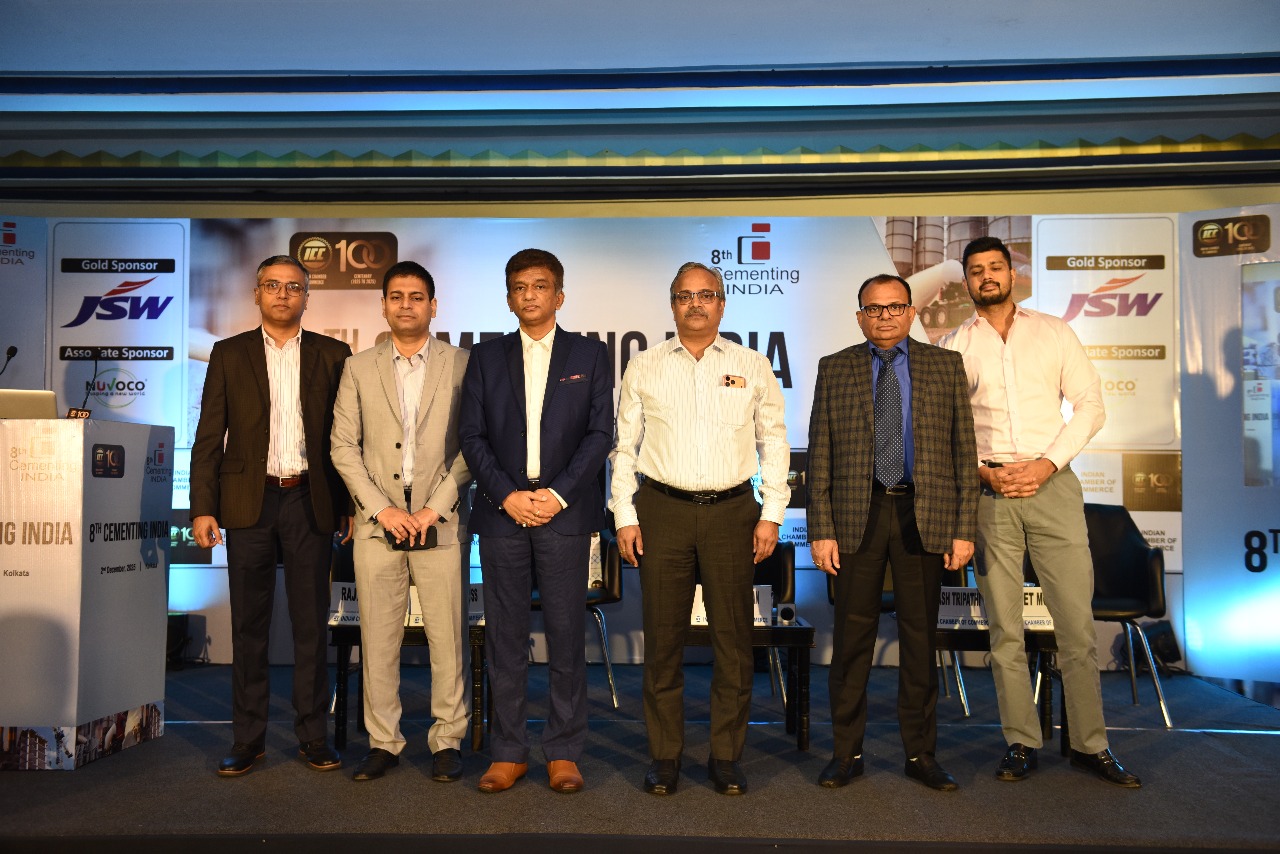
Stronger Environmental Regulation Redefining Industry Operations;
Hemanth Kumar, Vice President, Birla Corporation, highlighted the shift in regulatory enforcement under the amended Air (Prevention and Control of Pollution) Act, which now mandates legally binding siting norms for industrial units.
Under the revised framework:
-
Red-category industries: ≥ 500 m from water bodies/settlements
-
Orange-category units: ≥ 75 m (with discharge), ≥ 30 m (without discharge), ≥ 200 m from settlements
-
Green-category units: ≥ 30 m from water bodies, ≥ 100 m from residential areas
Online Continuous Monitoring Systems have become compulsory, while green-belt norms now stand at 25% (red), 20% (orange) and 10% (green) industries. Kumar noted Birla Corporation’s efforts — over 80,000 plantation activities, Miyawaki afforestation near Chittoor, mine reclamation in Sanmaniyan, and plastic-neutral and three-times water-positive operations supported by asset-scale rainwater harvesting.
Digital Plants, Skill Upgrade and Green Cement Take Centre Stage;
Santanu Adhikari, Cluster Technical Service Head East, Adani Group, said India produces globally competitive cement, yet rural users consuming nearly 70% of total cement — need better access to construction skill development. He shared that post acquisition of ACC and Ambuja, Adani scaled capacity from 70 to 100 million tonnes within ~30 months, adding nearly 1 million tonnes per month.
“More than seven lakh masons and contractors have been trained,” Adhikari said, detailing 97-point quality checks, AI-driven systems, robotics, sensors, XRD technology, and cross-belt analysers supporting operations. 95% of trade sales now come from green blended cement, backed by 24 plants and 100+ RMC units nationwide.
Construction Boom to Accelerate Demand for Sustainable Cement;
Saket Mohta, Managing Director, Merlin Group, called cement “the silent backbone of development”, emphasising ethical responsibility in product selection. Precast, modular construction, IGBC/GRIHA alignment and blended cement adoption are reshaping build cycles and sustainability benchmarks.
Nuvoco Vistas Corp. Ltd’s Chief Manufacturing Officer (East) & Sustainability Head, Raju Ramachandran, noted India’s current position:
-
Capacity (FY24): 631 million tonnes
-
Production: 417 million tonnes
-
Per-capita consumption: 250–270 kg (far below China, Brazil, Japan)
India’s green cement market, valued at USD 1.5 billion, is expected to double within 5–10 years, driven by LC3 technology and decarbonisation policies. Precast construction, he added, can shorten major project timelines by up to six months.
Future Defined by Digitisation, Policy Support and Sustainability;
Rajib Maitra, Partner, Deloitte, reiterated that low-carbon materials and precast systems will anchor the next phase of growth, with investment decisions increasingly shaped by regulatory evolution and ESG compliance. India, currently 2% of the global precast market, is poised to scale rapidly as national housing and infrastructure programmes expand.
Kailash Tripathi, AVP, Mangalam Cement, stated that the sector’s future resilience will be determined by the speed and depth of digital transformation, resource efficiency, and adoption of cleaner production pathways.
