

Language is the foundation of identity, the bridge of opportunity, and the heartbeat of human connection — Dr. Birbal Jha
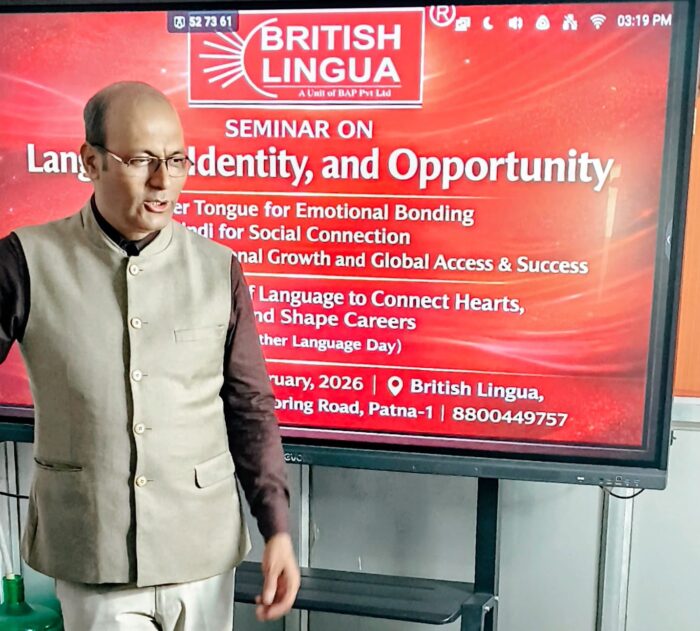
Patna, Feb 23: On the solemn and globally observed occasion of International Mother Language Day, the auditorium of British Lingua resonated with ideas that transcended grammar and vocabulary. The seminar, titled “Language, Identity, and Opportunity,” evolved into a compelling reflection on how words shape worlds and how language can transform lives.
Delivering the keynote address, noted educationist and social reform advocate Dr. Birbal Jha offered a sweeping vision of multilingual empowerment. His central thesis was both simple and profound:
“Language is not only a medium of communication; it is the foundation of identity, the bridge of opportunity, and the heartbeat of human connection.”
The audience — comprising educators, students, and thought leaders — listened in rapt attention as Dr. Jha unfolded what he described as the three pillars of linguistic strength: mother tongue, Hindi, and English.
The Mother Tongue: Where Identity Takes Root
In a deeply evocative passage, noted author Dr Birbal Jha described the mother tongue as “the first music we hear” — the language of lullabies, affection, and formative dreams. It is here, Dr Jha argued, that identity is first forged and confidence begins to grow.
Dr Jha reminded the gathering that linguistic roots anchor emotional stability and cultural continuity. “Modernity should expand our horizons, not erase our roots,” he observed, urging families and institutions alike to safeguard indigenous languages as repositories of collective memory.
The mother tongue, Dr Jha said, does not merely communicate thought; it nurtures self-respect and strengthens the psychological foundation upon which future aspirations stand.
Hindi: A Bridge Across Diversity
Turning to Hindi, Dr. Jha underscored its role as a vital instrument of social cohesion in India’s vast linguistic landscape. From public discourse to marketplaces, from governance to cinema, Hindi connects diverse communities without demanding uniformity.
“Language is the bridge between diversity and unity,” Dr Jha declared, emphasizing that inclusive communication reduces prejudice and fosters cooperation. In his view, Hindi in India enables participation and strengthens democratic dialogue by amplifying voices from villages, towns, and cities alike.
In a country of many tongues, Dr Jha suggested, a shared language of connection strengthens the social fabric.
English: A Gateway to Global Possibility
If the mother tongue roots identity and Hindi binds society, English, Dr. Jha argued, unlocks the world. In an age defined by globalization, English serves as the language of science, technology, business, and international collaboration.
“English does not define your identity; it multiplies your opportunity,” Dr Birbal Jha asserted, challenging the perception of English as a marker of superiority. Instead, he described it as a pragmatic tool — one that converts talent into visibility and ambition into achievement.
At British Lingua, Dr Jha noted, English education is not about imitation of accents but about articulation, clarity, confidence, and employability. Fluency, he stressed, empowers youth from small towns to compete on global platforms.
Language as Social Justice
Perhaps the most resonant moment of the address came when Dr. Jha framed language education as an instrument of social justice.
“Language education is social justice in action,” Dr Jha proclaimed. When individuals cannot express themselves, he said, their abilities remain hidden. When communication improves, confidence rises — and with confidence comes opportunity.
By equipping young minds with linguistic competence, educational institutions are not merely teaching grammar; they are dismantling barriers and expanding socio-economic mobility.
A Vision for a Multilingual Future
As the seminar drew to a close, Dr. Jha called upon the audience to embrace multilingualism as strength rather than confusion.
“Multilingualism is not confusion; it is competence,” Dr Birbal affirmed.
Dr Jha urged citizens to preserve their mother tongues, strengthen Hindi for national harmony, and master English for global excellence. A nation that values its languages, Dr concluded, secures its intellectual richness and social cohesion.
The applause that followed was not merely for a speech well delivered, but for an idea powerfully conveyed — that language is identity, dignity, and destiny intertwined.
On this International Mother Language Day, the message from British Lingua was clear and compelling:
Language connects hearts, builds society, and shapes careers — and in doing so, it shapes the future.
