

Buenos Aires, Seoul, Beijing, Berlin, Fort Collins, Hong Kong, London, New Delhi, Taipei, Tokyo, June 25: The cellular IoT module market is starting to look a little different. For years, most of the module innovation came from connectivity upgrades from 2G to 4G, then to NB-IoT to Cat 1 bis, and now 5G and RedCap. But that is beginning to change. Today, intelligence is becoming just as important as connectivity, but the path is proving less linear than many expected.
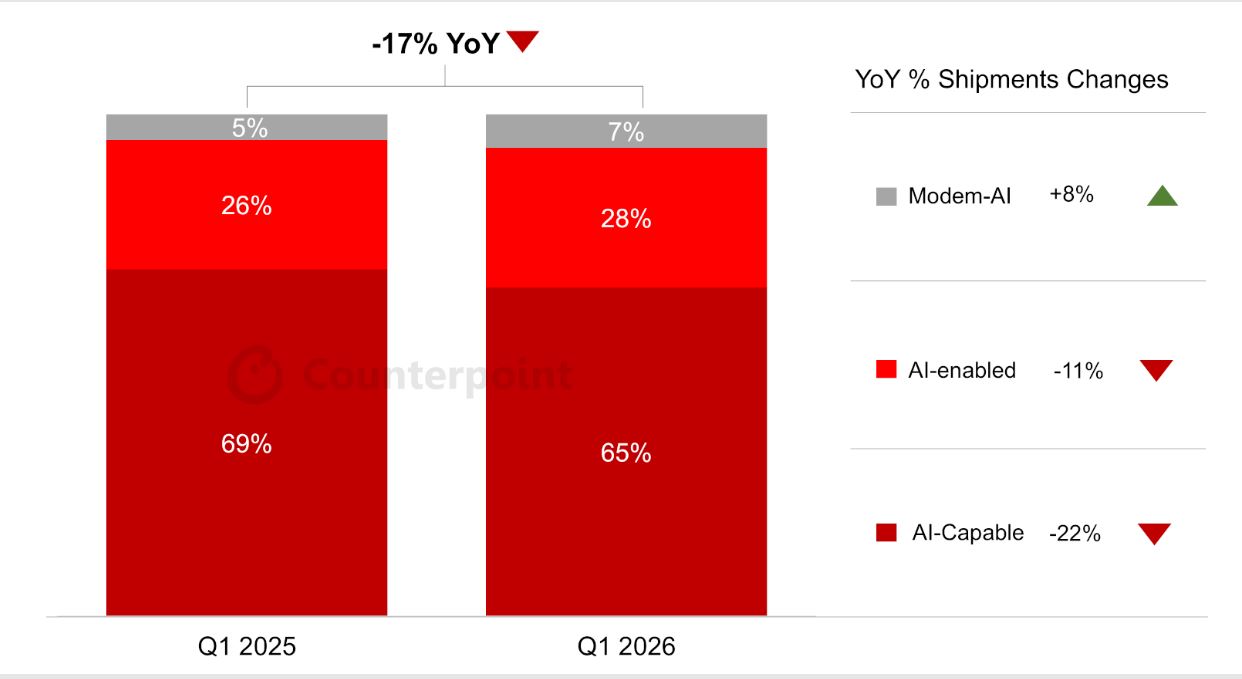
According to Counterpoint Research’s latest Cellular IoT AI Module & Chipset Tracker, AI-embedded cellular IoT modules contributed 6% of total cellular IoT module shipments in Q1 2026. While AI remains one of the most discussed topics across the IoT ecosystem, adoption lost momentum during the quarter for cellular AI modules. After growing 19% YoY in 2025, AI-embedded module shipments declined nearly 17% YoY in Q1 2026.
The slowdown was mainly due to rising memory prices, which have increased the bill of materials for many AI-enabled products. Unlike basic connectivity modules, AI-capable and AI-enabled modules typically require larger memory configurations to support local AI processing and computing workloads. As memory costs increased throughout the supply chain, several enterprise deployments were delayed, particularly in cost-sensitive segments.
AI-embedded Cellular Module Shipments Share by AI Capability, Q1 2026
Source: Counterpoint AI Module & Chipset Tracker & Forecast, Q1 2026
Commenting on the market scenario, Senior Analyst Tina Lu said “We are starting to see two different AI adoption paths in modules. One is the Modem AI modules where intelligence is directly embedded into modems (for example Qualcomm X72, X75, X80, X85 or Mediatek T830, T930) to handle tasks like optimization of connectivity, network selection and power efficiency, the second is application-centric AI where modules integrate CPUs, GPUs and dedicated NPUs to run AI processing locally.”
Lu added, “The different cost structure and component dependencies affected the growth and adoption of these two approaches. Modem AI, which is not dependent on memory and does not perform application processing, registered a growth of 8% YoY, whereas AI-capable and AI-enabled modules which mainly perform on-device edge AI and are dependent on higher memory configuration required to do processing tasks, declined 22% YoY and 11% YoY respectively, due to rising memory costs.”
Commenting on the drivers & outlook, Director of IoT Practice Mohit Agrawal said “Smart retail, rugged handhelds and industrial are the major adopters of AI-enabled modules whereas for AI-capable modules POS is driving the contribution. Modem AI growth is being single-handedly driven by router-CPE application as operators look to optimize network performance, improve power efficiency and deliver a better user experience in enterprise deployments and 5G FWA.”
Agrawal added, “Due to these memory price increases, AI-embedded cellular modules witnessed double-digit ASP growth as module players were forced to raise prices, eventually affecting demand across applications due to hardware costs. The recent slowdown does not change the direction of the market. AI adoption is still at an early stage across IoT applications. With ongoing traction in smart cameras, surveillance, retail, automotive, and industrial robotics, we expect AI penetration in cellular modules to reach 25% by 2030. Over time, AI will move beyond a few niche applications and become a standard feature, helping connected devices become smarter rather than simply remain connected.”
AI Category Definitions:
AI-Capable Modules: Modules integrating CPUs and GPUs that can support basic AI processing and lightweight inference, but without a dedicated AI accelerator. An example is the Fibocom SC226 module, which is powered by an ARM Cortex A53 quad-core processor, and includes a built-in Adreno 702 GPU.
AI-Enabled Modules: Modules integrating dedicated AI hardware such as NPUs, TPUs or AI engines to support advanced AI workloads and local inference. For example, the Meig SLM925 module, based on the QCM6125 SoC.
Modem AI Modules: Modules based on modem platforms with embedded AI capabilities focused on connectivity optimization, including network performance, power efficiency, positioning and signal management, rather than application-level AI processing.
