

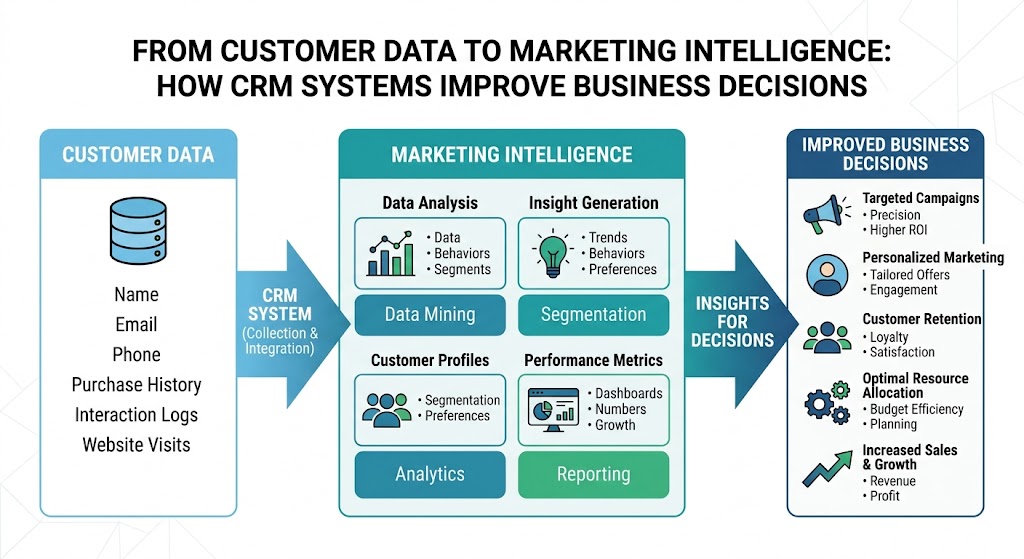
Customer data has become an important business asset as companies look for more effective ways to understand markets, reach customers and improve marketing returns. While CRM systems were traditionally viewed mainly as tools for managing sales leads and customer relationships, businesses are increasingly using the information stored in these platforms to understand customer behaviour and make better marketing decisions.
Every customer interaction can provide useful information. Purchase history, enquiries, website activity, responses to campaigns, sales conversations and service interactions can collectively create a clearer picture of what customers want and how their preferences are changing. When this information is properly organised and analysed, CRM data can help businesses move from broad marketing strategies towards more targeted and measurable campaigns.
Turning customer information into marketing intelligence
The real value of a CRM system lies not simply in storing customer information, but in what businesses can learn from that information. Customer analytics can help companies identify patterns in purchasing behaviour, understand different customer segments and recognise changes in demand.
For marketing teams, this can provide a more practical understanding of the audience they are trying to reach. Instead of treating all customers in the same way, businesses can identify groups based on purchasing behaviour, engagement, interests and previous interactions. This allows marketers to create communication that is more relevant to each segment and potentially improve the efficiency of campaign spending. Customer analytics is widely used for segmentation, targeting and understanding customer behaviour.
Making marketing budgets work harder
Marketing budgets are under growing pressure to demonstrate measurable business results. Companies are therefore looking beyond traditional measures such as impressions and reach and paying greater attention to whether marketing activity is contributing to enquiries, conversions, repeat purchases and revenue.
CRM data can help create this connection between marketing activity and business outcomes. By bringing campaign responses, lead progression and customer purchases into a common view, companies can better understand which marketing efforts are generating meaningful customer engagement and which areas may require a change in strategy.
This does not mean that every sale can be attributed to a single campaign. Customer decisions are influenced by multiple factors, including pricing, product quality, competition, seasonality and economic conditions. However, a well-managed CRM system can give businesses more evidence to support decisions about where marketing resources should be focused.
From mass marketing to more relevant communication
Customers today interact with brands through multiple channels, including websites, social media, email, mobile applications, physical stores and sales teams. This creates a large amount of information that businesses can potentially use to understand customer journeys.
CRM data can bring many of these interactions together and help marketers recognise where customers are in the buying process. A first-time visitor may require different communication from an existing customer who has already purchased a product. Similarly, a customer who has stopped engaging with a brand may need a different approach from one who regularly responds to offers.
This makes personalisation more practical. Rather than sending the same message to an entire database, businesses can use customer information to make communication more relevant to specific groups.
Better insights can support customer retention
Acquiring new customers can require significant marketing and sales investment, making customer retention an important part of business strategy. CRM data can help companies understand purchasing frequency, engagement levels and changes in customer behaviour.
For example, a decline in purchases or interactions may indicate that a customer is becoming less engaged. When such patterns are identified early, businesses can evaluate whether a service intervention, product update or targeted communication could help maintain the relationship.
This makes CRM useful not only for attracting customers but also for understanding the health of existing customer relationships.
Sales and marketing can work from the same information
Another important business benefit is the ability to bring marketing and sales teams closer together. In many organisations, marketing teams focus on generating leads while sales teams are responsible for converting them. If both teams operate with different information, opportunities can be missed and customer interactions can become repetitive.
A centralised CRM system can provide both teams with a common view of customer activity. Marketing teams can understand how leads progress after a campaign, while sales teams can see previous interactions and the source of a potential customer.
This shared information can make the customer journey more consistent and help businesses identify where leads are being lost before they become paying customers.
Data quality will determine the value of CRM
Having more customer data does not automatically result in better marketing. The quality of the information remains critical. Duplicate records, outdated contact details, incomplete customer profiles and inconsistent data entry can make analysis less reliable.
Businesses therefore need to treat CRM data as an ongoing management responsibility rather than a one-time collection exercise. Regular data cleaning, consistent processes and appropriate access controls can help maintain the reliability of customer information.
Privacy and responsible data use are equally important. As companies collect increasingly detailed information about customers, they need to ensure that data is handled in accordance with applicable laws, permissions and internal governance standards.
AI is expanding the role of CRM
The growing use of artificial intelligence is also changing what businesses can do with CRM information. AI and advanced analytics can help identify patterns across large customer datasets, automate certain marketing activities and support predictive analysis.
This could allow businesses to move beyond simply understanding past customer behaviour and explore potential future actions, such as identifying customers who may be more likely to make another purchase or those who may require additional engagement.
However, technology is only as effective as the data and business strategy behind it. Poor-quality information can produce poor insights, while automated recommendations still require human judgement and business context.
A strategic asset for modern businesses
The role of CRM is gradually expanding from a sales-management system into a broader source of business intelligence. When customer information is properly collected, analysed and connected with marketing and sales activity, it can help companies understand their markets more clearly and make more informed decisions.
For businesses, the objective is not simply to collect more customer data. The larger opportunity is to turn existing information into useful insights that can improve campaign planning, customer engagement, retention and marketing efficiency.
As competition increases and marketing budgets come under greater scrutiny, companies that can connect customer data with real business outcomes will have a stronger foundation for making marketing decisions. CRM systems, when supported by clean data, responsible governance and effective analytics, can become an important part of that process.

