

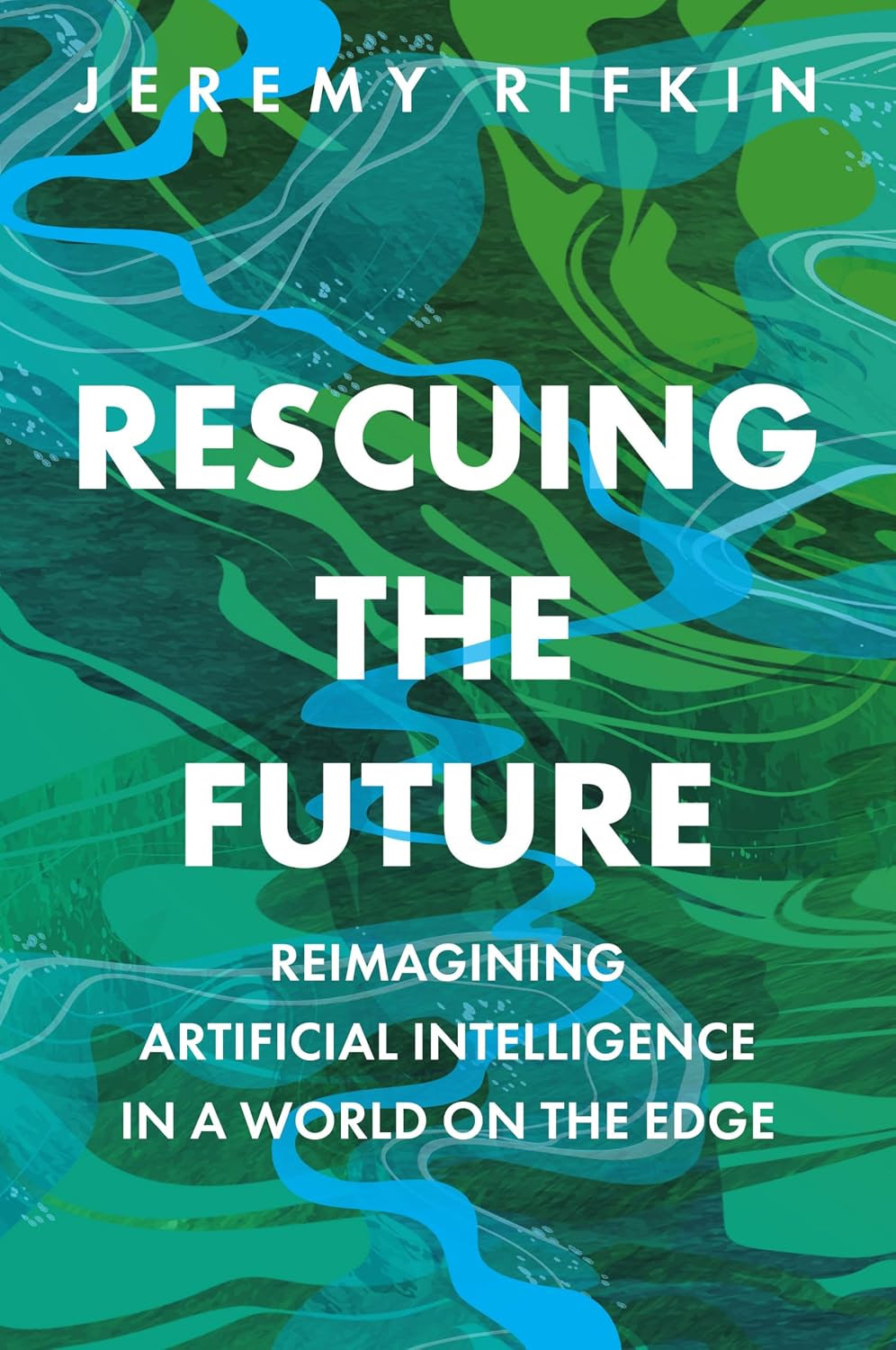
Jeremy Rifkin, one of the World’s Leading Public Intellectuals, Argues in his New Book ‘Rescuing the Future’ that the People’s AI is on a Deep Existential Curve and Likely to Surpass the Corporate AI Giants Well Before Mid-Century in Bioregions Around the World
Oct 15: For more than half a century, Jeremy Rifkin has occupied a singular place in intellectual life. Few public thinkers have attempted to synthesize philosophy, science, technology, economics, governance, ecology, culture, and civil society into a single interpretive framework for understanding historical transformation. Fewer still have done so with the consistency and long temporal arc that characterize Rifkin’s body of work. Across books such as Entropy, Algeny, Time Wars, Biosphere Politics, The End of Work, The Biotech Century, The Age of Access, The European Dream, The Empathic Civilization, The Third Industrial Revolution, The Zero Marginal Cost Society, The Green New Deal, The Age of Resilience, and Planet Aqua, Rifkin gradually assembled an intellectual architecture that anticipated a profound ontological transition now becoming visible in debates surrounding artificial intelligence.
At the center of this transition is a movement from what may be called AI substance ontology to AI process ontology. Substance ontology views reality as composed primarily of discrete things, bounded entities, stable objects, and isolated units. It privileges nouns over verbs, accumulation over flow, hierarchy over relationship, and ownership over participation. AI systems shaped by this ontology tend to centralize data, consolidate computational power, reinforce vertical command structures, and treat intelligence as an extractable commodity. This is the prevailing model pursued by many of the largest technology corporations and geopolitical powers. It is rooted in industrial-era assumptions regarding control, efficiency, prediction, and scale.
Process ontology, by contrast, understands reality as relational, dynamic, ecological, and emergent. Intelligence is not viewed as a thing but as a process arising from interaction, feedback, adaptation, communication, and co-evolution. From this perspective, AI is less a sovereign machine intelligence than a distributed nervous system embedded in social and ecological relationships. Intelligence emerges through networks, shared learning, open systems, and adaptive coordination across multiple scales of existence. Rifkin’s intellectual career can be read as a decades-long effort to prepare civilization for precisely this ontological shift.
What makes Rifkin unusual is that he did not begin with artificial intelligence. Instead, he explored the hidden assumptions of industrial civilization itself. In doing so, he uncovered the philosophical foundations now shaping AI development. Long before contemporary discussions about decentralized intelligence, edge computing, commons governance, ecological economics, or collaborative platforms, Rifkin was already examining the deeper civilizational transition away from mechanistic industrial models toward relational ecological systems.
In Entropy, published in 1980, Rifkin drew on the second law of thermodynamics to critique the industrial worldview. Industrial capitalism assumed that growth, production, and extraction could continue indefinitely through increasing mastery over nature. Rifkin argued instead that all economic systems are embedded within entropic energy flows and ecological limits. This was not merely an environmental argument; it was an ontological argument. Industrial civilization treated matter as inert substance available for exploitation. Rifkin countered that energy systems, ecological systems, and social systems are interdependent processes subject to irreversible transformation.
The significance of this insight for AI is immense. Current AI infrastructure depends upon vast energy consumption, global extraction networks, rare earth minerals, massive data centers, and planetary logistical systems. The dominant AI paradigm often imagines intelligence as infinitely scalable computational accumulation detached from ecological realities. Rifkin’s entropic perspective warns that no intelligence system can transcend the thermodynamic constraints of the biosphere. AI cannot be understood as an isolated technological object. It is embedded within material, energetic, ecological, and social processes. In this sense, Rifkin anticipated the critique of computational gigantism decades before it emerged in contemporary discussions about AI sustainability.
In Algeny, Rifkin turned to biotechnology and genetic engineering. Here again, he challenged the reductionist assumptions of modern science. The mechanistic worldview treated genes as isolated units that could be manipulated like machine parts. Rifkin argued that life is not reducible to discrete components because organisms exist within complex relational fields. Biological systems are dynamic processes shaped by context, interaction, and ecological interdependence.
This critique resonates powerfully with current debates about AI architectures. Many early AI systems were designed according to reductionist principles: symbolic manipulation, linear logic, isolated data structures, and rigid classification systems. However, contemporary developments increasingly rely on emergent behavior, neural adaptation, probabilistic inference, and networked learning. The movement from rule-based AI toward adaptive systems parallels the shift from genetic determinism toward ecological biology. Rifkin’s work anticipated the growing recognition that intelligence cannot be fully understood through atomistic reduction.
In Time Wars, Rifkin examined the commodification of time under industrial capitalism. Industrial society standardized time in order to synchronize labor, maximize efficiency, and discipline human activity within mechanical systems. Clock time became a tool of industrial governance. Rifkin contrasted this with biological and ecological rhythms that operate according to cyclical, adaptive, and relational temporalities.
This insight has profound implications for AI governance. Contemporary digital systems increasingly accelerate social life toward continuous optimization, prediction, and real-time surveillance. Human beings are pressured to conform to machine tempos. Yet process ontology suggests that resilience depends upon synchronizing technological systems with ecological and social rhythms rather than subordinating life to algorithmic acceleration. Rifkin’s critique of industrial time foreshadowed contemporary concerns regarding attention economies, cognitive overload, and the temporal colonization produced by digital capitalism.
In Biosphere Politics, Rifkin further expanded his ecological vision. He argued that political institutions designed during the industrial era are incapable of governing interconnected planetary systems. Nation-states emerged during a period when sovereignty, territory, and centralized control defined political organization. However, ecological crises transcend territorial boundaries. Climate systems, oceans, biodiversity, and atmospheric processes operate according to relational interdependence.
The same tension now appears in AI governance. Geopolitical competition encourages nations and corporations to pursue centralized AI supremacy. Yet AI systems increasingly function across distributed networks that cannot be effectively governed through purely territorial frameworks. Rifkin’s biospheric perspective implies that future AI governance may require bioregional, transnational, and commons-oriented institutions capable of managing shared informational ecosystems. His work anticipated the inadequacy of purely sovereign models in an interconnected world.
In The End of Work, Rifkin explored the automation revolution long before AI became a mainstream concern. He argued that advanced technologies would dramatically reduce the demand for traditional labor while destabilizing industrial employment structures. Importantly, Rifkin did not frame this merely as an economic problem. He saw it as a civilizational transition requiring a redefinition of human purpose, value, and participation.
The contemporary AI debate often focuses narrowly on productivity gains and labor displacement. Rifkin recognized earlier that automation challenges the ontological assumptions of industrial society itself. Industrial capitalism linked human worth to wage labor within centralized production systems. If intelligent automation reduces the need for human labor, then societies organized entirely around employment-based identity face existential instability. Rifkin therefore advocated expanding the role of civil society, voluntary associations, caregiving networks, cultural participation, and social commons.
This anticipates current discussions regarding post-work economies, universal basic income, collaborative commons, and human-centered AI. Process ontology does not define humans primarily as labor inputs within mechanized production systems. Instead, it emphasizes relational capacities such as empathy, creativity, stewardship, cooperation, and ecological participation. Rifkin understood that automation would force civilization to reconsider what it means to be human.
In The Biotech Century, Rifkin warned that the fusion of digital technologies and biological engineering could transform life into a commodified informational resource. He perceived that industrial capitalism was evolving into a bioinformational regime in which genes, organisms, and living processes would become subject to ownership, manipulation, and commercialization.
This analysis is directly relevant to contemporary AI systems trained on massive datasets extracted from human behavior, communication, creativity, and cognition. AI capitalism increasingly converts lived experience into computational capital. Human interactions become data streams feeding predictive systems. Rifkin foresaw this broader transformation in which informational control replaces industrial ownership as the dominant axis of power.
However, Rifkin also consistently identified countervailing possibilities. He recognized that network technologies could enable collaborative, distributed, and participatory systems rather than merely centralized domination. This theme became especially prominent in The Age of Access. Here Rifkin argued that industrial capitalism based on property ownership was evolving into a network economy based on access, subscriptions, experiences, and relationships.
This was a remarkably prescient insight into platform capitalism and digital ecosystems. Yet Rifkin interpreted the transition ambivalently. On one hand, access economies could deepen corporate surveillance and commodification. On the other hand, networked infrastructures could facilitate collaborative sharing systems and distributed participation. The ontological question concerned whether networks would reinforce centralized control or enable decentralized relationality.
Current AI development reflects precisely this tension. Centralized cloud AI models consolidate immense computational and financial power within a few corporations. At the same time, distributed AI architectures operating through edge computing, open-source ecosystems, cooperative platforms, and localized data stewardship suggest alternative pathways. Rifkin’s work anticipated the possibility that intelligence infrastructures could evolve toward commons-based coordination rather than monopolistic enclosure.
In The European Dream, Rifkin contrasted the American emphasis on individual accumulation and geopolitical power with the European emphasis on quality of life, social solidarity, cultural diversity, and transnational cooperation. While his characterization was sometimes idealized, the underlying philosophical distinction remains important. Industrial modernity prioritized autonomy, competition, and sovereignty. Emerging ecological civilization may prioritize interdependence, collaboration, and shared stewardship.
This distinction mirrors contemporary debates about AI governance models. One paradigm frames AI as an instrument for geopolitical dominance and market concentration. Another frames AI as a public utility embedded within democratic institutions and social ecosystems. Rifkin consistently argued that civilization must move from possessive individualism toward empathic interdependence.
This vision reached its fullest expression in The Empathic Civilization. In that work, Rifkin proposed that human history involves an expanding empathic consciousness shaped by evolving communication and energy regimes. As societies become more interconnected, humans develop broader capacities for identification with others. Empathy, in Rifkin’s view, is not merely a moral sentiment but a civilizational force.
The implications for AI are profound. Substance ontology often treats intelligence as detached rational calculation. Process ontology instead recognizes cognition as embodied, relational, and affective. Rifkin’s empathic framework suggests that future AI systems should not merely optimize efficiency or prediction but should enhance cooperative capacities within social and ecological networks.
This perspective sharply contrasts with purely instrumental AI models driven by surveillance, behavioral manipulation, and militarized competition. Rifkin understood that technological systems shape consciousness itself. Communication infrastructures alter how humans perceive relationships, time, identity, and responsibility. AI therefore cannot be governed solely as a technical issue because it transforms the cultural and psychological architecture of civilization.
In The Third Industrial Revolution, Rifkin articulated one of his most influential ideas: the convergence of digital communication networks with distributed renewable energy systems. He envisioned societies organized through lateral power rather than centralized command. Millions of individuals, communities, and enterprises could generate and share energy and information across intelligent networks.
This framework bears striking resemblance to emerging distributed AI ecosystems. Edge AI, fog computing, peer-to-peer networks, decentralized autonomous systems, and open-source collaborative platforms all reflect movement away from centralized industrial infrastructures toward distributed relational systems. Rifkin perceived that network intelligence operates differently from hierarchical industrial organization. Power flows laterally through interconnected nodes rather than vertically through centralized authorities.
Importantly, Rifkin did not romanticize decentralization in simplistic terms. He understood that distributed systems require new forms of coordination, governance, and trust. Process ontology does not eliminate structure; it redefines structure as adaptive relationality rather than rigid hierarchy. AI systems operating within distributed ecosystems must therefore balance autonomy with cooperation, local flexibility with global coordination.
In The Zero Marginal Cost Society, Rifkin extended this argument further. He proposed that digital technologies reduce the marginal cost of producing and sharing information, knowledge, and certain goods. As production costs approach zero, traditional capitalist market structures face disruption. Collaborative commons emerge alongside conventional markets.
This insight is central to current AI dynamics. Generative AI dramatically lowers the cost of producing text, images, software, music, and other informational goods. The industrial model of scarcity-based ownership becomes increasingly unstable. AI systems accelerate the transition toward abundance economies in which value derives less from exclusive possession and more from participation within networks.
However, Rifkin also recognized the dangers of monopolistic capture. Zero marginal cost systems can either democratize access or intensify corporate concentration depending upon governance structures. The struggle over AI today reflects this tension. Will AI infrastructures become global commons supporting distributed creativity and resilience, or will they become centralized instruments of extraction and surveillance?
In The Green New Deal, Rifkin connected ecological transition to economic transformation. He argued that decarbonization requires not merely technological substitution but systemic restructuring across energy, transportation, finance, governance, and social organization. Industrial civilization cannot solve ecological crises while preserving the ontological assumptions that created them.
This principle applies equally to AI. Sustainable AI cannot emerge simply by making existing systems more efficient. It requires rethinking the purposes, architectures, and governance models of intelligence systems themselves. Process ontology reframes intelligence as ecological participation rather than extractive optimization. AI becomes a tool for enhancing adaptive resilience within complex living systems rather than maximizing industrial throughput.
This theme culminates in The Age of Resilience. Here Rifkin argues that the industrial “age of progress” is giving way to an “age of resilience.” Industrial modernity prioritized efficiency, speed, scale, and economic growth. Yet highly optimized systems often become fragile. Climate disruptions, pandemics, financial crises, supply chain failures, and ecological instability reveal the vulnerabilities of centralized industrial systems.
Resilience requires diversity, redundancy, adaptability, local capacity, ecological integration, and cooperative governance. These are precisely the characteristics associated with process ontology. Intelligence within resilient systems emerges from distributed relationships rather than centralized control.
This insight is perhaps Rifkin’s most important contribution to AI discourse. Current dominant AI models often pursue maximal scale through centralized data centers, massive computational concentration, and universal predictive systems. Yet resilient AI futures may depend instead upon distributed intelligence operating close to local ecosystems and communities. Edge AI systems capable of adapting to specific bioregional conditions may prove more sustainable and democratic than monolithic cloud architectures.
Rifkin’s newest work, Planet Aqua, further deepens this ecological civilizational perspective. Water becomes a metaphor and material reality for understanding planetary interdependence. Oceans, hydrological cycles, and aquatic systems reveal the fluid relationality of life itself. Human civilization is inseparable from planetary metabolic processes.
This aquatic perspective reinforces process ontology at the deepest philosophical level. Substance ontology imagines discrete entities separated by boundaries. Water dissolves rigid boundaries and emphasizes circulation, flow, immersion, and mutual dependence. AI systems designed according to process ontology would similarly emphasize fluid adaptation, relational intelligence, ecological embeddedness, and participatory governance.
What ultimately distinguishes Rifkin’s contribution is not any single prediction or policy proposal. Some of his forecasts have been criticized as overly optimistic or technologically deterministic. Certain arguments simplify complex historical realities. Yet the enduring significance of his work lies elsewhere. Rifkin persistently identified the ontological contradictions within industrial modernity long before they became widely recognized.
He understood that technological revolutions are never merely technical. They transform how societies conceptualize reality itself. Energy systems, communication systems, economic systems, and governance systems co-evolve with philosophical assumptions about human nature, time, space, identity, and relationship. Rifkin consistently argued that the industrial worldview based on mechanistic substance ontology was reaching exhaustion.
Artificial intelligence now represents the decisive arena in which this ontological struggle unfolds. One pathway leads toward hyper-centralized computational empires governed through surveillance, predictive control, and extractive accumulation. This model extends industrial substance ontology into digital form. Intelligence becomes a commodified substance concentrated within proprietary systems.
The alternative pathway leads toward distributed intelligence embedded within ecological and social processes. In this model, AI enhances collaborative adaptation, bioregional resilience, commons governance, and empathic coordination across interconnected systems. Intelligence is understood as participatory process rather than proprietary object.
Rifkin did not invent process ontology. Philosophical traditions associated with thinkers such as Alfred North Whitehead, Henri Bergson, Gilles Deleuze, and ecological systems theorists developed related perspectives long before contemporary AI. Yet Rifkin performed a different and arguably equally important role. He translated process-oriented thinking into a public civilizational narrative accessible to policymakers, business leaders, activists, urban planners, educators, and civil society organizations.
In this sense, Rifkin served as a bridge figure between academic theory and societal transformation. He recognized earlier than most public intellectuals that ecological crisis, technological transformation, economic restructuring, and cultural change were converging into a single historical transition. His work consistently emphasized interconnectedness across domains that modern institutions artificially separated.
The importance of this synthesis becomes increasingly clear as AI systems permeate every aspect of civilization. AI is not merely a software industry. It reshapes labor, governance, culture, education, ecology, economics, warfare, identity, communication, and social relationships simultaneously. Fragmented disciplinary thinking cannot adequately address such transformations. Rifkin’s interdisciplinary approach therefore appears increasingly relevant.
Moreover, Rifkin’s work challenges the assumption that technological sophistication necessarily entails greater centralization. Industrial civilization equated scale with progress. Larger factories, larger bureaucracies, larger infrastructures, and larger corporations symbolized advancement. Rifkin instead envisioned distributed complexity in which smaller units cooperate across intelligent networks. This shift from centralized gigantism toward distributed relationality lies at the heart of process ontology.
Today, debates surrounding open-source AI, decentralized computation, local energy systems, community data trusts, cooperative platforms, and bioregional governance all echo themes Rifkin explored across decades. His writings anticipated that the future would not be defined solely by smarter machines but by changing relationships among energy, information, ecology, and human consciousness.
The transition from AI substance ontology to AI process ontology remains incomplete and contested. Centralized corporate and geopolitical models currently dominate much of the AI landscape. Yet the ecological, social, and democratic limitations of these systems are becoming increasingly visible. Climate instability, energy demands, data monopolization, algorithmic inequality, and social fragmentation expose the unsustainability of purely extractive AI paradigms.
Rifkin’s intellectual legacy suggests that the future of AI cannot be separated from the future of civilization itself. The question is not whether machines become intelligent. The deeper question concerns what conception of intelligence humanity chooses to cultivate. Will intelligence serve domination or participation? Extraction or stewardship? Centralization or resilience? Competition or empathy?
Across fifty years of writing and public engagement, Jeremy Rifkin repeatedly argued that humanity stands at civilizational thresholds requiring new ways of understanding reality. His body of work forms one of the most sustained attempts to articulate the philosophical foundations of an ecological, relational, and process-oriented civilization. Whether or not one agrees with all his conclusions, his influence on the emerging discourse surrounding AI, ecology, governance, and resilience is undeniable.
As artificial intelligence becomes the defining technological force of the twenty-first century, Rifkin’s writings appear less like isolated social commentary and more like preparatory texts for an ontological transformation already underway. His enduring contribution lies in helping societies imagine that intelligence, economy, governance, and human identity need not remain trapped within the mechanistic assumptions of the industrial age. He invited readers to envision civilization itself as a living process of interdependence embedded within the larger metabolism of the Earth.
In that sense, Jeremy Rifkin’s greatest achievement may not be any individual argument but the cumulative intellectual atmosphere created across his fifty-year career: a framework for perceiving the transition from industrial substance ontology toward ecological process ontology as the central drama of our historical moment. Artificial intelligence has now become the arena in which that drama will largely be decided.
Jeremy Rifkin is the bestselling author of twenty-five books translated into over thirty-five languages. He is a principal architect of the European Union’s and China’s economic plans for transitioning into a Third Industrial Revolution and he served as an economic advisor to Senate Majority Leader Charles Schumer on the U.S. infrastructure plan. He is listed among the top ten most influential economic thinkers in The Huffington Post’s global survey of “The World’s Most Influential Voices.”

