

New Delhi, Oct 22: The Ministry of Information and Broadcasting (MIB) has issued a fresh advisory asking private satellite television channels to strictly follow the Programme Code, amid concerns over sensational coverage, graphic visuals, inflammatory debates and the growing use of artificial intelligence in news production. The advisory was circulated on October 21, 2026.

Representational Image
The ministry said the advisory follows observations by the Inter-Departmental Committee (IDC) that telecasts on several channels did not conform to the spirit of the Programme Code under Rule 6 of the Cable Television Networks Rules, 1994. It warned that violations could invite action under the Cable Television Networks (Regulation) Act, 1995, and rules framed under it.
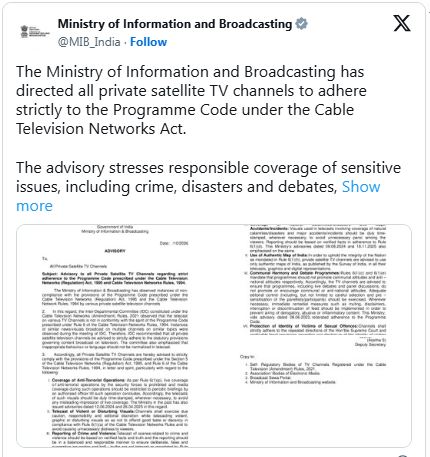
The Ministry of Information and Broadcasting has directed all private satellite TV channels to adhere strictly to the Programme Code under the Cable Television Networks Act. The advisory stresses responsible coverage of sensitive issues, including crime, disasters and debates, and warns of strict action against violations.
— Ministry of Information and Broadcasting (@MIB_India) October 21, 2026
Eight-point compliance advisory
The advisory lays out eight broad areas of compliance for broadcasters:
Anti-terror operations: Live coverage of security-force operations remains prohibited under Rule 6(1)(p). Channels should rely on periodic briefings by authorised officers until an operation ends, and time-stamp visuals where necessary to avoid creating a false impression of live coverage.
Violent and disturbing visuals: Channels must exercise editorial discretion, avoid excessive repetition or looping of distressing footage, and blur or mask visuals wherever warranted.
Crime reporting: Reporting should be fact-checked, balanced and responsible, without glorifying or normalising unlawful or socially undesirable behaviour.
Victim protection: Broadcasters must protect the identity of victims of sexual offences, including indirect details, photographs or family information that could identify them.
Disasters and accidents: Coverage of natural calamities, disasters and major accidents should be based on verified facts, with time-stamped visuals used to prevent unnecessary panic.
Maps of India: Channels have been asked to use only authentic maps published by the Survey of India in telecasts, graphics and digital representations.
Debates and communal harmony: Live panel discussions must not promote communal or anti-national attitudes; broadcasters should screen and sensitise participants and use corrective tools such as muting, disclaimers, interruption or discontinuation when needed.
Artificial intelligence: AI and generative AI may be used only in an assistive role, without compromising the accuracy, authenticity or sensitivity of news content.
Focus on AI in newsrooms
A notable addition is the ministry’s caution on AI-generated graphics, virtual news presentations and other AI-assisted programming. The advisory does not ban the technology outright but says it must not replace editorial judgment or weaken verification standards.
The ministry also asked broadcasters to strengthen internal content-review mechanisms and sensitise staff involved in news gathering, editing, production, transmission and telecast. It encouraged regular workshops and training sessions to ensure continued compliance.
Earlier warnings repeated
This is not the first time the Centre has flagged these issues. The MIB had earlier issued advisories on June 12, 2024, and April 26, 2025, reiterating restrictions on live coverage of anti-terror operations and responsible broadcast practices.
The latest advisory signals that the government expects channels to treat the Programme Code as an operational standard—not merely a legal formality—particularly in high-traction formats such as breaking-news coverage, crime reporting, disaster visuals and prime-time debates.

