

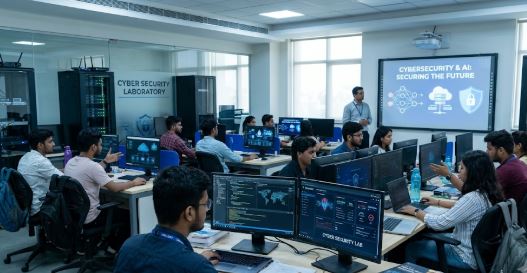
As digital technology becomes part of almost every aspect of modern life, cybersecurity is emerging as an essential area of education rather than an optional technical specialisation. From online banking and digital payments to artificial intelligence, cloud computing and e-commerce, the growing use of connected systems has increased the need to protect personal information, business operations and critical infrastructure. This shift is encouraging Indian colleges and universities to expand cybersecurity and information security programmes, creating new opportunities for students as well as the education and technology industries.
Today, organisations are not only looking for graduates who can develop software or manage computer networks. They increasingly need professionals who understand how digital systems can be attacked, how sensitive information can be protected and how security incidents should be handled. As a result, cybersecurity knowledge is becoming increasingly valuable across technology, finance, healthcare, manufacturing and government services.
For students entering higher education, learning cybersecurity can provide an opportunity to develop skills relevant to the changing employment market. For colleges, it represents an important opportunity to introduce specialised courses, improve industry partnerships and build a stronger position in technology education.
Why Cybersecurity Education Is Becoming Important in India
India’s rapid digital transformation has increased the importance of information security. Businesses are adopting cloud-based systems, digital payment platforms, artificial intelligence and connected technologies to improve productivity and customer services. However, greater digital dependence also exposes organisations to phishing, ransomware, identity theft, data breaches and other cyber threats.
According to Gartner, information security spending in India is projected to reach approximately USD 3.4 billion in 2026, reflecting an 11.7% increase over 2025. This growing investment highlights how seriously organisations are treating digital protection.
The demand for skilled professionals is another important factor. A 2025–26 cybersecurity skills assessment by the Data Security Council of India and SANS Institute found that 73% of surveyed enterprises reported limited availability of skilled cybersecurity candidates. The findings indicate that the challenge is not simply creating more technology graduates but developing professionals with the specialised capabilities employers require.
This is why cybersecurity education is becoming increasingly relevant. Students need to understand digital risks, information protection and responsible technology use, even if they do not ultimately pursue cybersecurity as their primary profession.
Colleges Are Expanding Specialised Cybersecurity Programmes
Traditional computer science education provides a foundation in programming, software development and networking. However, the growing complexity of cyber threats requires additional knowledge in areas such as ethical hacking, digital forensics, cloud security, network protection and security operations.
Indian educational institutions are responding by introducing specialised degrees, practical training and industry-oriented programmes.
A notable development in 2026 has been the introduction of a four-year Bachelor of Cybersecurity programme through collaboration between IIT Kanpur and IIT Madras. The programme is designed to combine academic instruction with practical exposure, including field deployment opportunities.
The University of Delhi has also strengthened its cybersecurity education initiatives through a partnership with the Indian Cyber Crime Coordination Centre under the Ministry of Home Affairs. The collaboration focuses on cybersecurity awareness, research, training and capacity building.
Such developments reflect a wider change in higher education. Institutions are recognising that cybersecurity requires dedicated academic attention, specialised faculty and access to practical learning environments.
Cybersecurity Is Becoming a Must-Know Skill for Today’s Students
Cybersecurity is no longer relevant only to students pursuing computer science or engineering. As digital tools become central to education, employment and everyday activities, basic knowledge of online safety and information protection is becoming useful across disciplines.
Students should understand how to identify phishing messages, protect passwords, secure personal devices, recognise online fraud and manage digital information responsibly. These capabilities are increasingly important in an environment where academic records, financial information and personal communication are stored and exchanged online.
For students interested in technology careers, more advanced learning can open pathways into ethical hacking, security analysis, cloud protection, digital investigation and risk management.
Even students studying commerce, business administration, law and management can benefit from cybersecurity awareness. Financial institutions, companies and government organisations need employees who understand data privacy, digital compliance and the risks associated with online operations.
This makes cybersecurity education relevant not just as a career choice but as a broader professional skill.
Practical Learning Will Shape the Future of Cybersecurity Courses
One of the biggest priorities for colleges is moving beyond textbook-based instruction. Cybersecurity is a practical discipline in which students need to understand how security systems work under real-world conditions.
Educational institutions are therefore investing in cybersecurity laboratories, simulated attack environments, network security exercises and digital forensic training. These facilities allow students to learn how to identify system weaknesses, investigate suspicious activity and understand incident response procedures in controlled environments.
The importance of practical exposure is clear from industry feedback. The 2025–26 cybersecurity skills assessment found that 63% of surveyed enterprises reported gaps in candidates’ hands-on technical abilities.
For colleges, this creates a strong reason to collaborate with technology companies, cybersecurity service providers and government agencies. Internships, live projects, expert-led workshops and industry-recognised certifications can make courses more relevant to employment requirements.
AI and Cloud Security Are Creating New Areas of Specialisation
Artificial intelligence is changing the cybersecurity landscape. Businesses are increasingly using AI to automate processes, analyse large volumes of information and improve decision-making. At the same time, these technologies introduce new security concerns involving data exposure, automated attacks, identity protection and the misuse of AI systems.
According to the 2025–26 cybersecurity skills assessment, 83% of surveyed organisations identified AI and generative AI security skills as a critical requirement.
This is creating demand for new areas of learning, including AI security, cloud infrastructure protection, application security, identity management and threat intelligence.
For colleges and training providers, regularly updating course content will be essential. Institutions that introduce emerging specialisations and practical learning opportunities can attract students who want to develop skills suited to the next generation of technology careers.
Cybersecurity Education Is Creating a New Business Opportunity
The growing importance of digital security is opening up opportunities across India’s education and professional training industries. The market is no longer restricted to universities offering degree programmes. Private institutes, online education companies, certification providers and technology firms can also participate in this expanding sector.
Some of the key business opportunities include:
1. Specialised cybersecurity institutes: Private education providers can offer professional programmes in ethical hacking, penetration testing, digital forensics, cloud security and network protection.
2. Online cybersecurity education: Digital learning companies can develop flexible courses, practical exercises and certification preparation programmes for students and working professionals.
3. Cybersecurity laboratories: Colleges and private training centres can establish specialised laboratories that provide practical exposure and support corporate training requirements.
4. Corporate skill development: Businesses need employees who understand information security and digital risk. Training companies can offer customised programmes for banks, IT firms, healthcare providers and manufacturing organisations.
5. Professional certifications: Certification and assessment providers can create opportunities through specialised examinations, skill assessments and advanced training programmes.
6. Industry-academia partnerships: Technology companies can collaborate with educational institutions to provide course content, software tools, internships, mentoring and employment-oriented training.
For education businesses, the opportunity lies in developing programmes that deliver measurable skills rather than relying solely on course enrolments. Strong industry connections, recognised certifications and practical training can help build long-term credibility.
Career Opportunities Extend Beyond the IT Industry
Cybersecurity qualifications can lead to several professional pathways, including security analyst, ethical hacker, penetration tester, cloud security engineer, digital forensic investigator and incident response specialist.
However, the demand for cybersecurity knowledge is not limited to technology companies.
Banks need specialists to protect digital transactions and financial records. Hospitals require secure systems for managing sensitive patient information. Manufacturing companies must protect connected machinery and industrial networks, while retailers need to secure payment systems and customer databases.
This wider demand creates opportunities for graduates across different sectors. It also provides scope for entrepreneurship in cybersecurity consulting, security assessments, managed security services and professional training.
What Colleges Must Do to Stay Competitive
As cybersecurity becomes a more important part of higher education, colleges will need to invest in qualified faculty, updated laboratories and practical learning infrastructure. Course content must evolve alongside emerging threats and technological developments.
Affordability will also matter. Students from smaller cities and economically diverse backgrounds should have access to quality cybersecurity education through scholarships, online courses, affordable certifications and regional training partnerships.
Educational institutions that combine strong academic foundations with practical experience and industry exposure can develop a meaningful advantage in an increasingly competitive education market.
The Road Ahead for Cybersecurity Education in India
Cybersecurity is becoming an essential part of India’s digital economy, and its importance will extend well beyond specialised technology careers. As businesses, institutions and individuals become more dependent on digital platforms, understanding how to protect information and secure online systems will become an increasingly valuable skill.
For students, cybersecurity education offers opportunities to build relevant professional capabilities and explore careers across multiple industries. For colleges, it provides scope to develop specialised programmes and strengthen their position in technology-driven education. For private education companies, it opens a growing market for professional training, certification and corporate skill development.
The future of cybersecurity education will depend on how effectively India connects academic learning with practical experience and industry requirements. Institutions that prepare students not only to understand technology but also to protect it will play an important role in building a more secure and skilled digital workforce.
