

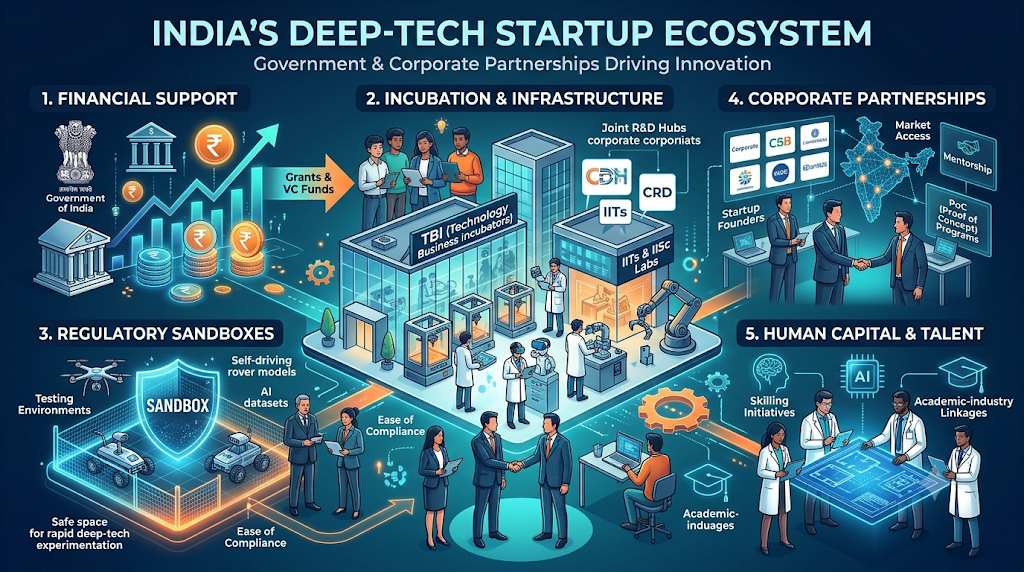
India’s deep-tech startup ecosystem is emerging as an important driver of the country’s next phase of industrial and technological growth. From artificial intelligence (AI) and semiconductor manufacturing to quantum computing, biotechnology, robotics and aerospace, homegrown startups are increasingly developing technologies that can address complex business and societal challenges.
The growth is supported by a combination of government funding, corporate partnerships, research institutions and rising investor interest. India now has more than 4,200 deep-tech startups, with the sector attracting approximately $2.3 billion in funding in 2025, registering 37% growth over the previous year. These figures reflect growing confidence in India’s ability to develop advanced technologies and build businesses around scientific innovation.
However, deep-tech entrepreneurship involves challenges that go beyond developing a product. Startups need substantial capital, specialised laboratories, skilled professionals and years of research before their innovations can become commercially viable. Government programmes are helping address these early-stage barriers, while corporate partnerships are providing access to industry expertise, testing facilities and potential customers.
The growing collaboration between the public and private sectors is therefore becoming essential to India’s ambition of transforming research capabilities into commercially successful technology businesses.
1. Government Funding Is Giving Deep-Tech Startups Long-Term Support
Deep-tech companies often require longer development cycles and higher investments than conventional startups. Recognising this, the government is strengthening financial support for businesses working on strategically important technologies.
Some major initiatives are shaping this ecosystem:
-
Research, Development and Innovation (RDI) Fund: With an allocation of ₹1 lakh crore over six years, the initiative aims to encourage private-sector investment in research-intensive technologies, including AI, quantum computing, biotechnology, robotics and advanced manufacturing. Its emphasis on long-term financing is particularly important for startups that cannot generate revenue immediately.
-
IndiaAI Mission: Approved with an outlay of ₹10,371.92 crore, the mission focuses on expanding computing infrastructure, supporting AI innovation and improving access to resources for developing advanced applications. This could reduce infrastructure costs for startups working on AI products and services.
-
National Quantum Mission: Backed by ₹6,003.65 crore over eight years, the mission supports research and development in quantum computing, communication and sensing technologies. It is also expected to encourage entrepreneurship in emerging scientific applications.
-
India Semiconductor Mission: With an approved outlay of ₹76,000 crore, the programme aims to strengthen India’s semiconductor manufacturing and design capabilities. It creates opportunities for startups involved in chip design, electronic components, testing and specialised engineering.
-
Startup India and seed funding support: Early-stage funding and incubation programmes help entrepreneurs develop prototypes, validate ideas and build initial business capabilities.
These initiatives reflect a shift in India’s technology strategy. The objective is not simply to encourage more startups, but to develop domestic capabilities in critical technologies and reduce dependence on imported solutions.
2. Corporate Partnerships Are Helping Startups Reach Commercial Markets
Access to funding can help startups develop innovative products, but finding customers and generating revenue remain equally important. Established corporations are increasingly becoming valuable partners in this process.
Large companies have the infrastructure, supply chains, technical teams and customer networks that young technology ventures often lack. By working together, corporations can access new technologies while startups gain opportunities to test their products in real business environments.
Important areas of collaboration include:
-
Industrial automation: Manufacturing companies are working with robotics and AI startups to improve production efficiency, automate repetitive tasks and reduce equipment downtime.
-
Enterprise AI: Large businesses are exploring partnerships with AI ventures to improve data analysis, customer management, cybersecurity and operational decision-making.
-
Healthcare innovation: Hospitals, diagnostic centres and medical research organisations can work with startups developing advanced medical devices, diagnostic technologies and AI-assisted solutions.
-
Energy technology: Power companies and industrial consumers can collaborate with startups working on battery storage, energy management and renewable energy solutions.
-
Semiconductor development: Established electronics and manufacturing companies can support emerging ventures through technical collaboration, testing and specialised component development.
One increasingly relevant approach is the venture-client model, where a corporation becomes an early customer of a startup rather than simply investing in it. This gives startups commercial validation and an opportunity to generate revenue, while companies can test innovative solutions without developing every technology internally.
3. Research Institutions Are Turning Scientific Discoveries into Businesses
India’s research institutions and universities are becoming important contributors to the deep-tech startup pipeline. Many promising technologies originate in academic laboratories, but researchers often need additional support to turn their discoveries into commercial products.
Incubation centres and innovation programmes are helping bridge this gap.
-
IITs and research institutions: They provide technical expertise, research facilities, intellectual property support and incubation opportunities for technology entrepreneurs.
-
Atal Innovation Mission: Supported by NITI Aayog, it encourages innovation and entrepreneurship through incubation and institutional support.
-
Technology Innovation Hubs: Under the National Mission on Interdisciplinary Cyber-Physical Systems, 25 technology innovation hubs have been established to strengthen research, technology development and entrepreneurship.
-
GENESIS initiative: Supported by the Ministry of Electronics and Information Technology, it aims to strengthen technology startups, particularly in Tier-II and Tier-III cities.
This institutional support is important because deep-tech entrepreneurship requires a combination of scientific knowledge and business understanding. Researchers need assistance with product engineering, regulatory requirements, market research, intellectual property protection and customer acquisition.
For smaller cities, stronger incubation networks could also create new opportunities for local entrepreneurs, engineering graduates and research professionals.
4. Rising R&D Investment Is Strengthening India’s Innovation Base
Research investment is essential for developing technologies that can compete globally. India’s expenditure on research and development has increased considerably over the past decade.
-
India’s gross expenditure on R&D increased from approximately ₹79,356 crore in 2013-14 to ₹2.45 lakh crore in 2023-24.
-
R&D expenditure as a share of GDP increased from 0.64% in 2020-21 to 0.84% in 2023-24.
-
Greater investment in research can support product development, scientific experimentation and the creation of intellectual property.
-
Stronger private-sector participation can help ensure that research addresses practical industrial requirements.
Although the increase is encouraging, India still has considerable scope to raise research spending relative to the size of its economy. Greater corporate investment and stronger university-industry collaboration will be important in closing this gap.
For businesses, this could mean access to locally developed technologies, specialised engineering solutions and innovations that improve productivity.
5. Artificial Intelligence Is Driving a Major Share of Deep-Tech Activity
AI has become one of the biggest areas of investment and entrepreneurial activity within India’s deep-tech ecosystem.
Approximately 84% of India’s deep-tech startups were associated with AI in 2025, while AI accounted for around 91% of deep-tech funding. This concentration highlights the growing importance of artificial intelligence in India’s technology economy.
Its applications are expanding across several industries:
-
Manufacturing: AI-powered quality inspection, predictive maintenance and intelligent automation can reduce operational costs and improve productivity.
-
Financial services: Advanced analytics can support fraud detection, risk assessment and more efficient customer services.
-
Healthcare: AI-assisted diagnostic tools and medical research applications can improve efficiency and support clinical decision-making.
-
Agriculture: Intelligent monitoring, precision farming and data-driven irrigation can help farmers use resources more efficiently.
-
Logistics: AI-based forecasting and route optimisation can improve supply-chain performance and reduce transportation expenses.
For startups, the commercial opportunity lies in developing solutions that address identifiable business challenges. Companies that demonstrate measurable improvements in cost, efficiency or service delivery are more likely to gain corporate customers.
At the same time, India needs to continue developing other technology segments, including biotechnology, quantum computing, semiconductor engineering and advanced materials, to build a diversified innovation ecosystem.
6. Funding and Commercialisation Remain Major Challenges
Despite stronger government support and growing investor interest, deep-tech startups face several obstacles before they can establish sustainable businesses.
-
Long development cycles: Advanced technologies can take years to move from research to commercial production, putting pressure on startup finances.
-
Limited patient capital: Early-stage funding may support prototypes, but companies often need much larger investments for testing, manufacturing and expansion.
-
Expensive infrastructure: Cleanrooms, specialised laboratories, testing facilities and certification centres involve significant costs.
-
Regulatory requirements: Startups in healthcare, aerospace, biotechnology and semiconductor-related industries must meet complex technical and regulatory standards.
-
Limited commercial demand: Some startups struggle to find buyers even after successfully developing a technology. Large enterprises and government agencies need to provide more opportunities for pilot projects and procurement.
-
Talent availability: Businesses need professionals with advanced scientific, engineering and commercial expertise, making specialised talent acquisition another challenge.
Addressing these issues will require more than financial assistance. Shared infrastructure, faster procurement, corporate pilot programmes and long-term customer commitments can help startups move from promising prototypes to market-ready products.
7. Deep-Tech Growth Could Create New Opportunities for Indian Businesses
The expansion of deep-tech companies has the potential to benefit India’s wider economy, particularly manufacturing, healthcare, energy, agriculture and industrial services.
For manufacturers, locally developed technologies could reduce dependence on imported equipment and components. For MSMEs, affordable automation and AI-based solutions could improve productivity without requiring substantial independent research investment.
The sector could also create high-value employment in engineering, scientific research, product development and technology management. As more startups expand their operations, demand for specialised professionals and industry-academia collaboration is likely to increase.
Investors may also find opportunities in emerging technology segments, although deep-tech requires a longer investment horizon and a careful assessment of commercial viability.
Conclusion: Collaboration Will Determine India’s Deep-Tech Future
India’s deep-tech startup ecosystem is moving into an important phase, with government funding, corporate partnerships and research investment creating a stronger foundation for innovation. However, the next stage of development will depend on how effectively these resources translate into commercial success.
Corporations need to become more active partners and early customers, research institutions must strengthen technology transfer, and startups need to focus on developing solutions that meet genuine market requirements. Greater access to long-term capital, specialised infrastructure and domestic procurement opportunities will also be essential.
India’s deep-tech ambitions will ultimately be measured not by the number of startups established or the amount of funding raised, but by the technologies that successfully reach the market, generate sustainable business value and compete globally. Stronger collaboration between government, industry and research institutions could make deep-tech a significant driver of India’s future industrial competitiveness and economic growth.
