

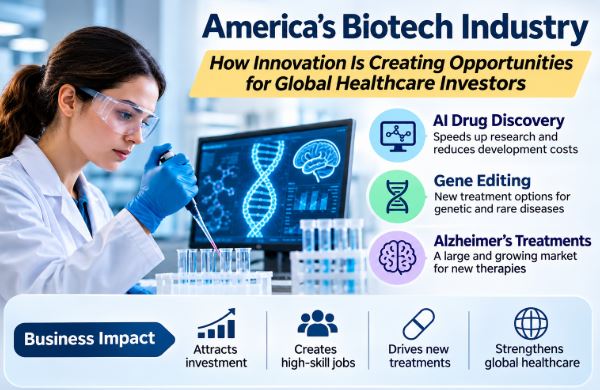
The biotechnology industry in the United States is entering an exciting period of transformation. Advances in artificial intelligence (AI), gene editing and precision medicine are changing how researchers understand diseases, develop treatments and deliver healthcare. These developments are not only creating new possibilities for patients but also attracting growing attention from investors around the world.
The US has long been one of the leading centres of biotechnology research and development. Its strong network of universities, research institutions, pharmaceutical companies, start-ups and venture capital firms has helped turn scientific discoveries into commercial healthcare products.
Today, a new wave of innovation is opening up opportunities across drug discovery, genetic medicine and treatments for chronic diseases. For global healthcare investors, the sector offers exposure to technologies that could shape the future of medicine. However, the potential rewards come with significant risks, including clinical trial failures, regulatory uncertainty and increasing international competition.
AI Is Changing the Way New Medicines Are Developed
One of the biggest developments in biotechnology is the growing use of artificial intelligence in drug discovery.
Traditionally, developing a new medicine has been a lengthy and expensive process. Researchers must identify potential drug targets, test different compounds, conduct laboratory experiments and complete several stages of clinical trials before a treatment can reach patients.
AI is helping researchers make parts of this process faster and more efficient. By analysing large amounts of biological and medical data, AI systems can help identify promising drug candidates, predict how molecules may behave and support the design of clinical research.
This could reduce the time and resources needed during early-stage drug development. Some industry estimates suggest that AI could significantly shorten parts of the discovery process, although the actual benefits vary by drug, disease and research programme.
For biotech companies, these tools may improve research productivity and create opportunities to develop treatments for diseases that have historically been difficult to address. Investors are therefore paying close attention to businesses combining biotechnology expertise with advanced computing capabilities.
However, AI cannot replace laboratory research or clinical testing. A promising prediction still needs to be demonstrated through rigorous scientific evidence before a medicine can be approved.
Gene Editing Is Opening New Possibilities in Medicine
Gene editing is another area attracting attention from researchers and investors. Technologies such as CRISPR allow scientists to make targeted changes to DNA, creating potential approaches for treating certain inherited and genetic conditions.
One particularly important development is in-vivo gene editing. Unlike ex-vivo approaches, where cells are removed from the body, modified and then returned to the patient, in-vivo techniques aim to deliver gene-editing tools directly into the body.
This approach could eventually make it possible to target specific organs and tissues, including the liver, lungs and potentially the brain. Researchers are exploring how these technologies could be used to address diseases that currently have limited treatment options.
The commercial potential is significant, but the technology is still developing. Questions around safety, delivery methods, long-term effects and treatment costs remain important considerations.
For investors, gene editing represents a high-growth area with considerable scientific and commercial uncertainty. Companies that demonstrate safe, effective and scalable treatments could become important players in the future healthcare market.
Alzheimer’s Research Creates a Major Healthcare Opportunity
The growing global burden of Alzheimer’s disease and other forms of dementia is creating demand for more effective treatments.
As populations age, healthcare systems face increasing pressure to manage conditions that require long-term care and support. Alzheimer’s disease is particularly challenging because it affects memory, thinking and the ability to carry out everyday activities.
Recent advances in treatment research have increased interest in disease-modifying therapies. These treatments aim to influence the progression of the disease rather than simply manage its symptoms.
Although new medicines have created hope for patients and families, important challenges remain. Treatment effectiveness, side effects, eligibility, affordability and access continue to influence how widely these therapies can be used.
The economic impact also extends beyond pharmaceutical sales. Treatments that help patients maintain independence for longer could potentially reduce some of the financial and practical pressures on families and healthcare providers.
For healthcare investors, Alzheimer’s research offers exposure to a substantial unmet medical need. Nevertheless, commercial forecasts should be treated carefully because the market will depend on clinical outcomes, regulatory decisions, reimbursement policies and patient access.
Why the United States Remains a Global Biotech Leader
The strength of America’s biotechnology industry is not based on scientific research alone. It is supported by an ecosystem that connects academic discoveries with private investment and commercial development.
Institutions such as the National Institutes of Health (NIH) provide significant support for biomedical research. Universities and research centres contribute scientific expertise, while venture capital firms help finance early-stage companies developing new technologies.
The Bayh-Dole Act has also played an important role in encouraging the commercialisation of inventions arising from federally funded research by allowing eligible institutions and organisations to retain ownership of certain inventions.
Strong intellectual property protections, established pharmaceutical companies and a large healthcare market further support the industry’s development.
This combination gives US biotech businesses access to research talent, funding and commercial partnerships. It also makes the country an attractive destination for international investors seeking exposure to healthcare innovation.
Investment Opportunities for Global Healthcare Investors
The expansion of biotechnology is creating opportunities across several parts of the healthcare value chain.
1. AI-powered biotechnology companies
Businesses using AI for drug discovery, biological research and clinical development are attracting attention. Their technologies could improve research efficiency and help pharmaceutical companies identify promising treatments.
2. Gene-editing and genetic medicine developers
Companies working on gene editing, cell therapies and genetic medicines offer exposure to a rapidly evolving area of healthcare. However, investors should carefully assess clinical progress, safety data and regulatory developments.
3. Pharmaceutical partnerships
Large pharmaceutical companies often collaborate with smaller biotech businesses to develop and commercialise new treatments. These partnerships can provide funding and access to established research, manufacturing and distribution networks.
4. Clinical research and manufacturing services
The growth of biotechnology also supports businesses providing clinical trial management, laboratory services, specialised manufacturing and research infrastructure. These companies can benefit from wider industry activity without relying on the success of a single drug candidate.
5. Treatments for chronic and age-related diseases
Demand for therapies targeting cancer, neurological conditions, cardiovascular diseases and other chronic illnesses is likely to remain an important driver of healthcare research.
For international investors, these opportunities offer different levels of risk and potential return. Established pharmaceutical companies may provide a different risk profile from early-stage biotech firms, whose valuations can depend heavily on clinical trial results.
Global Competition Is Increasing
Despite its strong position, the United States is facing growing competition in biotechnology.
China, in particular, is expanding its pharmaceutical research capabilities, clinical development infrastructure and biotechnology investment. Its growing role in drug development is creating new competition for American companies while also changing the global landscape for research partnerships and licensing agreements.
This competition may encourage faster innovation and create additional opportunities for international collaboration. At the same time, it introduces strategic challenges involving intellectual property, investment screening, research partnerships and pharmaceutical supply chains.
For global investors, understanding where a biotech company conducts its research, sources its materials and manufactures its products is becoming increasingly important.
Challenges Investors Should Consider
Although biotechnology offers considerable long-term potential, it is not a low-risk investment sector.
Drug development is expensive, and many experimental treatments fail to progress through clinical trials. Even when a medicine receives regulatory approval, commercial success is not guaranteed. Pricing pressure, competition, insurance coverage and patient access can all affect revenue.
Policy changes also matter. Debates around drug pricing, patent protections, research funding and international trade can influence the industry’s operating environment.
Currency movements may create another layer of risk for investors purchasing US-listed biotech shares from overseas markets. International investors should also consider tax rules, market volatility and the regulatory requirements of their home countries.
A balanced investment approach therefore requires more than identifying promising scientific discoveries. It also involves evaluating a company’s financial position, research pipeline, management team, intellectual property and ability to bring products to market.
The Future of America’s Biotechnology Industry
The next phase of biotechnology development is likely to be shaped by the combination of AI, genetic medicine, advanced diagnostics and personalised healthcare.
As scientific understanding improves, researchers may be able to develop treatments that are more targeted and better suited to individual patients. AI could support this progress by helping scientists analyse complex biological information and identify new research opportunities.
The United States is well positioned to remain an important centre of this transformation because of its established research institutions, investment networks and pharmaceutical infrastructure. However, maintaining that position will require continued investment in scientific research, skilled talent, manufacturing capacity and international competitiveness.
For global healthcare investors, America’s biotech industry represents an opportunity to participate in the development of future medical technologies. The strongest opportunities may emerge from companies that combine scientific innovation with sound financial management, credible clinical evidence and a clear path to commercialisation.
Ultimately, biotechnology investment is about more than following the latest scientific breakthrough. It is about recognising which innovations can become safe, effective and accessible treatments — and which businesses have the ability to bring them to patients around the world.
