

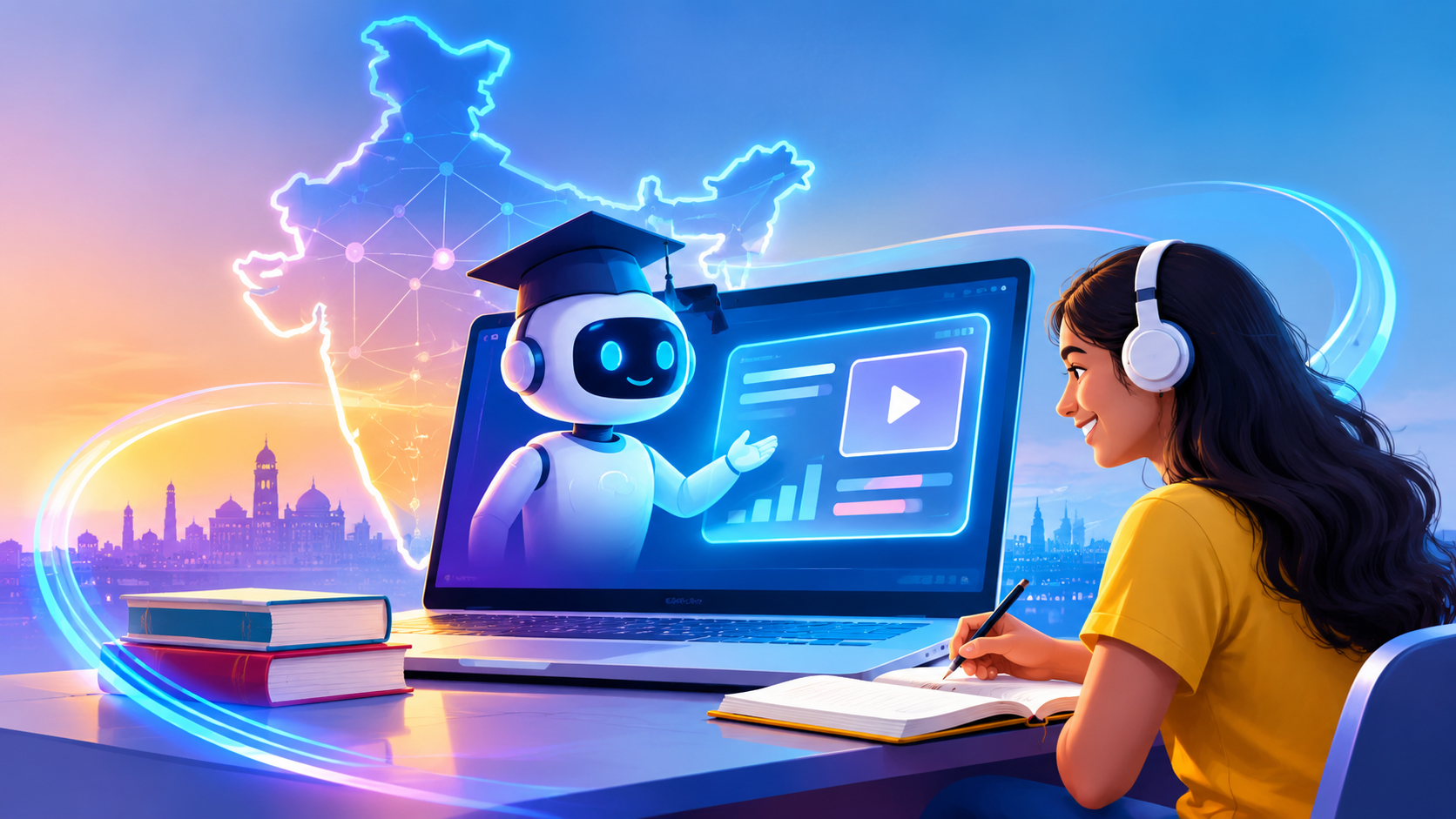
Nov 23: India’s education sector is undergoing a major transformation as artificial intelligence reshapes how students learn, teachers deliver lessons and educational institutions operate. Online education is moving beyond recorded lectures and digital study materials towards more interactive, personalised and technology-driven learning experiences. AI-powered platforms are making it possible to provide customised lessons, instant doubt-solving, automated assessments and learning support based on individual student needs.
With growing internet access, a young population and increasing demand for flexible education, India is emerging as an important market for digital learning. AI is adding another dimension to this growth by making online education more adaptive, accessible and responsive to different learning abilities.
India’s EdTech Market: Growth and Emerging Opportunities
India’s EdTech industry is expanding as students, working professionals and educational institutions increasingly adopt digital learning solutions. According to an August 2026 industry report, India’s EdTech market was valued at approximately ₹32,670 crore (USD 3.63 billion) in 2025 and is projected to reach ₹2,99,790 crore (USD 33.31 billion) by 2034. The digital education segment is also projected to grow at a compound annual growth rate of 24% between 2025 and 2030, reflecting the rising importance of online and technology-enabled education.
This growth is supported by several factors, including increasing smartphone adoption, affordable internet services, demand for competitive examination preparation, professional upskilling and wider acceptance of online courses. AI-powered learning is strengthening these trends by offering educational experiences that can adapt to individual requirements rather than following the same learning format for every student.
The major growth drivers include:
- Growing digital access: More students can access educational content through smartphones, computers and internet-connected devices.
- Personalised learning: AI can adjust lessons and practice exercises according to a student’s progress.
- Flexible education: Online courses allow learners to study at their own pace and from different locations.
- Career-focused learning: Demand for digital, technical and professional skills is creating opportunities for specialised courses.
- Technology integration: Schools, colleges and training institutions are increasingly exploring AI-assisted teaching and assessment.
AI Is Transforming the Online Learning Experience
Traditional online learning often relies on pre-recorded lessons, fixed study schedules and standardised assessments. Although these methods improve access to educational content, they may not address the different learning speeds and knowledge gaps of individual students.
AI-powered platforms can analyse learning patterns, identify areas where students struggle and recommend suitable study material. They can also provide explanations, generate practice questions and offer immediate feedback. This creates a more interactive learning environment in which students can receive support according to their individual progress.
Some of the key applications include:
- Personalised study plans: Learning schedules and content recommendations based on student performance.
- AI-powered tutoring: Interactive assistance for explaining concepts and answering academic questions.
- Automated assessments: Digital evaluation, instant feedback and identification of learning gaps.
- Smart recommendations: Suggestions for additional lessons, practice tests and revision materials.
- Progress tracking: Performance reports that help students and teachers monitor academic improvement.
These applications can make online education more engaging while helping learners focus on subjects and concepts that require additional attention.
Growing Adoption of Generative AI in Education
Generative AI is becoming increasingly relevant in India’s education ecosystem. A 2025 survey released in February 2026, covering 12,500 households and 2,500 teachers across 10 states, examined technology access and usage among children, parents and teachers from government and affordable private-school backgrounds.
The findings indicate that 35% of children who already use EdTech reported using generative AI for learning-related activities. Among these AI users, 96% used the technology multiple times a week, while 69% reported using it every day. The findings demonstrate growing engagement with AI-assisted learning among digitally active students, although they should not be interpreted as adoption rates across all Indian children.
Teacher adoption is also increasing. The same survey found that 51% of teachers who use EdTech were currently using generative AI for teaching and school-related activities. Among these AI-using teachers, 77% used it for lesson preparation and delivery, 47% for assessment creation and grading, and 44% for self-learning and professional development. These findings suggest that AI is becoming a support system for both classroom instruction and teacher productivity.
AI in Schools, Colleges and Higher Education
The adoption of AI is extending beyond individual online learners to schools, colleges and higher education institutions. Educational institutions are exploring AI-assisted teaching materials, automated assessment, virtual tutoring and digital academic support to improve learning delivery and administrative efficiency.
A 2025 survey of 30 leading higher education institutions in India found that more than 56% had implemented AI-related policies, while 60% permitted students to use AI tools. The survey also reported that 53% used generative AI to develop learning materials, 40% deployed AI-powered tutoring systems or chatbots, 39% had introduced adaptive learning platforms and 38% used AI for automated grading. Since the study covered 30 institutions, its findings provide an indication of adoption among the surveyed institutions rather than a national estimate for all colleges and universities.
AI is also influencing the way students prepare for examinations and acquire professional skills. Adaptive practice tests, instant explanations, digital simulations and personalised revision programmes can help learners identify weaknesses and prepare more effectively.
Improving Accessibility Through Digital Education
One of the biggest advantages of online education is its ability to reach learners beyond major cities. Students in smaller towns and rural areas can access educational resources without having to relocate or depend entirely on physical coaching facilities.
India’s internet infrastructure is supporting this expansion. The latest annual telecom performance report recorded approximately 1.09 billion internet subscribers at the end of March 2026, including more than 1.06 billion broadband subscribers. This expanding digital base provides a wider foundation for online education and technology-enabled learning.
However, access remains uneven. According to the 2025–26 school education data, 67.4% of schools had internet connectivity and 69.9% had computer facilities. This means a considerable proportion of schools still lack these essential digital resources. For online education to become more inclusive, platforms must consider connectivity limitations, affordability and access to suitable devices.
AI can further improve accessibility through features such as:
- Regional-language explanations and translated learning materials.
- Voice-based learning support for students who find typing difficult.
- Audio lessons and text-to-speech options.
- Low-bandwidth content for areas with limited internet connectivity.
- Flexible learning modules that can be accessed across different devices.
These features can help bring digital education to a wider group of learners, provided they are designed around local languages and actual student requirements.
The Role of AI in Teacher Productivity
AI is not only changing how students learn but also how teachers prepare and deliver lessons. Educators often spend considerable time creating lesson plans, preparing assignments, developing question papers and evaluating student performance. AI-assisted tools can help simplify these activities and reduce repetitive administrative work.
Teachers can use AI to generate practice questions, develop explanations for difficult topics, prepare classroom activities and organise study material according to students’ learning levels. They can also use performance data to identify students who may need additional academic support.
The 2025 education survey found that 80% of teachers using generative AI reported improved educational outcomes, while 60% reported saving time through its use. These are self-reported perceptions from participating teachers, not independently measured proof that AI directly improves academic results. Nevertheless, the findings highlight the potential of AI to support teaching when used appropriately.
Government Support and Digital Education Infrastructure
Government investment in digital infrastructure and AI education is creating additional opportunities for India’s EdTech ecosystem. Public initiatives are increasingly focusing on technology-enabled classrooms, digital learning resources, teacher development and future-ready skills.
The Union Budget 2026–27 included an allocation of ₹100 crore for a Centre of Excellence in Artificial Intelligence for Education. In March 2026, more than 1.79 lakh information and communication technology laboratories were also approved with an investment of approximately ₹7,634 crore to expand digital learning facilities across rural, tribal and aspirational districts. These initiatives reflect the growing policy focus on integrating technology into education and improving access to digital resources.
Continued investment in internet connectivity, digital classrooms, teacher training and affordable learning devices will be important for translating these initiatives into wider educational benefits.
Business Opportunities in India’s AI-Powered EdTech Market
The expansion of AI-powered education is creating opportunities across several segments of the industry. Demand is increasing not only for school-level learning but also for professional training, competitive examination preparation, language education and specialised skill development.
AI can help education providers offer more personalised services, improve course delivery and identify learner requirements. It also creates scope for new digital learning models that combine technology, instructional content and human guidance.
Promising areas of opportunity include:
- School education: Personalised lessons, interactive exercises and academic support.
- Competitive examination preparation: Adaptive mock tests, performance analysis and customised revision.
- Higher education: Digital tutoring, research assistance and AI-enabled academic resources.
- Professional upskilling: Courses focused on emerging technologies, digital skills and workplace requirements.
- Regional-language education: Learning content designed for students from different linguistic backgrounds.
- Corporate training: Flexible programmes for employee development and continuous learning.
Developers of educational solutions that focus on affordability, quality content, measurable learning outcomes and local requirements are likely to find opportunities in India’s evolving digital education market.
Challenges Facing AI-Powered Online Education
Despite its growth potential, AI-powered education faces several challenges. The accuracy of AI-generated responses, protection of student information, excessive dependence on automated assistance and unequal access to digital infrastructure remain important concerns.
Students may receive incorrect explanations or rely on AI-generated answers without understanding the underlying concepts. There are also concerns relating to plagiarism, academic integrity, online safety and the handling of personal information, particularly when young learners use digital platforms.
The latest national EdTech survey highlights these concerns. Among teachers using generative AI, 74% identified technology overuse as a risk for children, while 57% highlighted the possibility of incorrect information and 27% expressed concerns about digital privacy and fraud. These figures reflect teachers’ perceptions of potential risks rather than measured incidents across all students.
Addressing these challenges will require:
- Human oversight of AI-generated educational content.
- Strong safeguards for student data and privacy.
- Clear guidelines for responsible AI use in classrooms.
- Teacher training and digital literacy programmes.
- Accurate, curriculum-aligned and age-appropriate learning material.
- Affordable access across urban and rural communities.
- A balance between digital learning and teacher-led instruction.
The Future of AI-Powered Learning in India
The future of online education in India is likely to be shaped by the combination of artificial intelligence, interactive content, digital classrooms and personalised learning systems. As technology develops, learning platforms may become better at identifying knowledge gaps, adjusting course difficulty and providing real-time academic assistance.
Regional-language learning, voice-based interaction, virtual simulations and AI-supported career guidance could further expand the reach of digital education. At the same time, the growing importance of AI skills will encourage students and working professionals to pursue continuous learning and industry-relevant training.
However, technology alone cannot guarantee better education. Learning quality will continue to depend on good teaching, reliable content, student engagement and effective assessment. The strongest digital learning models will therefore combine AI capabilities with the experience and guidance of educators.
Conclusion
India’s EdTech industry is entering a new phase in which artificial intelligence is transforming online education from standardised digital lessons into more personalised and interactive learning experiences. Growing internet access, increasing AI adoption among students and teachers, and investment in digital education infrastructure are creating significant opportunities for the sector. While challenges relating to accuracy, affordability, privacy and digital access remain, the effective integration of AI with quality teaching can make education more flexible, inclusive and accessible. The future of online learning will not depend on technology replacing teachers, but on technology helping teachers teach better and enabling students to learn with greater confidence.
