

New Delhi, Nov 25: India’s cultural diversity has always been united by a shared civilisational spirit. Across centuries, languages, literature, traditions and knowledge systems have travelled beyond geographical boundaries, creating connections that continue to shape the country’s identity. Celebrating this enduring unity, Kashi Tamil Sangamam returns with its fifth edition from 28 November to 12 December 2026, placing the timeless teachings of the Thirukkural at the heart of its celebrations.
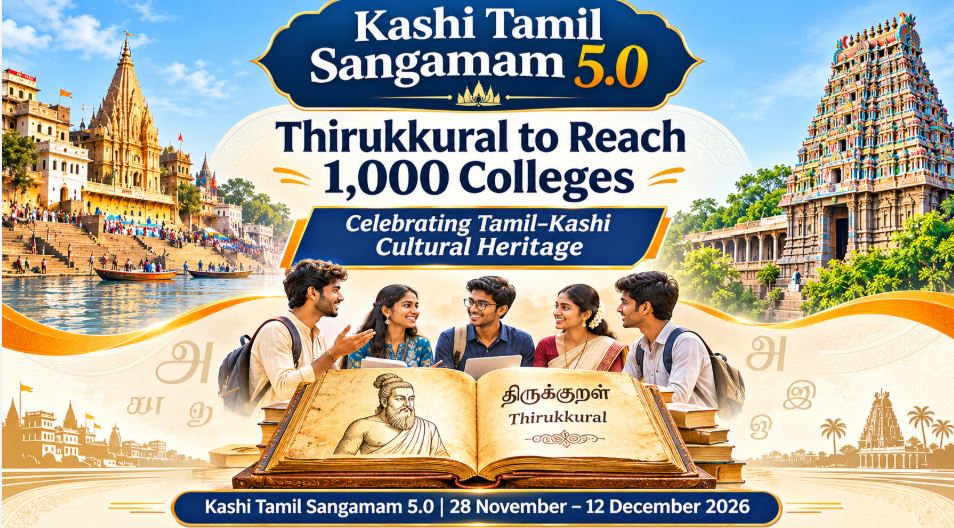
Under the theme “Thirukkural Payilvom – Thirukkural Abhyas Karen” (Let’s Learn Thirukkural), the initiative seeks to introduce the ethical and philosophical wisdom of the classical Tamil text to students and young learners across India.
With approximately 1,400 delegates from Tamil Nadu expected to visit Varanasi, Prayagraj and Ayodhya, the programme will combine academic engagement, cultural exploration, literary exchanges and spiritual experiences. A major highlight will be a nationwide Students’ Engagement Programme involving 1,000 Higher Education Institutions, taking the message of the Thirukkural beyond regional and linguistic boundaries.
More than a cultural festival, Kashi Tamil Sangamam represents an effort to strengthen India’s shared heritage through meaningful interaction, knowledge-sharing and mutual understanding.
Kashi and Tamil Nadu: A Civilisational Bond Across Centuries
The relationship between Kashi and Tamil Nadu is deeply rooted in India’s historical, spiritual and intellectual traditions. For generations, people from Tamil Nadu have travelled to Kashi as part of their religious and cultural practices, while the sacred city has remained an important centre of learning and spiritual exploration for people across the country.
The cultural connections are visible in several historic landmarks. Hanuman Ghat and Kedar Ghat in Varanasi have long been associated with Tamil communities. Swami Kumaragurupara of Dharmapuram Adheenam travelled from Tamil Nadu to Kashi and established the Kedareshwar Temple at Kedar Ghat. The approximately 200-year-old Kumaraswamy Mutt and Markandeya Ashram further reflect this enduring relationship.
In Tamil Nadu, Tenkasi is popularly known as the Kashi of the South, symbolising the spiritual connection between the two regions. The presence of a chair dedicated to Mahakavi Subramania Bharati at Banaras Hindu University also reflects their shared intellectual and literary heritage.
Kashi Tamil Sangamam seeks to build on these historical connections by bringing together people from both regions and creating opportunities to experience each other’s languages, traditions, knowledge and ways of life.
Thirukkural: Ancient Wisdom for a Modern Generation
The central theme of the fifth edition highlights one of India’s most celebrated literary and philosophical works — the Thirukkural.
Authored by the revered Tamil poet and philosopher Thiruvalluvar, the Thirukkural comprises 1,330 couplets organised into three sections: Aram (virtue), Porul (wealth) and Inbam (love).
Its teachings address ethics, human relationships, governance, social responsibility and the principles of a meaningful life. Despite originating in ancient Tamil literature, its universal values continue to resonate across cultures, generations and societies.
To make this literary treasure accessible to a wider audience, the Central Institute of Classical Tamil (CICT) has translated the Thirukkural into 25 Indian languages, including all 22 languages listed in the Eighth Schedule of the Constitution, as well as several foreign languages. It is also available in Braille.
Through Kashi Tamil Sangamam 5.0, the focus will be on encouraging young people to read, understand and apply these timeless teachings in their everyday lives.
Connecting 1,000 Higher Education Institutions Through Learning
One of the most significant initiatives of this edition is the nationwide Students’ Engagement Programme, designed to introduce the Thirukkural to students from diverse academic disciplines and linguistic backgrounds.
The programme will connect 1,000 Higher Education Institutions through structured learning, research activities and campus-based engagement.
Participating institutions will assess interested students and nominate one student each on merit. Selected students will subsequently participate in an online academic orientation conducted in the 22 scheduled Indian languages and English.
This will be followed by a one-month academic and research engagement supported by multilingual learning materials provided by CICT.
Eligible selected students will receive a stipend of ₹10,000, subject to programme guidelines and completion of the prescribed requirements.
Each participant will prepare a four-to-ten-page article or research note under the guidance of a faculty member and deliver a one-hour presentation on the Thirukkural at their respective institution.
By combining research, discussion and academic presentations, the initiative aims to transform the study of classical literature into an engaging learning experience for India’s youth.
Tamil Teachers to Bring Thirukkural into Uttar Pradesh Classrooms
Taking the literary exchange directly to educational institutions, Kashi Tamil Sangamam 5.0 will also feature a special teaching initiative in schools and colleges across Uttar Pradesh.
Around 50 teachers from Tamil Nadu will visit the State to introduce students to the Thirukkural and its core ethical teachings.
Experts on the classical text will conduct interactive sessions, orientation programmes and quizzes in schools and colleges, particularly in Varanasi.
The initiative will provide students with an opportunity to explore Tamil literature while developing an appreciation of its universal values.
The National Book Trust, in association with Rashtriya e-Pustakalaya, will also organise interactive school sessions in Varanasi focusing on reading habits, storytelling and creative learning activities.
Together, these initiatives aim to make literary and cultural exchange an integral part of the educational experience.
Taking Thirukkural Beyond Books Through Digital Outreach
In an increasingly connected world, technology offers new opportunities to preserve and share India’s classical knowledge traditions.
Kashi Tamil Sangamam 5.0 will use digital platforms and multilingual resources to bring the Thirukkural closer to readers across the country.
The Thirukkural Multilingual App developed by CICT provides access to all 1,330 couplets with translations into the 22 scheduled Indian languages.
The outreach programme will also include animated videos, short films based on selected couplets and Thirukkural audiobooks.
In an innovative public communication initiative, Thirukkural couplets accompanied by translations are planned for passenger information systems and signboards at railway stations, airports and highway toll plazas, in coordination with Indian Railways, the Airports Authority of India and the National Highways Authority of India.
These efforts will take the wisdom of Thiruvalluvar beyond classrooms and libraries, making it accessible to people during their everyday journeys.
1,400 Delegates to Experience the Cultural Landscape of Kashi
The fifth edition will bring approximately 1,400 delegates from Tamil Nadu to northern India. Organised into seven groups of around 200 participants each, they will undertake an eight-day journey comprising four days of travel and four days of visits and structured activities.
The participants will represent seven categories:
Students
Teachers
Writers and media professionals
Agriculture and allied sectors
Professionals and artisans
Women
Spiritual leaders
Their itinerary will cover Varanasi, Prayagraj and Ayodhya, offering opportunities to experience the region’s religious, historical, cultural and intellectual traditions.
In Varanasi, delegates will visit important landmarks, including Kashi Vishwanath Temple, Sarnath or Banaras Hindu University, Ramnagar Fort and Bharat Mata Temple. The programme will also feature Ganga Aarti, Ganga Snan, academic interactions and cultural performances.
The journey will extend to the Triveni Sangam in Prayagraj and the Shri Ram Temple in Ayodhya.
A special Tamil heritage circuit will connect delegates with important sites associated with the Tamil presence in Kashi, including Mahakavi Subramania Bharati’s ancestral house, Kedar Ghat and Kashi Madam in Little Tamil Nadu. An academic interaction with the Tamil Department of Banaras Hindu University will further strengthen the intellectual dimension of the programme.
Academic Conferences and Cultural Celebrations
Kashi Tamil Sangamam 5.0 will be inaugurated on 28 November 2026, while the valedictory ceremony is scheduled for 12 December 2026. Students selected under the nationwide engagement programme will participate in both functions online.
Banaras Hindu University, in partnership with the Bharatiya Bhasha Samiti, will co-host a National Conference on the Thirukkural, bringing scholars and experts together to discuss the relevance of the classical text.
The Ministry of Culture will support cultural performances, screenings of Thirukkural short films and other cultural showcases at the programme venues.
Handloom and handicraft outlets representing Tamil Nadu and Uttar Pradesh will also be established at the main venue, providing delegates an opportunity to explore the artistic traditions and craftsmanship of both regions.
These activities will create a vibrant platform where literature, scholarship, performing arts, traditional crafts and cultural practices come together.
Four Editions That Strengthened India’s Cultural Connections
Since its launch in 2022, Kashi Tamil Sangamam has evolved into an important platform for celebrating India’s shared civilisational heritage.
Kashi Tamil Sangamam 1.0 – 2022
The inaugural edition brought more than 2,500 participants from Tamil Nadu, representing 12 different walks of life, to Varanasi, Prayagraj and Ayodhya. The programme featured academic seminars, cultural exchanges, exhibitions of handlooms and handicrafts, regional cuisine, books and traditional art forms.
Kashi Tamil Sangamam 2.0 – 2023
Held from 17 to 30 December 2023 at Namo Ghat in Varanasi, the second edition expanded the cultural and academic engagement. It featured real-time, app-based Tamil translation of the Prime Minister’s speech and exchanges on literature, philosophy, spirituality, music, dance, yoga, Ayurveda and modern innovations.
Kashi Tamil Sangamam 3.0 – 2025
Conducted from 15 to 24 February 2025, the third edition focused on the legacy of Sage Agasthyar and the connection between India’s traditional knowledge systems and contemporary learning. Around 1,000 delegates from Tamil Nadu and 200 students from Central Universities participated. The edition also featured cultural performances by more than 869 artists and 190 local folk and classical groups, attracting nearly two lakh visitors.
Kashi Tamil Sangamam 4.0 – 2025
Held from 2 to 15 December 2025, the fourth edition adopted the theme “Tamil Karkalam – Let us learn Tamil”. It brought together more than 1,400 delegates and introduced Tamil language learning initiatives in Uttar Pradesh. Fifty trained Tamil teachers and coordinators helped teach basic Tamil to over 1,500 students across 50 schools. The programme also included Tamil learning study tours for 300 college students from Kashi, a special Sage Agastya Vehicle Expedition and the translation of Tolkappiyam into four Indian and six foreign languages.
Building on these achievements, the fifth edition takes the cultural exchange further by placing classical literature and youth participation at the centre of the initiative.
Ek Bharat Shreshtha Bharat: Unity Through Shared Knowledge
Kashi Tamil Sangamam is organised by the Department of Higher Education, Ministry of Education, in collaboration with IIT Madras, Banaras Hindu University, the Central Institute of Classical Tamil and the Government of Uttar Pradesh. Several other Central Ministries and Departments, including Culture, Railways, Tourism and Textiles, also contribute to the initiative.
The programme reflects the vision of Ek Bharat Shreshtha Bharat, which seeks to strengthen national integration through cultural understanding and meaningful connections between different regions of the country.
By bringing together students, teachers, scholars, artisans, professionals and spiritual leaders, the Sangamam creates opportunities for people to learn from one another and appreciate India’s diverse cultural traditions.
The fifth edition gives this vision a fresh educational dimension. By introducing the Thirukkural to thousands of students and encouraging its study across languages and disciplines, it seeks to connect India’s ancient literary wisdom with the aspirations of its younger generation.
From the sacred ghats of Kashi to the literary traditions of Tamil Nadu, Kashi Tamil Sangamam 5.0 celebrates a timeless message: India’s diversity is its strength, and its shared knowledge heritage is a powerful foundation for national unity. Through the universal wisdom of the Thirukkural, the initiative seeks to ensure that the values of India’s classical past continue to inspire the generations of tomorrow.
