

New Delhi, Nov 26: Indian scientists have demonstrated a new way to detect extreme solar particle events using compact gamma-ray detectors installed at research stations in the Arctic and Antarctica, potentially opening the door to a wider and more cost-effective global space-weather monitoring network.
Representational Image
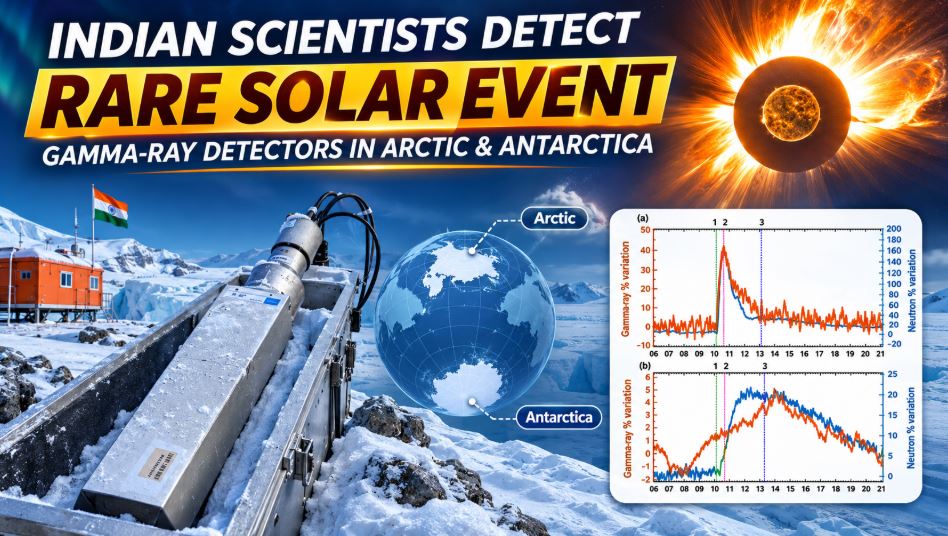
Researchers from the Indian Institute of Geomagnetism (IIG), Mumbai, detected signatures of a rare solar phenomenon known as a Ground-Level Enhancement (GLE) from observations recorded at Ny-Ålesund in the Arctic and Maitri station in Antarctica. The findings relate to a powerful solar event recorded on November 11, 2025, designated GLE #77.
The event was associated with an intense X-class solar flare, a fast coronal mass ejection (CME) and a strong solar energetic particle (SEP) event. The detection demonstrates how ground-based gamma-ray observations can complement conventional neutron-monitor systems used to track high-energy particles arriving from the Sun.
Gamma-ray detectors capture different responses at two poles
The research used sodium iodide (NaI(Tl)) scintillation gamma-ray detectors installed by IIG at the two polar research locations as part of its programme to study cosmic rays and space-weather phenomena.
The instruments recorded distinct responses to the November 2025 event. Maitri in Antarctica registered a prompt response, while the detector at Ny-Ålesund in the Arctic showed a more gradual variation.
Researchers compared the gamma-ray count rates across different energy ranges with pre-event background levels, conventional neutron-monitor observations and particle measurements from the Geostationary Operational Environmental Satellites (GOES).
The analysis also examined and ruled out other possible sources of enhanced radiation signals, including terrestrial radioactivity, lightning-related thunderstorm ground enhancements, terrestrial gamma-ray flashes, gamma-ray bursts and solar flares.
The recorded signatures were found to be consistent with measurements from the established neutron-monitor network, supporting the use of gamma-ray detectors as an additional tool for identifying GLE events.
A more accessible approach to space-weather monitoring
Ground-Level Enhancements are among the most intense forms of solar energetic particle events. They occur when highly energetic particles, mainly protons released during powerful solar eruptions, travel through interplanetary space and enter Earth’s atmosphere.
These particles interact with atmospheric molecules and produce secondary particles, including hadronic, mesonic and electromagnetic components. Studying such events helps scientists understand how solar activity affects Earth’s atmosphere and space environment.
Conventional neutron monitors have long been used to detect GLEs. However, the IIG study highlights the potential of gamma-ray detectors as a relatively compact and cost-effective complementary option.
A broader network of such instruments at strategically selected locations could improve the geographical coverage of ground-based observations and help scientists examine how high-energy solar particles interact with Earth’s atmosphere under different geomagnetic conditions.
Strengthening India’s contribution to space-weather research
The study was carried out by Prof. G. Vichare, P. Thakur and C. Selvaraj of IIG, along with Prof. N. Gopalswamy of NASA.
The findings have been published in The Astrophysical Journal Letters. The research underlines the scientific value of India’s polar observation facilities and their contribution to international efforts to understand extreme space-weather events.
By successfully identifying GLE #77 through gamma-ray measurements at both polar stations, the researchers have demonstrated a complementary approach that could support the development of a wider global monitoring network.
The work could also improve scientific understanding of solar eruptions, high-energy particle propagation and the Sun-Earth connection, particularly as extreme space-weather events can pose challenges to satellites, communication systems and other technological infrastructure.

