

New Delhi, Nov 27: India’s efforts to convert industrial waste into useful infrastructure materials have received a boost, with the CSIR-Central Road Research Institute (CSIR-CRRI) winning the CII 4R Awards 2026 for its innovative steel slag-based road technologies.
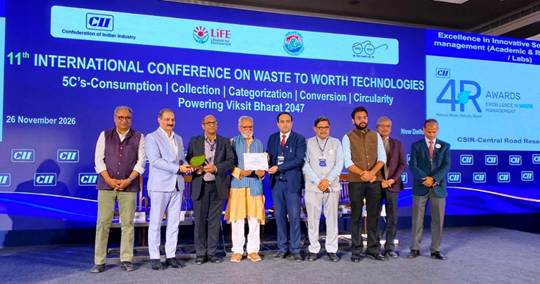
The New Delhi-based research institute received the award in the category of ‘Excellence in Innovative Solutions for Sustainable Waste Management by Research Labs/Academic Institutions’. It was also named among India’s Top 30 Waste-to-Worth Leaders for developing Steel Slag Road® Technology and ECOFIX®, an instant pothole repair mix made from iron and steel slag.
The awards were presented on November 26 at the 11th International Conference on Waste-to-Worth Technologies, held at Hotel The Lalit in New Delhi. CSIR-CRRI Director Dr. Ch. Ravi Sekhar and Satish Pandey, Scientist G and Head of the institute’s Flexible Pavement Division, received the recognition from Prof. Anil Gupta, founder of the Honey Bee Network and a prominent advocate of grassroots innovation.
Steel slag finds a new use in road construction
India’s steel industry generates approximately 30 million tonnes of steel slag, creating a significant challenge in industrial waste management. CSIR-CRRI’s technology seeks to address this issue by scientifically processing the by-product and using it as an aggregate in road construction.
Steel Slag Road® Technology offers an alternative to conventional natural aggregates, helping reduce dependence on quarried materials while creating productive uses for industrial waste. The approach supports resource conservation and promotes circular economy practices in the infrastructure sector.
Pandey, who developed both Steel Slag Road® Technology and ECOFIX®, highlighted the potential of these innovations to convert large volumes of steel industry waste into useful construction materials.
ECOFIX offers an alternative for pothole repairs
Alongside road construction, CSIR-CRRI has developed ECOFIX®, an iron and steel slag-based instant pothole repair mix designed for road maintenance.
The technology demonstrates how industrial by-products can be incorporated into practical solutions for infrastructure upkeep. Its commercialisation by RAMUKA GLOBAL SERVICES under a technology licence from CSIR-CRRI illustrates the role of industry and startups in taking research-based innovations to the market.
The partnership highlights how collaboration between public research institutions and private enterprises can help translate indigenous technologies into commercially usable products.
Steel slag road model draws attention at conference
At the conference exhibition, CSIR-CRRI presented a model of the world’s first steel slag road, constructed at Hazira in Surat, Gujarat, using scientifically processed steel slag aggregates.
The display highlighted the application of industrial by-products in road infrastructure and showcased the potential of research-led solutions to address waste management challenges while supporting sustainable construction.
Recognition for circular economy innovation
The CII 4R Awards recognise initiatives that advance sustainable waste management and resource efficiency through the principles of Reduce, Reuse, Recycle and Repair.
The recognition of CSIR-CRRI and its technology commercialisation partner underscores the importance of linking scientific research, technology transfer and entrepreneurship to address industrial waste challenges.
As a constituent laboratory of the Council of Scientific and Industrial Research under the Ministry of Science and Technology, CSIR-CRRI works in road and transportation engineering, developing technologies for safer, more sustainable and resilient infrastructure.
The institute’s latest recognition brings attention to the growing scope for using industrial waste as a resource. Wider adoption of such technologies could help reduce pressure on natural construction materials, improve waste utilisation and support India’s transition towards a more resource-efficient infrastructure sector.
