Australia, Odisha Talks Focus on Clean Energy, Agriculture and Skill Development

In a step toward strengthening international cooperation, Bernard Lynch met Odisha Deputy Chief Minister KV Singh Deo at Lok Seva Bhawan to explore partnerships in renewable energy, agriculture, and technological innovation.

Australia, Odisha Talks Focus on Clean Energy, Agriculture and Skill Development

Pic Credit: Pexel

During the discussion, Lynch appreciated Odisha’s strong performance in both energy and agriculture, noting that the state has surpassed national growth trends in the farming sector. He also highlighted the state’s progress in modernising its power infrastructure, which has enhanced electricity generation and transmission capabilities.

Responding to this, Singh Deo outlined the government’s recent initiatives to expand renewable energy production and promote clean energy adoption. He emphasised that supportive policies are being implemented to better utilise natural resources and accelerate sustainable development.

The talks also underlined Odisha’s agricultural achievements, with record production levels contributing to rising farmer incomes. Both sides expressed confidence that closer collaboration between Australia and Odisha would open new opportunities in clean energy, agriculture, and technology.

In a separate meeting, Lynch held discussions with Industries Minister Sampad Chandra Swain, focusing on boosting industrial investment, skill development, and technical education. The engagement signals growing international interest in Odisha’s development trajectory and its potential as a hub for innovation and skilled workforce growth.


Odisha Speeds Up City Gas Expansion to Boost Energy Security

Odisha Speeds Up City Gas Expansion to Boost Energy Security

Pic Credit: Pexel

Amid growing uncertainty in global fuel markets, the Odisha government has stepped up efforts to build a robust and future-ready energy infrastructure by fast-tracking the expansion of city gas distribution (CGD) networks across the state. The initiative is aimed at improving energy security while promoting cleaner fuel alternatives for households, industries, and transportation.

The strategy was reviewed at a high-level meeting chaired by Chief Secretary Anu Garg at Lok Seva Bhawan. Senior officials, including Hemant Sharma and Usha Padhee, participated in the discussions alongside representatives from leading energy companies such as GAIL, Bharat Petroleum Corporation Limited, and Adani Total Gas.

A key focus of the meeting was identifying and eliminating bottlenecks that have slowed the rollout of gas infrastructure projects. Delays in approvals for pipeline installation, coordination challenges among departments, and procedural inefficiencies were highlighted as major hurdles. In response, the government has introduced a time-bound clearance mechanism, directing municipal corporations and relevant departments to approve all pending pipeline-laying permissions within 24 hours. This step is expected to significantly accelerate project execution on the ground.

The expansion of CGD networks is central to Odisha’s broader push toward sustainable and diversified energy use. By promoting Piped Natural Gas (PNG) for domestic and commercial use, the government aims to provide a safer, more convenient alternative to traditional cooking fuels like LPG. At the same time, increased availability of Compressed Natural Gas (CNG) is expected to support cleaner mobility solutions, particularly in urban transport systems.

Officials believe that strengthening last-mile connectivity will play a crucial role in ensuring widespread adoption of these alternatives. Efforts are being made to extend the gas pipeline network deeper into cities and emerging urban clusters, making clean energy accessible to a larger population. This expansion is also expected to benefit small and medium enterprises by providing a reliable and cost-effective fuel source.

The government has set an ambitious deadline of June 30 to achieve key milestones in infrastructure development. This sense of urgency reflects a proactive approach to reducing dependence on conventional fossil fuels and insulating the state from external supply shocks. It also aligns with national goals of increasing the share of natural gas in the overall energy mix.

Beyond environmental benefits, the initiative is likely to generate economic opportunities. Infrastructure development, network maintenance, and increased industrial activity linked to gas availability are expected to create jobs and stimulate local economies. Moreover, improved energy access can enhance the ease of doing business, making Odisha a more attractive destination for investment.

Overall, the accelerated rollout of city gas infrastructure marks a significant step in Odisha’s transition toward a cleaner, more resilient energy future. By combining policy support, administrative efficiency, and industry collaboration, the state is positioning itself to meet rising energy demands while prioritizing sustainability and long-term growth.


Nita M. Ambani Honoured at Kalinga Institute of Social Sciences with 2025 Humanitarian Award

In a moment that celebrated compassion, leadership, and social commitment, Nita M. Ambani was honoured with the prestigious KISS Humanitarian Award 2025 at the campus of Kalinga Institute of Social Sciences in Bhubaneswar.

The award recognises her extensive contribution to social development through the Reliance Foundation, where her initiatives have touched millions of lives across India. Her work spans critical sectors such as education, healthcare, rural transformation, women’s empowerment, and sports development—areas that directly impact communities at the grassroots level.

The honour was presented by Mohan Munasinghe in the presence of Achyuta Samanta, whose institutions have long been associated with inclusive education and tribal empowerment.

More than just an award ceremony, the event reflected a shared vision of building a more equitable society. Speaking on the occasion, Ambani’s recognition symbolised not only her leadership but also the collective efforts of countless individuals working under her foundation to bring meaningful change.

Over the years, her initiatives have focused on uplifting underserved communities—providing access to quality education, improving healthcare delivery in rural areas, supporting women to become self-reliant, and nurturing young sporting talent across the country. Her approach combines scale with empathy, ensuring that development is both impactful and inclusive.

The KISS Humanitarian Award is regarded as a tribute to individuals who dedicate their lives to social progress, and this year’s recognition of Nita Ambani underscores the growing importance of corporate-led philanthropy in shaping India’s development journey.

As the ceremony concluded, the message was clear: meaningful change is possible when vision meets action, and when influence is used to uplift those who need it most.

Major Industrial Investments Approved in Odisha, Boosting Jobs and Regional Growth

Odisha Clears ₹4,510 Crore Industrial Push to Drive Jobs, Regional Development, and Sectoral Growth

Major Industrial Investments Approved in Odisha, Boosting Jobs and Regional Growth

Pic Credit: Pexel

In a significant move to accelerate industrialization and create large-scale employment, the Odisha government has approved a diverse portfolio of investment projects across the state. The proposals, cleared at the latest meeting of the State Level Single Window Clearance Authority, represent a combined investment of ₹4,510 crore and are expected to generate over 10,000 jobs in 11 districts.

At the forefront of this industrial expansion is Century Plyboards (India) Ltd, which plans to establish a major plywood manufacturing facility in Koraput district. With an investment of ₹870.82 crore, the project is poised to strengthen the wood-based manufacturing ecosystem while also creating employment opportunities in one of the state’s relatively underdeveloped regions.

Complementing this, Pidilite Industries will set up a tile adhesive manufacturing unit in Balasore. Known for its leadership in construction chemicals and adhesives, the company’s investment is expected to support the growing infrastructure and housing demand in eastern India.

In the services and technology domain, PricewaterhouseCoopers (PwC) is set to establish a technology center in Khordha with an investment of ₹60 crore. This project highlights Odisha’s emerging position as a destination for knowledge-based industries and is likely to generate high-skilled employment opportunities.

The approved projects reflect a deliberate strategy by the state government to ensure balanced regional development. Districts such as Koraput, Kalahandi, and Balangir—traditionally considered economically lagging—have received focused attention in this round of approvals. The initiative aligns with the government’s broader vision to distribute industrial growth more evenly across the state.

Beyond these headline investments, the approvals span a wide range of sectors. In textiles, new ventures in weaving and technical fabrics are expected to boost manufacturing capabilities. The pharmaceuticals and medical devices sector will see fresh investments aimed at strengthening healthcare infrastructure and production capacity.

The metals and mining sector continues to attract strong interest, with multiple projects in steel and aluminum processing lined up in districts like Cuttack, Sundargarh, and Keonjhar. Meanwhile, green energy initiatives and chemical manufacturing projects, including a sulphuric acid plant and ethanol production unit, signal a push toward both industrial sustainability and value-added production.

Infrastructure development also forms a key part of the investment landscape. A logistics park in Sambalpur will enhance supply chain efficiency, while several new hospitality projects—including star-category hotels in Koraput, Bolangir, Bhubaneswar, and Puri—are expected to boost tourism and related services.

Overall, the latest round of approvals underscores Odisha’s growing attractiveness as an investment destination. With a mix of manufacturing, services, and infrastructure projects, the state is positioning itself for long-term economic resilience. By combining large-scale investments with a focus on regional inclusivity and employment generation, Odisha is taking a decisive step toward becoming a more balanced and industrially robust economy.

Charles Thorn Awarded 2026 Dannie Heineman Prize for Mathematical Physics

Washington, Mar 18: AIP and the American Physical Society are honored to award Charles Thorn with the 2026 Dannie Heineman Prize for Mathematical Physics.

Thorn is being recognized for “fundamental contributions to elementary particle physics, primarily the theory of strong interactions and the development of string theory.”

This annual award recognizes significant contributions within the field of mathematical physics and was presented at the APS Global Physics Summit in Denver on March 16.

“Dr. Charles Thorn has made tremendous contributions to the field of theoretical physics, and AIP is pleased to honor him with this prize in collaboration with APS,” said Michael Moloney, CEO of AIP. “He was on the cutting edge of the research that led to the development of string theory as we know it today, and that lifelong accomplishment deserves celebration.”

Since childhood, Thorn has been interested in how things work. In his teenage years, he found through mathematics and physics that this curiosity broadened to include phenomena that were not visible to the naked eye. Studying physics introduced him to many puzzling ideas, which led him to choose the Massachusetts Institute of Technology for undergraduate studies.

Thorn graduated from MIT with a Bachelor of Science in physics in June 1968. He then went on to earn his doctorate in theoretical elementary particle physics from the University of California, Berkeley in 1971.

His doctoral advisor was Stanley Mandelstam, a former winner of the Dannie Heineman Prize for Mathematical Physics. At Berkeley, Thorn began work on one-loop dual resonance models (DRM). Inspired by the work of P. Ramond, A. Neveu, and J. Schwarz, his later graduate work showed how to include subatomic particles known as fermions into the DRM.

He also began work that would later lead to the development of the “no-ghost theorem.” In quantum theory, a “ghost” was a whimsical name given to an apparently negative probability event, which can ruin the consistency of quantum mechanics. The “no-ghost theorem” was finalized by Thorn and his colleague Peter Goddard at CERN and was later named the “Goddard-Thorn theorem.” It proved the absence of negative probabilities in DRMs, which established that these models were consistent with quantum mechanics. Around the same time, fellow physicist Richard Brower also completed an independent proof of this concept.

Thorn joined the faculty of MIT in 1973 and developed the

“MIT Bag Theory” along with his colleagues A. Chodos, R. Jaffe, K. Johnson, Thorn, and V. Weisskopf. This theory has evolved as a practical model of baryons, which are described as three weakly interacting quarks in a “bag.”

Thorn said the no-ghost theorem and MIT Bag Theory were highlights of his career.

“I think of my other work as growing out of those two achievements,” he said.

In 1980, Thorn, P. Ramond, R. Field, and T. Curtright formed a new particle theory group at the University of Florida; P. Sikivie joined the group a year later. Thorn and Curtright had a very fruitful collaboration studying the quantum Liouville field theory, which was awarded the Jesse W. Beams Medal in 2005 by the Southeastern Section of APS.

Currently, Thorn is a professor emeritus of physics at the University of Florida and is an APS Fellow. In addition to being honored to receive the 2026 Dannie Heineman Prize for Mathematical Physics, he said he was pleasantly surprised.

“There was plenty of recognition when I was doing this work,” Thorn said. “But the fact that this award is recognizing something I did a long time ago — it was stunning to me.”

Coal capacity and pricing mechanisms help buffer short-term market impacts

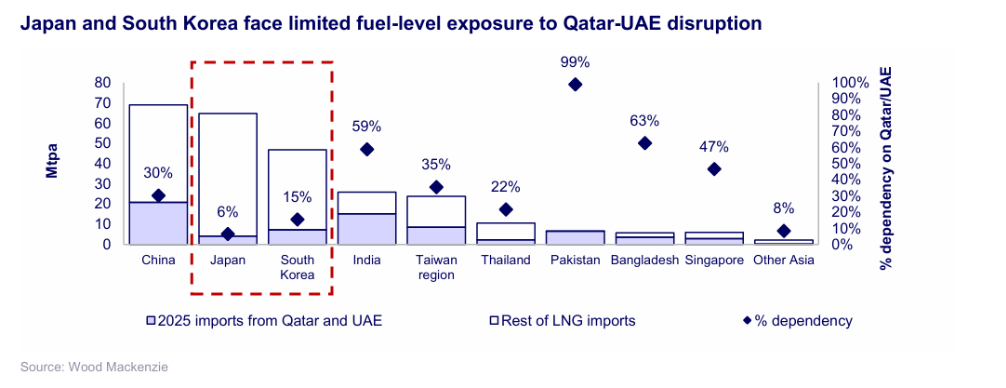
LONDON/HOUSTON/SINGAPORE, 18 March – The Middle East conflict is reinforcing energy security as a central pillar of power planning in Japan and South Korea, with coal generation providing a significant near-term buffer. During the current shoulder season, coal fleets could offset up to 70% of gas-fired generation in Japan and more than 100% in South Korea of the same season last year, according to new analysis from Wood Mackenzie. 

While both markets remain relatively insulated from immediate fuel supply disruption, the crisis is accelerating structural shifts toward nuclear expansion, slower coal retirements and the localisation of clean energy supply chains.  

Coal capacity and pricing mechanisms help buffer short-term market impacts


Limited short-term exposure to LNG disruption 

Unlike many Asia-Pacific markets, Japan and South Korea face manageable near-term risk from potential LNG supply disruption through the Qatar–UAE corridor. According to Wood Mackenzie, Japan’s direct exposure to the disruption is around 6%, compared with approximately 15% for South Korea. 

“Diversified procurement and long-term contracts provide Japan and South Korea with multiple layers of protection, delaying the impact of fuel price volatility on power end users,” said Xiaonan Feng, principal analyst, Asia Pacific power and renewables research at Wood Mackenzie. “However, the broader policy implications of the crisis are likely to be long-lasting.” 

In Japan, fuel cost pass-through is delayed by around three to six months due to bilateral pricing mechanisms. In South Korea, the cost-based power pool and retail tariff caps help limit short-term volatility, although this places additional financial strain on Korea Electric Power Corporation (KEPCO). 

Coal provides critical system flexibility 

During the current shoulder season, coal fleets could offset up to 70% of Japan’s and more than 100% of South Korea’s gas-fired generation based on 2025 levels, if utilisation rates increase significantly. This flexibility, however, is seasonal and would decline during peak summer months when coal plants are already operating at higher capacity. 

“Coal continues to play an important role as a strategic reserve for both countries, particularly during periods of fuel market stress,” Feng said. 

Japan’s position is further supported by the restart of five nuclear reactors since 2022, adding 4.6 GW of baseload capacity that is insulated from fossil fuel price volatility. 

Nuclear policy momentum strengthens  

In Japan, the transition from post-Fukushima nuclear minimisation to expansion is now firmly established, making nuclear power an essential for long-term energy security. This policy shift is expected to provide stable electricity to meet rising demand, particularly from data centres, and reduce reliance on fossil fuel imports. Similarly, in South Korea, nuclear power continues to gain policy and public support. The government has identified nuclear as critical to meeting future electricity demand, with the potential for additional capacity beyond current plans. Decisions on lifetime extensions for approximately 7.8 GW of reactors due to reach design limits by 2030 will be key to the country’s energy mix, according to Wood Mackenzie. 

Renewables strategy shifts toward localisation 

At the same time, both markets are increasingly prioritising domestic supply chains within their energy transition strategies. Japan is reassessing its reliance on imported solar panels while focusing on next-generation technologies such as perovskite cells and expanding offshore wind capacity. South Korea has already moved to favour domestically manufactured equipment in recent offshore wind and battery storage auctions, signalling a shift toward localisation over lowest-cost deployment. 

Outlook is dependent on the duration of the disruption 

The extent of market impact will depend on the duration of the conflict, Wood Mackenzie noted. If disruptions persist into peak summer demand, the effectiveness of coal as a buffer will diminish, increasing exposure to tighter supply conditions. 

A stronger US dollar could also amplify cost pressures by increasing fuel import costs in local currency terms. 

“The immediate risks are manageable, but the long-term direction is clear,” Feng concluded. “Energy security considerations will continue to accelerate nuclear expansion, delay coal retirements and drive greater emphasis on domestic energy supply chains in both markets.” 

Orange Business Summit 2026 Unveils Next-Generation Innovation with Trusted AI, Cloud, and Secure Connectivity Solutions

Mar 17: Orange Business is set to convene over 1,000 customers at the Orange Business Summit 2026 on March 17-18, unveiling a portfolio of trusted technological innovations designed to empower enterprises to adapt, operate autonomously, and ensure business continuity in an unpredictable world.

The summit will spotlight 14 breakthrough innovations, including four major new solutions based on trusted cloud environments and powered by AI: Orange Drone Guardian, Live Intelligence Studio, Live Collaboration, and reimagined enterprise communications.

Empowering Enterprises Through Trusted Innovation
“Organizations face unprecedented pressures as they navigate complex and volatile market conditions,” said Aliette Mousnier-Lompré, CEO of Orange Business. “Our commitment is stronger than ever: to help our customers build resilience and embrace the future with confidence. Possibility starts with technology you can trust, and Orange Business is uniquely positioned as the bridge between ambition and achievement.”

Attendees at the summit will experience live demonstrations across trusted connectivity, cloud, cybersecurity, and AI, providing enterprises with tools to tackle business-critical challenges while future-proofing their strategies.

Key Innovations Announced at the Summit

  • Orange Drone Guardian – Europe’s first anti-drone-as-a-service solution detects, identifies, and classifies intrusive drones in low-altitude airspace across France, with plans for expansion across Europe. Targeted at operators of critical infrastructure, public authorities, and major event organizers, it combines Orange’s sovereign infrastructure with advanced detection technologies.

  • Live Intelligence Studio – Extending the capabilities of the generative AI platform, Live Intelligence Studio empowers enterprises to securely develop, deploy, and manage intelligent AI agents. This innovation helps automate tasks and analyze data with human-like insights, ushering enterprises into the agentic era.

  • Reimagined Enterprise Communications – Integrating AI and trust, Orange Business enhances enterprise communications with features such as branded calling, deepfake detection, AI-augmented customer care, and agentic telephony. This strengthens security and operational efficiency while enabling trusted engagement between customers and employees.

  • Live Collaboration – A sovereign suite of modular collaboration tools consolidating messaging, calendars, document co-editing, video conferencing, and intranet functions into a unified platform. Hosted on Cloud Avenue SecNum and fully managed by Orange, it provides enterprises with greater control over data, costs, and architecture while mitigating vendor lock-in and cloud vulnerabilities.

Investing in a Secure and Resilient Future
The Orange Business Summit 2026 will also showcase real-world customer success stories, demonstrating how trusted innovation drives operational excellence and sustainable growth. By combining AI, secure cloud, and advanced connectivity, Orange Business is helping enterprises navigate uncertainty with confidence, enabling smarter, faster, and safer operations.

transcosmos signs a partnership agreement with the Tokyo University of Pharmacy and Life Sciences to promote pharmacist operational transformation to address the 2040 Problem


Contributes to community medical services through research on new services that help streamline pharmacists’ operations. By leveraging DX/BPO expertise, works on developing next-generation talent

Tokyo, Japan, Mar18:transcosmos announced its partnership with the Tokyo University of Pharmacy and Life Sciences (Location: Tokyo, Japan; President: Yoshihiro Mimaki; TUPLS). The partnership—Partnership Agreement on Promoting Pharmacist Operational Transformation to Address the 2040 Problem—is aimed at promoting the transformation of pharmacists’ operations to address the so-called 2040 Problem, a significant worker shortfall expected in Japan by 2040.

From left: Yoshihiro Mimaki, President of TUPLS, and Satoshi Takayama, Corporate Executive Officer, transcosmos

[Key points] ●An educational institution and a private-sector company will engage in a cross-industry collaboration and leverage their respective experience and expertise built over the years to resolve challenges in community medical services, including labor and resource shortages, and conduct research on new services that help streamline pharmacists’ operations.

●Discuss measures to enhance operations in communities facing pharmacist shortages and develop pharmaceutical education programs by leveraging expertise in digital transformation (DX) and business process outsourcing (BPO).

●Through education and research that combine professional pharmaceutical knowledge with DX/BPO expertise, contribute to developing next-generation talent who can support an ever-changing medical environment.

[Overview] Through this initiative, the two parties will collaborate beyond their respective fields as an educational institution and a private-sector company to contribute to community medical services by utilizing the experience and expertise each party has built over the years.

Addressing the 2040 Problem has become an urgent challenge for Japan, as the country is expected to face both increased medical demand and a shortage of medical professionals leading up to 2040, the year when second-generation baby boomers will turn 65 or older. Communities that are expected to face a severe shortage of pharmacists, in particular, must streamline operations while maintaining the quality of medical services with limited human resources.

Under this partnership agreement, transcosmos and TUPLS will work closely together and utilize their respective strengths and resources to resolve challenges in community medical services arising from the 2040 Problem, such as workforce and resource shortages, and conduct research on new services that support the streamlining of pharmacists’ operations. More specifically, the two parties will discuss measures to enhance operations in communities facing pharmacist shortages and will work on developing pharmaceutical education programs leveraging expertise in digital transformation (DX) and business process outsourcing (BPO).

Through education and research that combine professional pharmaceutical knowledge with DX/BPO expertise, the two parties will also contribute to developing next-generation talent who can support an ever-changing medical environment.

As the development of the so-called Community-based Integrated Care System progresses in recent years, pharmacists are expected to actively engage in community medical services and take on wider roles. At the same time, they are expected to adopt new approaches that increase work efficiency through digital technologies and optimize operational processes.

transcosmos and TUPLS will promote effective collaboration and drive advanced initiatives to help build a sustainable community-based medical service system toward 2040.

[Comments from project representatives] Yoshihiro Mimaki, President, Tokyo University of Pharmacy and Life Sciences “We are excited to have the opportunity to utilize transcosmos’s DX and BPO expertise for student education and research to address challenges that future pharmacists and medical professionals will face, such as operational efficiency and worker shortages. Through this new industry-academia collaboration, we will contribute to resolving challenges in community medical services by promoting education and research that combine pharmaceutical expertise with the latest digital technologies and by developing talent who can support an ever-changing medical environment.”

Satoshi Takayama, Corporate Executive Officer, transcosmos inc. “We are delighted with this partnership agreement with the Tokyo University of Pharmacy and Life Sciences, which aims to transform pharmacists’ operations to address the 2040 Problem. We are sincerely grateful for this opportunity to apply our DX and BPO expertise that we have built over the years to the field of pharmacist operational transformation and contribute to resolving challenges in community medical services. We expect that our efforts in research and education through this partnership will help develop next-generation talent who will lead the medical field of the future.”

transcosmos is a trademark or registered trademark of transcosmos inc. in Japan and other countries. Other company names and product or service names used here are trademarks or registered trademarks of respective companies.


India’s 1.4 Billion People Key to Global Green Transition; Green Infrastructure to Drive Growth: Jitendra Singh

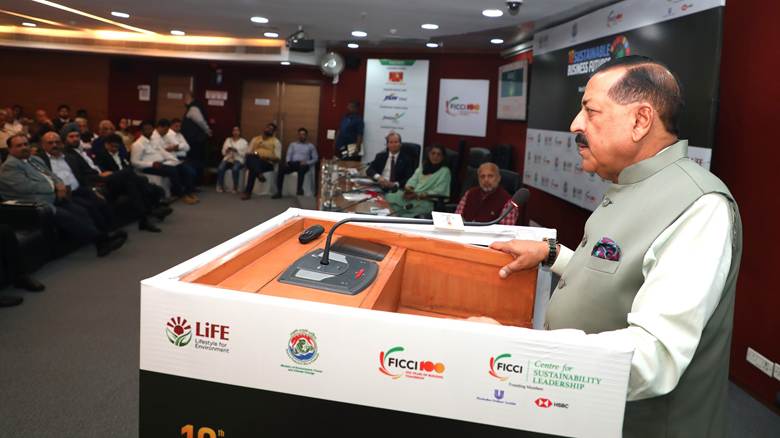
India, home to nearly 1.4 billion people, holds a pivotal role in the global transition towards a greener future, said Jitendra Singh, Union Minister of State (Independent Charge) for Ministry of Science and Technology and Ministry of Earth Sciences, while addressing the 10th Sustainable Business Futures Summit 2026.

The minister said that India stands at a decisive stage in the global shift towards a green economy, and its development trajectory will significantly influence the success of worldwide sustainability efforts.

“With a large share of the world’s population, India’s progress will play a critical role in shaping the outcome of the global green transition,” he said, adding that the country now has both an opportunity and responsibility to emerge as a leading driver of sustainable development powered by clean energy and green technologies.

India’s 1.4 Billion People Key to Global Green Transition; Green Infrastructure to Drive Growth: Jitendra Singh

Green Infrastructure as Growth Engine

Highlighting the country’s future growth strategy, Singh said green infrastructure will be a central pillar of India’s economic expansion in the coming decades. According to him, the global economy is increasingly moving towards recycling, regeneration and environmentally sustainable technologies, and India is aligning its development pathway with these priorities.

He noted that India’s economic journey over the past decade has been marked by a strong expansion of its innovation ecosystem. The country now hosts over two lakh startups, placing it among the world’s leading startup ecosystems.

Notably, nearly half of these startups are emerging from Tier-II and Tier-III cities, indicating a significant shift in entrepreneurial activity beyond traditional metropolitan hubs.

Clean Energy for Emerging Technologies

The minister also emphasised the need for a robust clean energy ecosystem to support emerging sectors such as data centres and artificial intelligence, which require reliable and continuous energy supply.

In this context, Singh highlighted the significance of the SHANTI Act, describing it as a major reform that opens India’s nuclear energy sector to wider participation, including private players, and enables the expansion of clean and dependable power generation.

Integrated Approach to Green Transition

India’s approach to sustainability, Singh said, is based on an integrated strategy that combines technological innovation, economic growth and environmental protection.

This includes:

  • Development of next-generation energy systems

  • Advanced energy storage technologies

  • Flexible and digitally enabled power grids capable of integrating multiple energy sources such as solar, wind, nuclear and hydrogen

  • Climate modelling and risk analytics

  • Sustainable construction technologies

Net Zero and Sustainable Lifestyles

Referring to policy direction from Narendra Modi, Singh reiterated that India has committed to achieving net-zero emissions by 2070. He also highlighted the importance of the Lifestyle for Environment (LiFE) initiative, which promotes sustainable consumption and environmentally responsible lifestyles.

According to the minister, this reflects India’s broader vision of inclusive and responsible growth aligned with global environmental priorities.

Circular Economy and Collaborative Action

Singh also underscored the growing importance of circular economy practices, noting that innovative waste-to-wealth initiatives are helping redefine the concept of waste by converting it into economic and environmental value.

Looking ahead, he said future infrastructure development must prioritise climate resilience, sustainable urban systems, clean mobility solutions and water security, supported by collaboration between government, industry and research institutions.

“The era of working in silos is over,” Singh said, stressing that collective action and partnerships will be critical for achieving long-term sustainability and building a green future.

Empowering Panchayats: Inside the Latest Rs.1,789 Crore Rural Funding Push

The Union government’s recent release of over ₹1,789 crore in untied grants to rural local bodies across five states marks another step in strengthening grassroots governance in India. The funds, disbursed under the recommendations of the Fifteenth Finance Commission, will benefit Panchayati Raj Institutions (PRIs) and Rural Local Bodies (RLBs) in Chhattisgarh, Gujarat, Madhya Pradesh, Telangana and Maharashtra.

While the announcement appears routine—Finance Commission grants are released regularly—its broader significance lies in how these funds are reshaping fiscal decentralisation and accountability in India’s rural governance framework.

Strengthening the Fiscal Backbone of Panchayats

India’s Panchayati Raj system comprises more than 2.6 lakh Gram Panchayats, making it one of the largest grassroots governance networks in the world. However, many of these institutions historically struggled with limited financial autonomy and dependence on state governments.

Finance Commission grants have gradually become a crucial funding source for rural local bodies. The 15th Finance Commission recommended over ₹2.36 lakh crore for rural local bodies between FY 2021 and FY 2026, making it one of the largest fiscal transfers aimed directly at local governance.

The latest release of ₹1,789 crore reflects the Centre’s continued push to ensure that funds reach local institutions capable of delivering essential services and development works in villages.

Why Untied Grants Matter

A significant feature of this release is that it primarily consists of Untied Grants, which give local governments flexibility to address location-specific development needs.

Unlike centrally sponsored schemes that come with strict guidelines, untied funds can be used across the 29 subjects listed in the Eleventh Schedule of the Constitution, including rural infrastructure, local roads, agriculture support services, drinking water, sanitation, and community assets.

This flexibility is critical because rural development needs vary widely—from water management in drought-prone regions to sanitation infrastructure in densely populated villages.

Compliance-Driven Funding

Another key aspect of the grant release is that fund disbursement is tied to compliance and financial accountability.

The grants are recommended by the Ministry of Panchayati Raj and the Department of Drinking Water and Sanitation under the Ministry of Jal Shakti, and then released by the Ministry of Finance.

States receive funds in two installments each year, but only after meeting eligibility conditions such as:

  • Submission of utilisation certificates for previous grants

  • Completion of audits

  • Uploading development plans on digital governance platforms

  • Compliance with financial reporting systems

The fact that a portion of funds released in this cycle represents previously withheld installments highlights how the system is increasingly linking fiscal transfers to governance performance.

Regional Implications

Among the five beneficiary states, Madhya Pradesh and Gujarat received the largest shares, reflecting their large number of Panchayati Raj institutions.

In Chhattisgarh and Telangana, the grants will help support local governance in predominantly rural regions where Panchayats play a central role in delivering public services.

Meanwhile, the release of withheld funds to Maharashtra indicates improved compliance by local bodies that had earlier missed eligibility requirements.

Beyond Funding: Improving Service Delivery

Although Finance Commission grants are often seen as fiscal transfers, their impact goes beyond funding. The grants are designed to improve service delivery outcomes at the local level, particularly in areas such as sanitation, drinking water supply and rural infrastructure.

Tied grants, which accompany untied grants in the Finance Commission framework, focus specifically on water and sanitation services—two sectors where Panchayats have a direct implementation role.

This aligns with national programmes such as rural sanitation and drinking water initiatives, where local institutions are expected to manage and maintain assets over the long term.

The Bigger Governance Shift

The latest grant release also reflects a broader shift in India’s governance model toward decentralised development and digital transparency.

Over the past few years, digital platforms have been introduced to track Panchayat finances, planning and audits, making it easier for the Centre and states to monitor fund utilisation.

As a result, rural local bodies are gradually transitioning from being passive recipients of funds to accountable local governments responsible for planning and execution.

A Continuing Experiment in Decentralisation

India’s Panchayati Raj system has often been described as one of the most ambitious decentralisation experiments in the world. However, its success depends heavily on whether local institutions receive adequate financial resources and the capacity to use them effectively.

The latest Finance Commission grant release underscores the Centre’s commitment to strengthening this system—but it also highlights the growing emphasis on performance, compliance and accountability.

If implemented effectively, such fiscal transfers could help transform Panchayats into more responsive institutions capable of addressing the diverse development needs of rural India.