

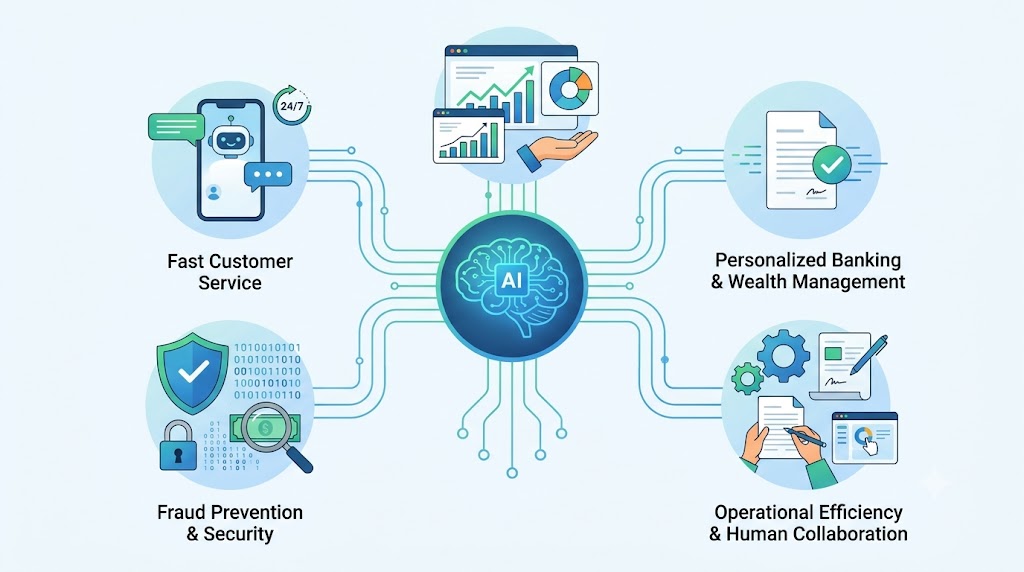
Artificial intelligence is changing the way financial institutions operate and how customers interact with their money. From instant banking assistance and faster loan processing to fraud prevention and personalised financial insights, AI is helping banks, lenders, insurers and investment firms rethink the way they deliver services.
For customers, the change is becoming increasingly visible. Tasks that once required lengthy paperwork, repeated phone calls or visits to a bank branch can now be completed through digital platforms with fewer steps. AI-powered systems can answer routine questions, identify unusual transactions and help customers understand their spending patterns.
For financial institutions, the opportunity goes beyond convenience. Automating repetitive work can improve operational efficiency, support faster decisions and allow employees to focus on more complex customer needs. However, as AI becomes more deeply integrated into financial services, concerns about data privacy, security, fairness and accountability are also growing.
The industry’s challenge is to use AI not simply to make financial services faster, but to make them more reliable, accessible and useful for customers.
AI Is Making Customer Service Faster and More Convenient
Customer expectations have changed significantly as digital banking has become more common. People increasingly expect immediate access to account information, quick answers to payment-related questions and convenient ways to resolve everyday problems.
AI-powered chatbots and virtual assistants are helping financial institutions meet these expectations. Using natural language processing, they can respond to common questions about transactions, account services, card payments and application procedures.
Unlike conventional support systems limited by business hours, AI assistants can provide basic information around the clock. They can also guide customers through digital banking services and direct more complicated requests to the appropriate department.
For banks, this can reduce the time employees spend handling repetitive enquiries. For customers, it can mean less waiting and easier access to routine services.
However, financial questions are not always straightforward. Disputed transactions, loan difficulties and suspected fraud may require careful investigation and human judgement. AI-powered support works best when customers can easily reach a trained representative whenever automated assistance is insufficient.
Personalised Banking Is Changing Customer Relationships
AI is helping financial institutions move towards services that reflect individual customer needs rather than offering identical recommendations to everyone.
By analysing relevant transaction data and spending patterns, AI systems can identify recurring expenses, highlight changes in spending and provide reminders about upcoming payments. Some applications can help users organise budgets, monitor savings goals and understand where their money is going.
These features can make financial management more accessible, particularly for customers who want greater control over their household budgets but do not regularly consult a financial adviser.
Personalisation also creates opportunities for banks to improve customer engagement by presenting relevant services at appropriate times. Yet there is an important distinction between helping customers manage their money and encouraging them to purchase additional financial products.
Recommendations must be relevant, transparent and suitable for the customer’s circumstances. Financial institutions also need to protect sensitive information and follow applicable data protection requirements.
When used responsibly, AI can help customers make better-informed decisions without making financial management unnecessarily complicated.
Faster Loan Processing Could Improve Access to Credit
Loan applications traditionally involve several stages, including identity checks, document verification, income assessment and credit evaluation. When these processes depend heavily on manual work, applications can take longer to complete.
AI can help lenders automate parts of this process by extracting information from documents, identifying missing details and supporting the assessment of credit applications. This can reduce repetitive administrative work and allow employees to focus on applications that require additional scrutiny.
For customers, the potential benefits include fewer delays, a smoother application process and quicker decisions. For lenders, improved processing can help manage larger application volumes without increasing administrative workloads at the same pace.
AI may also support the assessment of applicants with limited conventional credit histories, provided the information used is reliable, relevant and permitted under applicable rules.
However, automated decisions must not become a substitute for responsible lending. If a model relies on biased data or makes decisions that cannot be adequately explained, deserving applicants could be unfairly excluded.
Financial institutions must test their systems, monitor lending outcomes and maintain appropriate review procedures. Faster credit decisions are valuable only when they remain fair, accurate and responsible.
AI Is Strengthening Fraud Detection and Financial Security
As digital payments and online banking expand, financial fraud remains a major concern for consumers and institutions. Fraudsters continually adapt their methods, making it difficult for traditional rule-based systems to identify every suspicious activity.
AI can strengthen transaction monitoring by examining large volumes of data and detecting patterns that differ from normal behaviour. Systems may flag unusual transaction amounts, unexpected payment frequency or suspicious combinations of account and device signals.
When potential fraud is identified, financial institutions can request additional authentication, flag transactions for investigation or take other appropriate security measures.
This ability to process information rapidly can help banks respond to potential threats more effectively. It can also help fraud teams prioritise cases that require immediate attention.
Nevertheless, AI systems are not infallible. Legitimate payments can be incorrectly flagged, while sophisticated fraudulent activity may go undetected. Financial institutions must continually evaluate their systems and make it straightforward for customers to resolve false alerts.
Combining AI-based monitoring with strong authentication, cybersecurity practices and human investigation can provide a more balanced approach to protecting financial transactions.
Generative AI Is Transforming Financial Operations
Beyond customer-facing services, generative AI is creating new possibilities for the internal operations of financial institutions.
Banks and insurance companies handle large volumes of contracts, policy documents, customer communications and regulatory information. Reviewing and organising these materials can consume considerable employee time.
AI tools can assist with document summaries, internal research, information retrieval, initial report preparation and the organisation of compliance-related material. Employees may be able to find relevant information more quickly instead of manually searching through lengthy documents.
These applications can improve productivity, but they require proper supervision. AI-generated content can contain errors, overlook important details or produce misleading summaries. Confidential customer and financial information must also be protected.
Financial institutions need clear policies governing the use of AI, including which data can be processed, how outputs are verified and who remains responsible for the final decision.
The goal should be to help employees work more effectively rather than allow automated systems to make important decisions without appropriate oversight.
AI Is Changing Investment and Wealth Management
Investment and wealth management firms are also exploring AI to improve research, analyse portfolios and monitor financial risks.
AI systems can process large amounts of market information, compare investment scenarios and identify patterns that analysts may want to investigate further. Wealth managers can use these tools to prepare client reports, explain portfolio performance and evaluate whether an investment strategy remains aligned with a customer’s objectives.
For individual investors, digital platforms can make financial information easier to understand and provide convenient access to portfolio insights. These tools may help people engage more actively with their finances.
However, investment decisions involve uncertainty. Market conditions can change rapidly, and patterns identified in historical data may not continue. AI-generated insights can also be incomplete or based on incorrect assumptions.
Financial institutions must communicate these limitations clearly. AI can support investment analysis, but it cannot guarantee returns or eliminate market risk. Significant financial decisions still require careful assessment of individual goals, risk tolerance and financial circumstances.
Agentic AI Could Bring the Next Wave of Financial Automation
The development of agentic AI is creating interest across the financial services industry. Unlike systems designed primarily to answer questions or generate content, agentic systems can be designed to complete multiple steps towards a defined objective.
Potential applications include gathering documents for an application, preparing financial summaries, coordinating internal workflows and assisting with routine account-related tasks.
In the future, more advanced systems may help customers organise payments or manage selected financial activities within clearly defined limits. Such capabilities could reduce manual effort and make digital services more convenient.
However, allowing an AI system to initiate a financial transaction carries greater risk than using one to provide information. Strong authentication, explicit permissions, transaction limits and detailed audit trails are essential. High-impact actions may also require human approval.
Financial institutions will need to demonstrate that these systems can operate reliably before extending their authority over sensitive financial activities.
The Cost of AI Adoption and the Need for Responsible Innovation
Despite its potential, AI adoption requires investment in technology, data infrastructure, cybersecurity and employee training. Integrating new systems with older banking platforms can be difficult, while maintaining accuracy and reliability requires continuous monitoring.
Financial institutions must also address the risks of algorithmic bias, data leakage, cyberattacks and inaccurate AI-generated information. A flawed automated decision can affect a customer’s access to credit, financial security or confidence in the institution.
These concerns make governance an essential part of AI adoption. Banks and other financial businesses need clear accountability, regular testing and procedures for investigating errors and complaints.
They should also evaluate whether AI is delivering measurable improvements. Faster service, fewer processing errors, lower fraud losses and better customer satisfaction are more meaningful indicators of success than the number of AI tools deployed.
A responsible approach can help institutions capture the benefits of automation without compromising customer interests.
The Future of Financial Services Will Depend on Trust
Artificial intelligence is opening new possibilities across banking, lending, insurance and investment management. It can make everyday transactions more convenient, help financial institutions detect suspicious activity and improve the speed at which information is processed.
Yet technology alone will not determine which businesses succeed. Customers must have confidence that their personal information is protected, their financial needs are understood and important decisions are made fairly.
Financial institutions that combine AI with transparent communication, strong security and human oversight will be better positioned to build lasting customer relationships.
Ultimately, the future of AI in financial services is not just about automating tasks or reducing costs. It is about creating a financial system that responds more effectively to customer needs while preserving the reliability and trust on which the industry depends.
