embedUR systems Develops Edge AI Solution on NXP Platform to Advance Automotive Sensing Technology

India – June 06th 2025 – embedUR systems, a leader in embedded software and Edge AI solutions, has developed an Ultra-Wideband (UWB) Sensing Edge AI solution with NXP® Semiconductor’s Trimension™ NCJ29D6 platform. This technology powers gesture-based control, such as hands-free trunk opening for cars, and extends to advanced sensing applications in automotive and beyond.


NXP’s Trimension NCJ29D6 is a fully integrated, low-energy UWB transceiver IC designed for secure ranging and radar applications in automotive environments. It supports Digital Key functionality for seamless, hands-free vehicle access while also enabling radar-based applications, such as Child Presence Detection (CPD) and kick-sensing for easy trunk access. By leveraging ranging and radar capabilities in a single chip, the Trimension NCJ29D6 maximizes system value and reduces overall cost.

embedUR systems optimized a lightweight and efficient UWB Gesture and Motion Recognition Model to work with NXP’s Trimension NCJ29D6, allowing for real-time gesture detection at a compact model size of just 215 KB.

Enhancing Experiences with UWB AI

This UWB-powered AI model allows for intuitive, touch-free vehicle interactions, and enables new affordable opportunities all running on the Edge, such as:

  • Touch-Free Trunk Opening – Open the trunk with a wave of a hand or foot.
  • Parking Assistance – Start/stop automated parking maneuvers using gestures.

Beyond automotive, this technology can be adapted for consumer electronics, industrial automation, and smart home applications, enabling touch-free user interactions across multiple industries.

Optimized AI for UWB Sensing Applications

embedUR systems specializes in embedded AI on the Edge, model optimization, and real-time processing on power-efficient, low-memory edge devices. The combination of secure ranging and radar support in the Trimension NCJ29D6 provides a unique foundation for advanced AI-driven sensing applications. By leveraging this platform, embedUR delivers robust and efficient UWB gesture recognition for a range of use cases.

“With our expertise in embedded AI and UWB technology, we are delivering practical, hands-free interaction solutions that enhance safety and convenience,” said Eric Smiley, VP of Business Development at embedUR systems. “This project demonstrates how UWB, combined with optimized Edge AI models, can help create advanced sensing applications for automotive and beyond.”

Michael Leitner, General Manager, Secure Car Access at NXP Semiconductors, confirms: “The knowledge of embedUR in wireless sensing and efficient implementation of data processing on edge devices positions embedUR to fully leverage the capabilities of our Ultra-Wideband (UWB) devices. EmbedUR demonstrated very positive results in UWB-based gesture sensing and we are looking forward to further applications that embedUR is able to address based on our UWB IC.”

Driving Edge AI Acceleration

With over two decades of expertise in embedded systems and wireless technologies, embedUR has delivered AI-powered solutions across automotive, industrial, and IoT markets. embedUR has developed a range of Edge AI applications, such as a real-time image segmentation model running on an Arm® Cortex®-M7 at under 300 KB and deployed facial recognition AI pipelines on a low-power edge device with <1MB memory footprints. embedUR’s engineers routinely optimize AI models to fit within 200–500 KB, enabling real-time inference on power and memory efficient platforms without sacrificing accuracy. This proven track record in model compression, quantization, and efficient runtime integration positions embedUR to help customers accelerate development cycles, meet strict power/memory budgets, and bring next-generation products to market faster.

Regulating the Game: India’s Journey Towards Safer Online Gaming

India’s online gaming sector is booming. What started as light entertainment has now become part of millions’ daily routines. But with scale comes responsibility. And the question the industry is now asking itself is: how do we grow while also protecting the player?

From thoughtful product design to fairness frameworks, the online gaming space – particularly in skill-based games – is shifting towards a more mindful, responsible future. Platforms are integrating fairness tools like RNG certification and anti-bot measures to ensure trust and transparency. Gaming platforms such as Zupee, exemplify this shift by offering short, skill-based games that promote cognitive skills and social interaction.

  • Time-Limited Play That Respects a Player’s Life

One of the smartest interventions in gaming today is also one of the simplest: time limits. Platforms are intentionally designing games that end in under 10 minutes – just enough for a quick burst of fun, without the risk of long hours. This matters more than ever in a world where screen time is easy to lose track of.

Games like time-bound Ludo or card-based strategy games allow users to play at their convenience – during a break, while commuting, or winding down – without compromising their day. It’s a quiet but important shift that helps players stay in control.

  • Designing for Trust: Fair Play Isn’t a Feature, It’s the Foundation

In real money gaming, fairness isn’t a luxury – it’s the baseline. Today’s top platforms are building that trust through tools like RNG (random number generation) for unbiased outcomes, third-party audits, and blockchain-led verification systems.

Zupee, for example, has doubled down on transparency with both RNG certification and robust anti-bot protections – ensuring players know they’re always up against real people and fair odds. When users feel confident in the process, they’re more likely to play with a clear, healthy mindset.

  • Games That Ask You to Think, Not Just Tap

There’s a common misconception that mobile gaming is mindless. In reality, skill-based games often require quick thinking, risk assessment, and emotional control. Take Ludo – not the version from your childhood but its competitive, timed counterpart. You’re weighing probability, reading the opponent, and adjusting strategy on the fly.

This kind of play quietly builds cognitive skills. Players aren’t just reacting – they’re planning, learning, and growing. For many, that’s the real reward.

  • Social Play, Real Skills

The best games don’t just entertain – they teach you how to lose, how to wait your turn, and how to stay calm when you’re one move away from winning. Multiplayer formats create an unexpected space for sportsmanship. You learn how to compete without taking it personally, and how to reconnect with others through a shared childhood game – just with a modern twist.

It’s part nostalgia, part life lesson. And in an age where digital spaces often feel isolating, these small but meaningful interactions matter.

  • Regulation and Responsibility Are Now Part of the Game Plan

It’s no longer enough to be popular. Platforms are now being held to higher standards by both users and regulators. We’re seeing the rise of self-regulatory frameworks, increased transparency around taxation, and serious conversations about how to differentiate games of skill from games of chance.

Many operators, including those in the casual and board game segment, have embraced this shift – not just for compliance but as a long-term investment in industry credibility. That includes certifications from recognized bodies, regular audits, and an active push toward safer, more inclusive gaming environments.

  • The Bottom Line

Gaming isn’t just about play anymore – it’s about responsibility. As the industry grows, the leaders won’t be the ones chasing downloads. They’ll be the ones designing for trust, mental well-being, and genuine connection. Responsible gaming isn’t a checkbox. It’s the future.

Revolutionizing Content Creation with AI-Driven Tools in 2025

AI is now a key tool that makes content creation much easier in this digital era. Because of AI, creators can make great visuals, whether photographic or filmed, more quickly and effectively than ever before. One breakthrough in image creation is the development of AI generators, which help everyone create high-quality images without advanced tech abilities.

AI Image Generators: Transforming the Creative Process

AI is used more and more by digital artists, social media managers and marketers to create images. With the help of deep learning, these tools generate both realistic and abstract images, art and designs from just a few words of input. As a result, photo creators can quickly produce top-quality images for use on websites, blogs, social media networks and other platforms, without spending a lot on software.

One of the best tools in the field is the Free AI Image Generator from Magic Hour AI. Because of this tool, anyone can easily produce attractive visuals which is very helpful for people who need unique images. It doesn’t matter if you’re blogging, creating ads or just experimenting with images; this tool helps you make accurate and creative images.

Elevating Video Editing with AI

It’s not just about creating still images with AI; it’s also changing video editing. Before, traditional editing needed plenty of time and practice, but with AI, the process is often computerized. It is now easier than before to improve videos because AI manages scene transitions and color correction.

AI can go through your video, highlight important parts and even recommend changes that fit with the video’s theme or reason for making it. It is especially convenient for those creating large amounts of video content who still aim for the best results.

The Future of Content Creation: AI as a Creative Partner

As AI keeps improving, creating all kinds of content becomes more possible. Many people depend on AI for enhancing pictures, videos and even for making fresh illustrations. Artists can try new concepts, experiment with different tools and simplify their production methods.

Over the next few years, we may see new AI tools that give us better control over how we create music. People who want to lead in the industry should learn about existing AI tools and see how AI can aid their work.

Magic Hour AI offers a Free AI Image Generator that makes it possible for anyone to create many types of images. No matter if you’re an expert or just starting in design, this AI image generator makes it easy for you to visualize what you imagine.

Conclusion

With AI, people without special technical qualifications can access content-creation applications that were previously only for industry experts. Thanks to AI for image creation and online video editors, it’s possible now for content creators to impress their audience with better-looking materials like never before. Developments in AI technology indicate that content creation will expand, giving those who adapt lots of new opportunities.

Engineering a Secure Tomorrow: Cybersecurity Careers on the Rise

By-Er. Koneru Lakshman Havish, Vice President, KL Deemed to be University

Cybersecurity has become an important concern for businesses, governments, and individuals. With the increasing reliance on digital platforms and the surge in cyber threats, there is a growing demand for cybersecurity professionals. Aspiring engineers looking to make their mark in a dynamic and rewarding field should consider cybersecurity as a promising domain. This article explores the importance of cybersecurity, the skills required, and the opportunities it offers to engineers.

What is Cybersecurity?

Cybersecurity refers to the practice of protecting systems, networks, and data from digital attacks, thefts, and damage. The goal is to ensure the confidentiality, integrity, and availability of information and resources. As organizations and individuals become more connected through the internet, the risk of cyberattacks such as hacking, phishing, and data breaches continues to rise. Cybersecurity professionals play a crucial role in preventing, detecting, and mitigating these threats.

Why is Cybersecurity a Thriving Domain?

The growing threat of cybercrime has made cybersecurity a thriving domain for engineers. The reasons are as follows:

  1. Increase in Cyber Threats: With the rise of sophisticated cyber-attacks, businesses and organizations are investing heavily in cybersecurity to protect their data and infrastructure. This has created a significant demand for skilled professionals.
  2. Pervasiveness of Technology: As industries such as finance, healthcare, and retail embrace digital transformation, the need for robust security systems grows. The Internet of Things (IoT) and cloud computing have further expanded the potential attack surfaces, making cybersecurity even more essential.
  3. High Demand for Skilled Professionals: According to industry reports, the cybersecurity workforce gap is widening, creating numerous opportunities for engineers. The shortage of qualified professionals has made it one of the fastest-growing sectors in the technology industry.
  4. Lucrative Salaries and Job Stability: The demand for cybersecurity professionals has led to high salaries and job stability. As the risks of cyberattacks escalate, organizations are willing to offer competitive pay and benefits to attract talents.

Skills Required for a Career in Cybersecurity

Aspiring engineers looking to pursue a career in cybersecurity need to develop a diverse set of skills. These include both technical and soft skills. Some essential skills for cybersecurity professionals include:

  1. Technical Knowledge: Engineers should have a strong understanding of networks, operating systems, and cryptology. Familiarity with protocols like TCP/IP, DNS, and HTTP, as well as knowledge of firewalls, VPNs, and intrusion detection systems (IDS), is highly essential.
  2. Programming Skills: A deep understanding of programming languages such as Python, Java, and C is beneficial for developing security tools, automating tasks, and analysing vulnerabilities. Knowledge on Kali Linux, and Caine will be very essential too.
  3. Problem-Solving Abilities: Cybersecurity professionals need to think critically and creatively to solve complex security issues. Engineers must be able to identify vulnerabilities, anticipate potential threats, and respond to incidents promptly.
  4. Knowledge of Cybersecurity Tools and Frameworks: Familiarity with security tools such as Wireshark, Metasploit, and Nessus, along with industry frameworks like NIST and ISO/IEC 27001, can give engineers a competitive edge in the field.
  5. Continuous Attention and Patience: Cybersecurity requires a high level of continuous attention to analyse the indicators of a potential breach. Engineers must be thorough when reviewing systems and logs to detect vulnerabilities.
  6. Soft Skills: Strong communication, teamwork, and leadership skills are essential, as cybersecurity professionals often work in collaborative environments and must effectively convey technical information to non-technical stakeholders.

Educational Pathways for Aspiring Engineers

Aspiring engineers can pursue various educational pathways to enter the cybersecurity domain. Here are a few steps they can take:

  1. Bachelor’s Degree in Engineering or Computer Science: A solid foundation in engineering or computer science provides the necessary knowledge for a career in cybersecurity. Courses in networking, operating system, data structures, and algorithms are fundamental to understanding cybersecurity concepts.
  2. Specialized Cybersecurity Programs: Many universities and institutions offer specialized programs in cybersecurity. These programs cover topics such as ethical hacking, cryptography, network security, Digital forensics, and security governance.
  3. Certifications: In addition to formal education, certifications can enhance an engineer’s qualifications and make them more attractive to employers. Popular certifications include CompTIA Security+, Certified Information Systems Security Professional (CISSP), Certified Ethical Hacker (CEH), and Certified Information Security Manager (CISM).
  4. Internships and Hands-on Experience: Gaining practical experience through internships, personal projects, or open-source contributions is invaluable for aspiring engineers. Hands-on experience helps engineers understand real-world challenges and develop the skills required to tackle them.

Career Opportunities in Cybersecurity

Cybersecurity offers a wide range of career opportunities for engineers, from technical roles to leadership positions. Some of the common career paths include:

  1. Security Analyst: Security analysts monitor systems for potential threats and ensure that security protocols are followed. They may also be responsible for responding to security incidents and conducting risk assessments.
  2. Ethical Hacker (Penetration Tester): Ethical hackers test the security of systems by simulating cyber-attacks to identify vulnerabilities. They help organizations strengthen their defences before malicious hackers can exploit weaknesses.
  3. Security Architect: Security architects design and implement secure network systems. They work closely with other departments to ensure that security measures are integrated into every aspect of the organization’s technology infrastructure.
  4. Incident Responder: Incident responders are responsible for managing and mitigating the impact of security breaches. They work to contain the breach, investigate its cause, and prevent future occurrences.
  5. Chief Information Security Officer (CISO): The CISO is a senior executive responsible for overseeing an organization’s cybersecurity strategy. They ensure that the organization’s security measures align with its business goals and regulatory requirements.

Conclusion

Cybersecurity is a preferred domain that offers numerous opportunities for aspiring engineers. As technology continues to evolve and cyber threats become more sophisticated, the demand for skilled cybersecurity professionals’ increase. Engineers with the right technical skills, certifications, and practical experience can embark on a rewarding career in cybersecurity, contributing to the protection of critical infrastructure and classified information. With job stability, lucrative salaries, and the chance to work on cutting-edge technologies, cybersecurity presents an exciting and fulfilling career path for the next generation of engineers.

Operant AI Launches Woodpecker to Open Source Automated Security Testing

Bengaluru, May 22 2025, Silicon Valley-headquartered Operant AI, has launched Woodpecker, an open-source, automated red teaming engine, that will make advanced security testing accessible to organisations of all sizes. Woodpecker is designed to help organizations proactively detect and address security vulnerabilities across AI systems, Kubernetes environments, and APIs. 

Red teaming is a simulated cyberattack used to test and improve an organization’s cybersecurity readiness. It involves ethical hackers emulating real-world adversaries to uncover vulnerabilities and assess how effectively defenses can detect, respond to, and mitigate threats. Traditionally, such sophisticated security testing is reserved for large enterprises with dedicated security teams. Red teaming has now become increasingly vital for organizations of all sizes—especially as modern infrastructure grows more complex with the rise of cloud-native applications and AI technologies.

According to the IBM X-Force Threat Intelligence Index 2025, AI-related vulnerabilities have become a critical concern for security teams, driven by the rapid adoption of Large Language Models (LLMs) and automated agents across enterprise environments. Notably, the Asia Pacific region accounted for over one-third of global cyberattacks in 2024, underscoring the urgent need for proactive defense. 

Red Teaming for all

“Security vulnerabilities don’t discriminate based on an organization’s size or resources, we believe red teaming should not be a privilege for a few, it should be a foundational practice for all,” said Vrajesh Bhavasar, CEO and co-founder of Operant AI. “With Woodpecker, we’re leveling the playing field by providing enterprise-grade red teaming capabilities in an open source solution that any organization can deploy. Security testing at this depth should be a universal right, not a privilege reserved for those with the largest security budgets.”

Woodpecker is built for today’s GenAI world

Threats such as prompt injection, data poisoning, and model leakage continue to rise, yet only 24% of generative AI projects are currently secured, according to the IBM report.  The DSCI–Seqrite India Cyber Threat Report 2025 also underscores the growing complexity of attacks, with 62% of malware detections occurring in cloud environments. Advanced threats like BlackMamba, a generative AI-powered malware that rewrites its code on the fly, are already bypassing traditional defenses—targeting critical sectors such as healthcare and BFSI.

Woodpecker is purpose-built to address these modern threats targeting AI applications, cloud APIs, and Kubernetes environments and is designed to mimic how real attackers operate across multiple layers of infrastructure.

“Secure AI applications like Cohere’s North demand rigorous testing across complex components. Woodpecker simplifies this with open-source red teaming, enabling early vulnerability detection and encouraging secure AI adoption,” said Prutha Parikh, Head of Security at Cohere and board member at the Coalition for Secure AI.

Woodpecker provides automated red teaming capabilities across three critical domains:

  1. Kubernetes Security: Identifies misconfigurations, privilege escalations, and vulnerable deployment patterns within container orchestration environments.
  2. API Security: Simulate various attack scenarios to uncover vulnerabilities in API endpoints, authentication mechanisms, and data handling processes.
  3. AI Security: Tests machine learning models and AI systems for prompt injection, data poisoning, and other emerging AI-specific attack vectors.

“The era of reactive security is over, especially with the rise of LLMs and AI agents in live applications,” asserted Dr. Priyanka Tembey, Operant’s co-founder and CTO. “Woodpecker puts the power of proactive red teaming directly into the hands of developers, allowing them to rigorously test and secure their environments against emerging threats before they materialize.”

Key Features of Woodpecker:

  • Red Teaming Across Kubernetes, APIs, and AI Workflows
      • Red Teams for K8s, APIs, and AI Models/Agents
      • Multi-layer Threat Simulation across runtime, APIs, and LLM integrations
  • Automated LLM Red Teaming
      • Covers prompt injection, jailbreaks, model theft, sensitive data leakage and more
      • Uncover vulnerabilities by testing malicious prompts originating from both adversarial and typical users.
      • Test output manipulation and filtering evasion
  • Compliance Mapping for regulatory Frameworks
      • Covers across threat vectors for OWASP top 10 for K8s, API and AI, MITRE ATLAS and NIST
    • Open-Source and Free
      • Benefit from a powerful red teaming tool without licensing fees, fostering widespread adoption.
  • Easy Integration
    • Seamlessly integrate Woodpecker into existing security workflows and CI/CD pipelines.

Operant’s Woodpecker is now available as an open source project on https://github.com/OperantAI/woodpecker. Operant invites security engineers, developers, and the open-source community to explore, contribute, and help advance the future of proactive cybersecurity.  As part of the launch, Operant will also host hackathons and developer engagement programs in India, alongside community collaborations with the Coalition for Secure AI (CoSAI), where the company is an active member. For more information on Woodpecker visit https://www.operant.ai/solutions/woodpecker-red-teaming

With the launch of Woodpecker, an open-source and easy-to-use platform, Operant is democratizing advanced security testing accessible to every organization, regardless of their size or expertise. Woodpecker already simulates >50% of OWASP top 10 threats across APIs, Kubernetes, and LLMs, exceeding the threat simulation scope of leading commercial red teaming products. Woodpecker enables security teams, developers, and DevOps professionals to proactively identify vulnerabilities and build more resilient applications, without the cost and complexity of traditional solutions.

SHRM Tech 2.0 2025 Kicks Off with Powerful Conversations on AI, Human Potential and the Future of Work

Mumbai, 21 May 2025 : The much-anticipated SHRM Tech 2.0 2025 commenced today in Mumbai with a powerful opening that brought together some of the most influential voices in business, HR, and technology. Hosted by the SHRM India (Society for Human Resource Management), the event is set to shape the future of the workplace through high-impact discussions, innovation showcases, and leadership insights.

A powerful opening segment set the tone for the transformative event. In her welcome address, Achal Khanna, CEO – SHRM India, MENA & APAC, emphasized the need for a human-centred approach to digital transformation, and said, “SHRM Tech is not just a platform for conversations – it’s a launchpad for action. As we step into a future powered by AI and human ingenuity, we must focus on trust, purpose, and adaptability. Limitless possibilities unfold when people and technology come together to lead change. People influence the global growth, we influence the people”.  

Some of the keynote speakers like Zarin Daruwala, Former Cluster CEO – India & South Asia, Standard Chartered Bank, Richard Rekhy, Vice Chair, Grant Thornton Bharat & Former CEO, KPMG India, Dr. Praveer Sinha, CEO & Managing Director, The Tata Power Company delivered thought-provoking perspectives.

Day 1 at SHRM Tech 2.0 2025 featured a series of dynamic panel discussions that tackled some of the most pressing themes in the world of work. Experts delved into topics exploring AI’s impact on talent acquisition, from building high-intent pipelines with employer branding to enhancing hiring decisions through smart assessments. With agentic AI, culture personalization, and inclusive leadership beyond performative I&D, the focus remains human-centric. Ultimately, it’s about blending speed, ethics, and trust to empower delegates with actionable insights and tools to drive change in their organizations.

The vibrant Tech Expo and Start-Up Zone saw 90+ solution providers showcase next-gen HR technologies—ranging from AI-powered recruitment bots to immersive L&D platforms—drawing attention from CHROs, talent leaders, and investors.

Building on the momentum of an inspiring first day, Day 2 of SHRM Tech 2.0 2025 promises to deliver deeper insights and future-forward thinking. The day will feature a high-impact sessions by Andy Biladeau, Chief Transformation Officer, SHRM; Pranjal Sharma, Economic Analyst, Advisor & Author, The Next New; A. Balasubramanian, Managing Director & CEO, Aditya Birla Sun Life AMC; Puneet Chandok, President, Microsoft India & South Asia & several other illustrious names from industry. These experts will dive into pressing themes including data ethics, redefined leadership, and building adaptive, digitally resilient organizations. The thought-provoking sessions will herald a vibrant Workplace 2.0—where recognition, roles, and resilience evolve through AI, leadership, and culture in concert, not conflict.

With over 2,000+ delegates, 150+ speakers, and 100+ partners, SHRM Tech 2025 has set the stage for workplace transformation at scale.

VergeCloud Launches L4 Gateway Pro: Real-Time Traffic Control for Gaming, Fintech, and IoT

Bangalore, 20 May, 2025: VergeCloud, India’s fast-growing CDN and edge infrastructure provider, today announced the launch of L4 Gateway Pro, a powerful Layer 4 proxy solution that gives developers full control over network layer with unmatched performance, security, and flexibility.

Built for low-latency, high-concurrency applications, L4 Gateway Pro empowers businesses to handle real-time workloads — from multiplayer gaming and live trading systems to VoIP and IoT platforms — with ease.

Feature Highlights:

  • Full support for TCP traffic routing
  • Firewall rules for protocol-level access control
  • Load balancing with health checks and failover
  • Support Different Proxy protocols for preserving client IPs
  • Multi-domain and subdomain configurations
  • Integrated DDoS protection at the transport layer
  • Transparent Proxy Mode (Non-Terminating)

“With L4 Gateway Pro, we’re giving developers a simple way to manage raw TCP connections at the edge,” said Dheeraj Chaudhary, Director of Technology at VergeCloud. “Whether you’re running high-frequency financial apps or real-time multiplayer games, you need predictable routing and deep control — and we deliver that with firewall rules, load balancing, and more.

This solution is designed to support a wide range of demanding applications across industries. For gaming platforms, it ensures lightning-fast, lag-free gameplay and smooth voice communication, keeping players fully immersed. Fintech and trading applications benefit from secure and seamless data flow through advanced load balancing and DDoS protection. In IoT networks, it efficiently manages millions of connected devices with intelligent traffic control and secure access mechanisms. Lastly, for VoIP and real-time applications, it delivers crystal-clear call quality and real-time performance, supported by robust monitoring and built-in security features. For high-security websites and services that require L3/L4 DDoS protection without compromising SSL/TLS key control, L4 Gateway Pro offers transparent proxying modes, allowing full protection at the network layer while leaving TLS termination at the customer’s infrastructure.

This is ideal for banks, crypto platforms, and regulated industries, ensuring maximum privacy and compliance while keeping their services safe from volumetric attacks.

L4 Gateway Pro is now available to all Professional and Enterprise plan users. Developers can deploy and manage configurations directly from the VergeCloud dashboard or API.

COLORFUL Redefines Innovation with Stunning Showcase at COMPUTEX 2025

Mumbai, India, May 17th, 2025 – Colorful Technology Company Limited, a leading brand in gaming PC components, gaming laptops, and HiFi audio products, proudly announces its joint booth showcase at this year’s COMPUTEX in partnership with Segotep. Segotep is a leading brand specializing in PC cases, power supplies, peripherals, and cooling solutions.

The booth will be divided into six major themed areas, offering visitors a comprehensive look into COLORFUL’s latest innovations. Highlights include dedicated zones for motherboards and graphics cards, SSD storage, custom MOD builds, immersive gaming experiences, and laptops — all designed to deliver cutting-edge technology and interactive engagement for PC enthusiasts and gamers alike.

Upgraded iGame Neptune Series PC

The new iGame Neptune all-in-one chassis introduces a groundbreaking cooling design by stacking the radiators for the CPU and GPU. sandwich. This layout not only enhances the visual appeal by creating a compact dual 360mm radiator cooling system that promotes a more unified, streamlined build. The design aims to deliver an aesthetically clean and functionally efficient experience for high-performance PC enthusiasts.

To improve cooling under heavy workloads, the GPU radiator pivots outward. This prevents direct overlap of the air ducts and reduces internal heat buildup, ensuring stable temperatures and optimal performance over extended sessions.

At the core of this flagship setup is the iGame Z790D5 Neptune motherboard paired with a specially selected Intel Core i9-14900K (SP100+) processor. The bundle also includes a premium 2TB M.2 SSD and a fully modular iGame 1250W Gold power supply with the latest ATX 3.1 and PCIe 5.1 standards. Packaged in a high-end metal aviation case, the product offers a complete top-tier experience, including white-glove door-to-door installation service for the ultimate convenience. Completing the new iGame Neptune gaming PC, it is equipped with the iGame GeForce RTX 5080 Neptune OC graphics card.

New Ultra Series PC

cful 3

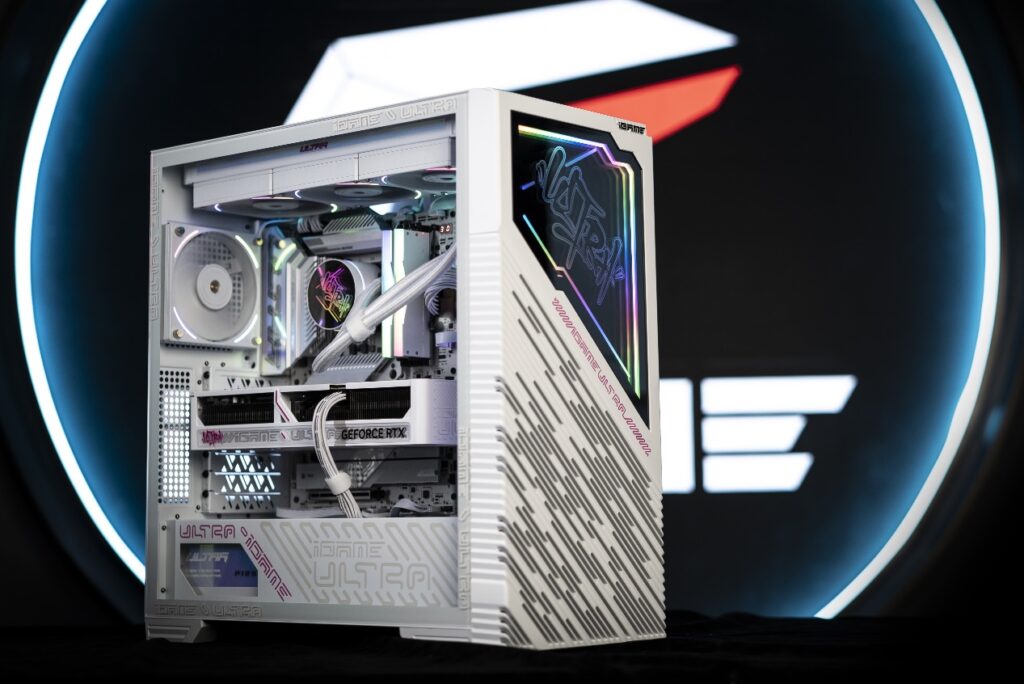
Complementing the launch of the 50 Series Ultra graphics cards, the chassis has also received an upgrade. Featuring a bold new look, the case is styled with a vibrant Ultra graffiti-style logo that reflects the spirit of the Ultra product line. Paired with the latest iGame LQ360 Ultra W 2025 cooler, which also sports the same graffiti-inspired design, the setup delivers both high-performance cooling and eye-catching aesthetics for gamers who want their rig to stand out.

COLORFIRE MEOW Series PC

c4

The MEOW Series chassis by COLORFIRE blends nostalgic charm with contemporary PC design, drawing inspiration from the timeless look of retro game consoles. Its sleek white-and-orange color palette and handheld console-style front panel transport users back to the golden age of gaming from the ’80s and ’90s.

The COLORFIRE MEOW Series features a charming pet-inspired design with playful Bobi cat graphics and paw print details. Its cozy, cat bed–like interior adds personality and warmth, making it ideal for gamers and creators who value both style and performance.

The new MEOW Series PC features a Bobi-themed micro-ATX chassis measuring 470x244x370mm – equipped with the COLORFIRE B650M MEOW WIFI motherboard and new COLORFIRE GeForce RTX 5060 Ti MEOW-ORG 16GB graphics card.

COLORFUL EVOL Gaming Laptop

cf4

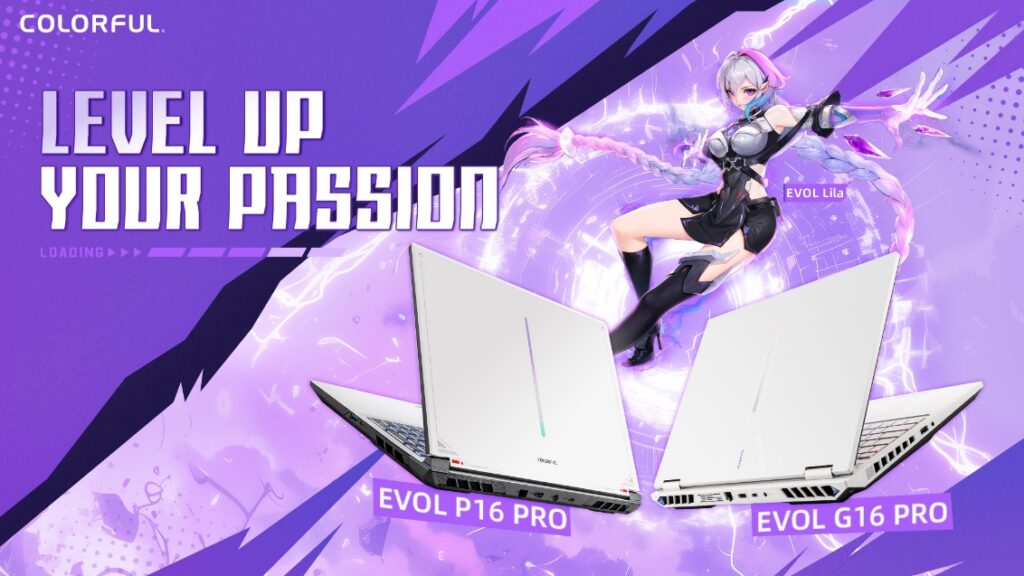
The new EVOL G16 Pro and EVOL P16 Pro laptops debut with full-power NVIDIA RTX 5080 and RTX 5070 Ti laptop GPUs, delivering top-tier graphics performance for gamers and creators alike. These models are also equipped with up to the latest 14th Gen Intel Core i9-14900HX processor, featuring 24 cores and 32 threads, and reaching a peak P-core turbo frequency of 5.8GHz. With support for Intel’s Application Optimization (APO), users can expect enhanced gaming responsiveness and performance across demanding workloads.

Both laptops feature a 2K QHD resolution (2560×1600) display with a newly upgraded 300Hz refresh rate, ensuring ultra-smooth visuals with minimal lag or screen tearing. With 100% sRGB color coverage, every frame is rich in detail and color accuracy, making these laptops ideal for high-performance gaming and immersive content creation.

Visit COLORFUL at COMPUTEX

Booth L0608, 4F, Hall 1, Nangang Exhibition Center, Taipei

May 20~23, 2025

Pricing and Availability

For more information on availability and pricing, please contact your local COLORFUL Technology representative.

HITS Professor and NTU Convert Carbon Dioxide to Renewable Fuels Using Sunlight

Mumbai / Chennai, 17th May 2025: In a significant stride towards combating climate change, Professor Indrajit Shown from the Chemistry Department at Hindustan Institute of Technology and Science (HITS), Chennai, has developed a photocatalytic system that transforms harmful carbon dioxide (CO2) into valuable renewable fuels using sunlight. This research, published in the prestigious journal Nano Energy, marks a major advancement in green chemistry and aligns with multiple United Nations Sustainable Development Goals (SDGs).

Professor Indrajit Shown, in collaboration with Dr. Li-Chyong Chen’s team from National Taiwan University, engineered a novel ZnS/ZnIn2S4 (ZIS) heterostructure photocatalyst. This innovative material utilizes solar energy to efficiently convert CO2 into hydrocarbons, notably acetaldehyde (C2H4O), a crucial step towards sustainable fuel production. The team successfully created a single-pot hydrothermally synthesized ZnS/ZIS composite, which introduced a novel strain-induced direct Z-scheme mechanism, significantly enhancing the photocatalytic efficiency.

Professor Indrajit Shown said“Our goal is not just scientific discovery, but real-world solutions to combat climate change. This research represents a critical step in converting CO₂—a major greenhouse gas—into valuable resources. This research is the culmination of a robust collaborative effort between HITS and National Taiwan University, demonstrating the power of international cooperation in tackling global challenges. The team’s collective expertise in nanomaterials, energy conversion, and catalysis has culminated in the development of a highly effective and practical photocatalytic system.”

This advanced ZnS/ZIS composite has demonstrated a quantum efficiency 200 times higher than conventional ZnS-based methods, significantly improving the process of CO₂ reduction. Unlike previous approaches, the system selectively produces acetaldehyde using visible light, a crucial advancement in green fuel technology. Stringent isotope-labeled ¹³CO₂ testing confirmed that the hydrocarbons generated originated directly from CO₂ photoreduction, eliminating contamination concerns. This research directly contributes to SDG 7 (Affordable and Clean Energy), SDG 13 (Climate Action), SDG 9 (Industry, Innovation and Infrastructure), and SDG 12 (Responsible Consumption and Production).

Col. (Hon) Dr. S.N. Sridhara, Vice Chancellor of Hindustan Institute of Technology & Science remarked: This groundbreaking research by Professor Indrajit Shown and his team provides innovative solutions for a sustainable future. By harnessing solar energy to convert CO2 into useful fuels, this development not only advances scientific knowledge but also provides a tangible pathway to addressing one of the world’s most pressing environmental challenges. This achievement highlights our institution’s role in driving scientific progress and the potential of nanotechnology in clean energy solutions. We are confident that such innovations will pave the way for a greener and more sustainable future

The research team is now exploring AI-driven approaches to discover even more efficient photocatalysts, promising further breakthroughs in this critical field. With such innovations, HITS continues to cement its position as a leader in sustainable technology research, proving that today’s environmental challenges can become tomorrow’s solutions.

Transform Enterprise Workloads up to 4x Faster with Agentic AI

India—May 16, 2025— You’re likely aware of the huge appetite organizations of all sizes have to leverage AI technology to rethink their business and deliver intelligent, data-driven outcomes faster. Recent research shows that 64% of enterprises are investing in AI in 2025, and 63% are accelerating cloud migration plans. The correlation between these is important for you: migrating your mission-critical applications and data to build a trusted foundation is what transforms good AI into great AI.

This increasing need to move to the cloud doesn’t change the fact that migrating and modernizing workloads remains one of the most tedious (but critical) projects for your enterprise to undertake. At AWS, we’ve spent nearly two decades leading enterprise migration and modernization, helping tens of thousands of customers like you transform their businesses. Despite that, 75% of enterprise workloads remain on premises, with 70% of Fortune 500 companies still running on software written over two decades ago. And traditional migration and modernization projects often stretch to 18 months or more, creating a bottleneck in your path to AI innovation. In 2024, we asked ourselves: What if we could combine our 19 years of migration expertise with the latest advancements in AI to eliminate bottlenecks and accelerate transformation projects from years to months or even weeks? The result is AWS Transform, a revolutionary service that uses agentic AI to accelerate and simplify the migration and modernization of your infrastructure, applications, and code.

Introducing AWS Transform: The Future of Your Enterprise Modernization

AWS Transform (previewed as Amazon Q Developer transformation capabilities at re:Invent 2024) uses specialized AI agents to remove the heavy lifting and automate complex migration and modernization tasks for your VMware, mainframe, and .NET workloads, delivering completed transformation projects up to 4x faster. This new agentic AI service uses AWS advancements in foundational models, LLMs, machine learning, graph neural networks, automated reasoning, and AI infrastructure to deliver an entirely new migration and modernization experience for you. And the results from our preview speak for themselves:

  • AWS Transform agent for .NET can modernize Windows-based .NET applications to Linux up to four times faster than traditional methods and realize up to 40% savings in licensing costs.
  • AWS Transform agent for mainframe can decompose monolithic z/OS COBOL applications into components that can be run in the cloud in minutes instead of months.
  • AWS Transform agent for VMware can automate the conversion of on-premises VMware network configurations to AWS equivalents up to 80 times faster than manual approaches.

AWS Transform uses a chat experience that acts as a knowledgeable transformation assistant, helping you specify objectives, share project context, assess business plans and cost savings, review and adapt transformation plans, review and approve code and infrastructure suggestions and more. AWS Transform also brings together your cross-functional teams in a unified web experience where you can review tasks, track progress, and collaborate throughout the project keeping you in control of transformation plans for your most complex legacy applications including:

Modernizing Windows-based .NET Applications to reduce costs by up to 40%

The AWS Transform agent for .NET accelerates your .NET Framework application porting from Windows to Linux, reducing operating costs by up to 40%. This cost savings is achieved by reducing your Windows Server licensing costs, version upgrades, maintenance, and end-of-support challenges, while also shrinking transformation costs across analysis, planning and refactoring. Using the .NET agent, you can chat using natural language to share transformation objectives and project context, and have AWS Transform analyze dependencies, apply domain expertise from past modernization journeys to develop customized modernization plans, and autonomously transform code, execute unit tests, generate transformation summary, and validate Linux-readiness.

AWS Transform enhances performance and scalability of your applications by transforming .NET Framework application code to cross-platform .NET which is Linux ready, and porting private packages, automating unit test execution, and providing explainable transformation decisions. This new agent enables you to transform hundreds of applications in parallel with consistent results through a unified web experience, streamlining collaboration across your teams and empowering you to efficiently tackle large-scale modernization projects.

“By using AWS Transform for .NET to port one of our .NET Framework applications to .NET Core 8, we reduced 70% of the modernization effort, with 100% success. As we continue our modernization process for the entire core application, we estimate a total development time and effort reduction of up to 80%. The next steps include incorporating one of our major backend applications into the transformation effort from Windows to Linux, deploying it on Amazon ECS and AWS Fargate as microservices.” – Enrique Zazueta, Grupo Tress Internacional (GTI), Director of Software Development

Accelerating Mainframe Modernization from Years to Months

You can now streamline your entire modernization process with the AWS Transform agent for mainframe, accelerating timelines by up to 50% while reducing risk and complexity. Through the chat interface, you can define high-level modernization goals and negotiate your job plan. When you’re ready, AWS Transform processes your mainframe applications written in COBOL, JCL (Job Control Language) and those relying on CICS (Customer Information Control System) transaction manager, BMS (Basic Mapping Support) screens, DB2 databases, and VSAM (Virtual Storage Access Method) data files.

You’ll benefit from advanced code analysis that rapidly identifies dependencies and missing files, reducing downstream project delays. Using Graph Neural Networks, you can decompose your monolithic applications into manageable modules, enabling targeted modernization approaches while preserving your critical business logic. Throughout the project, AWS Transform acts as your AI assistant, learning from your progress and answering questions about your programs based on generated technical documentation.

When you’re refactoring applications, you can convert your COBOL, JCL, and DB2 to Java and Postgres, leveraging state machines and state transition graphs for enhanced accuracy. For reimagining your applications, you’ll get comprehensive technical documentation, business rules, and logical flows extracted from millions of lines of your code. With intelligent orchestration of AI agents, you can modernize your mainframe applications in the cloud with greater speed, simplicity, and confidence while preserving your institutional knowledge through detailed documentation.

“By leveraging AWS Transform’s AI agent functionality, we were able to significantly streamline the process that would typically require experienced engineers to accurately interpret, document, and verify the relationships between programs and the logic of business codes. For instance, in the analysis of complex components—a task that would normally take approximately one month—we confirmed that the same process could be completed within just about one week. This represents a major step forward in enhancing both efficiency and productivity.” – Hitoshi Okayama, General Manager, Broker Dealers System Service Department, Nomura Research Institute, Ltd.

Reducing VMware Modernization Planning from Weeks to Minutes

You can avoid rising VMware licensing fees while optimizing your infrastructure and reducing operational overhead with the AWS Transform agent for VMware. The chat interface guides you to add connectors to your on-premises VMware environments or upload your asset inventories from third-party tools. After you specify your goals, the agent automates tasks such as application discovery, dependency mapping, migration planning, network conversion, server migration, and EC2 instance optimization. You’ll have the ability to review, approve, and edit artifacts through a human-in-the-loop mechanism.

Using Graph Neural Networks, you can analyze your network traffic and communication patterns to identify dependencies and automatically generate optimal migration wave plans. You can convert your complex network configurations to AWS equivalents, including VPCs, subnets, security groups, and transit gateways, while addressing your network migration challenges through enhanced capabilities like isolated VPCs and flexible Hub-and-Spoke configurations. With AWS Transform for VMware, traditional network configuration tasks that typically take two weeks can be completed in one hour, and migration wave planning that usually requires weeks of analysis can be completed in 15 minutes.

“At SourceFuse, we’re excited about the transformational potential of AWS Transform for VMware. By automating critical steps like dependency mapping, network translation, and wave planning, we’ve seen execution times improve by up to 90%, while reducing manual effort by 80%. This capability empowers us to deliver faster, lower-risk migrations, helping our customers achieve cloud readiness sooner and build a scalable, future-proof foundation on AWS.” Rajiv Lokare, Head of DevOps, SourceFuse

Ready to start your transformation?

We are excited about the significant shifts we’ve been able to drive by applying agentic AI to reducing transformation complexity and accelerating timelines. This is the just beginning of our journey of rethinking the migration and modernization of your most critical workloads and we look forward to helping you use AWS Transform to start yours. Reach out to your AWS team or one of our AWS Migration and Modernization Competency partners today to leverage our Migration Acceleration Program (MAP) and Experience-Based Acceleration (EBA) programs to plan your transformation. Or dive into AWS Transform on your own to experience the power of agentic AI and intelligent automation for unprecedented speed, scale and performance as you migrate and modernize to AWS and embrace AI to drive innovation for your business.