Archives February 2026

Reinventing a Legacy Brand in the Digital Age

For many heritage brands, history can feel less like a foundation and more like an anchor. In an era of rapid technological change and evolving consumer habits, sticking to “business as usual” often leads to irrelevance. To thrive, these iconic brands must execute a Legacy Pivot—a strategic shift that embraces a digital-first approach while honoring their heritage. By focusing on four key principles—utility, speed, design, and connectivity—legacy brands can evolve from local favorites into global digital leaders.

The Utility Shift: From Niche Products to Lifestyle Emotions

Legacy brands often struggle with shrinking niches. When a brand is strongly tied to a single product that no longer holds daily relevance, it must expand into broader lifestyle categories. The goal is to transform occasional purchases into daily interactions.

For example, a traditional greeting card company might expand into home décor and everyday stationery. The most significant transition, however, is moving from product-centric to emotion-driven marketing. Today’s consumers invest in the feelings and experiences a brand evokes, not just the products.

A tiered strategy can help: offering entry-level digital products for younger audiences while maintaining premium physical collectibles for dedicated enthusiasts. This ensures relevance across demographics.

The Velocity Shift: Redefining Distribution and Speed

In the digital era, “how fast” a brand delivers is as crucial as “what” it delivers. Legacy brands must move from traditional operations to agile, consumer-centric models.

Quick commerce, micro-warehouses, and “dark stores” can enable sub-30-minute deliveries. Meanwhile, phygital strategies position physical stores as experience hubs while digital channels handle fast transactions.

Building proprietary Direct-to-Consumer (DTC) platforms allows brands to eliminate intermediaries and retain full ownership of customer data—the modern “oil” fueling growth.

The Aesthetic Shift: Modernizing the Visual Narrative

“Brand fatigue” is a growing challenge for heritage brands. To stay relevant, brands must modernize visually and tonally, appealing to younger audiences without losing their identity.

This includes clean, aesthetic designs suited for social media and nostalgia-driven storytelling to engage older millennials. Strategic collaborations with influencers or “cool” brands can bridge generational gaps and borrow cultural capital.

The Connectivity Shift: Global Reach through Data and Tech

Digital transformation enables brands to expand globally without costly physical expansion. Data-driven personalization shifts marketing from mass campaigns to tailored experiences powered by AI and CRM insights.

Participation in open platforms, such as ONDC, ensures brands remain visible wherever customers search, capturing every moment of consumer intent.

The Transformation Matrix: From Legacy to Digital

This evolution changes every core pillar of business. Inventory shifts from slow-moving, product-specific stocks to fast-moving, lifestyle-oriented offerings. Stores no longer wait for customers—they deliver directly, sometimes within ten minutes.

Marketing transforms from nostalgic storytelling to aesthetics-driven dialogues supported by influencers. Most importantly, brands shift from local or community-based operations to borderless, global entities.

Reinventing a legacy brand doesn’t mean abandoning its history. It means translating enduring values into a digital language, ensuring relevance, resilience, and vitality for the next century.

GCPL Welcomes MAT Credit Relief in New Tax Regime

Sudhir Sitapati, MD & CEO, GCPL

Mr Sudhir Sitapati, Managing Director & Chief Executive Officer, Godrej Consumer Products Ltd.

“We particularly welcome the MAT credit set-off being allowed up to 25% of the tax liability under the new tax regime. This move improves cash flows and makes the new tax regime smoother for companies with accumulated credits, freeing up capital for reinvestment into growth and consumption-led categories”

Evocus enters into a strategic partnership contract with Sober & Co for its mixers

Mumbai, Feb 03: Evocus, a leading functional beverage brand, has acquired the exclusive distribution rights of Sober & Co, a clean-label beverage brand, for the mixers portfolio, effective immediately.

As part of the partnership, Evocus will take over distribution across all channels, offline retail, e-commerce, and on-trade, while Sober & Co. will continue to independently manage production and product development. The collaboration is designed to significantly strengthen Sober & Co’s market presence, which currently has about a 1000 retail touch points across India.

Through Evocus’s robust distribution network and deep market reach, Sober & Co. ‘s mixer range is expected to expand rapidly across key markets in India, making the brand more accessible to consumers nationwide.

Commenting on the partnership,  Clavell Santiago  VP – HoReCa Sales and Marketing, Evocus said,

“This partnership allows us to strengthen our basket offering and add greater value to our customers and partners. Sober & Co aligns strongly with our focus on clean-label, high-quality beverages, and we see a strong synergy between our portfolios.”

The association marks a strategic step for Evocus as it continues to identify and collaborate with brands that complement its positioning in the functional and premium beverage space.

Sharaan Kripalani, Founder/CEO of  Sober & Co added,

  “Partnering with Evocus enables us to scale faster and reach a wider audience across India, while allowing us to stay focused on product quality, product innovation, and operations.”

Evocus will be the exclusive distribution partner for the mixers offered by Sober & Co in India. While the company is evaluating similar opportunities, it continues to remain selective, working only with brands that share a strong strategic and portfolio fit.

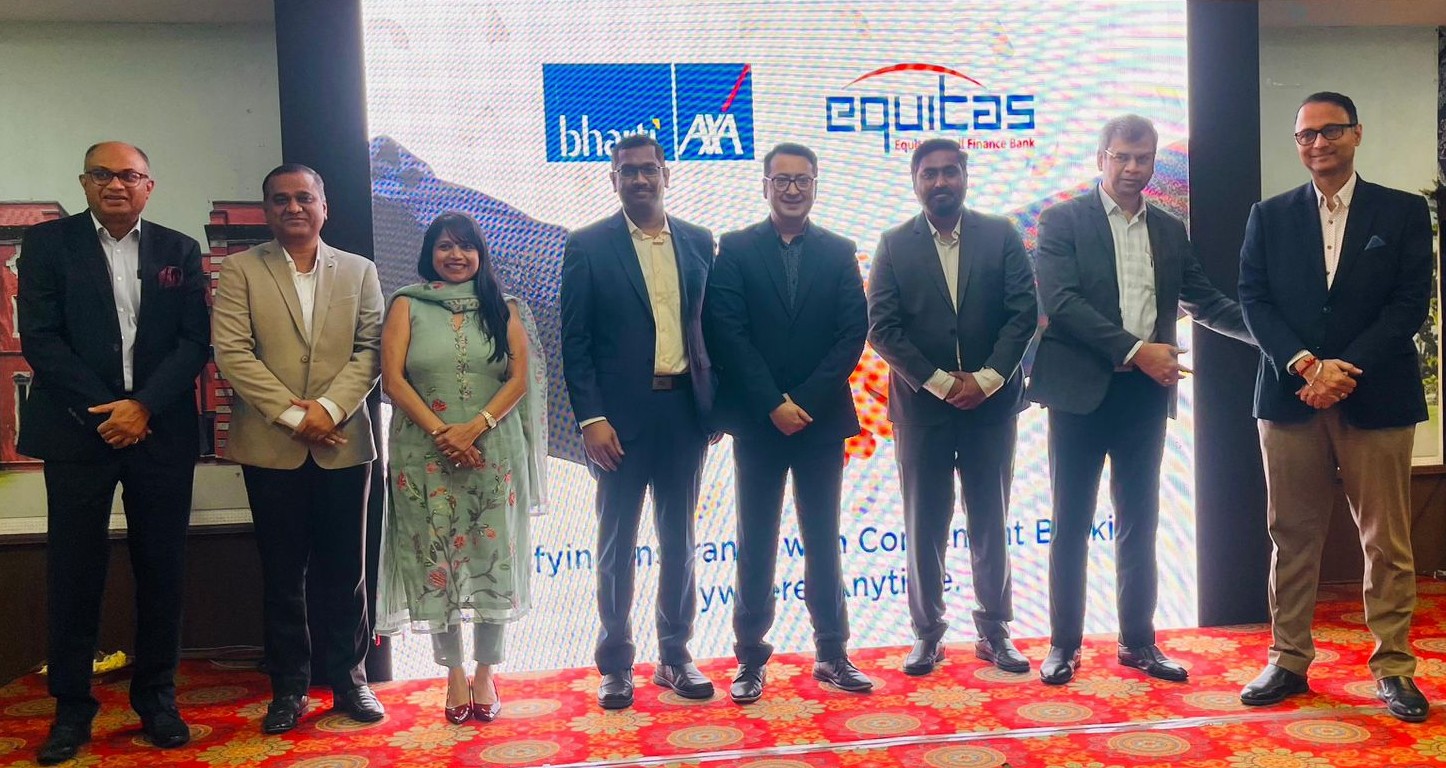
Bharti AXA Life Insurance and Equitas Small Finance Bank Announce Strategic Bancassurance Partnership

Mumbai, Feb 3: Bharti AXA Life Insurance, a subsidiary of Bharti Life Ventures Private Limited (Bharti Group Company), has entered into a strategic bancassurance partnership with Equitas Small Finance Bank. The partnership marks a significant step toward deepening life insurance penetration across India, especially within semi-urban and rural markets.

BAXA-Equitas_Press Release

Through this partnership, Bharti AXA Life Insurance will offer its range of protection, savings and retirement plans to customers of Equitas Small Finance Bank, enabling financial security and long-term wealth planning for individuals and families across India. Customers can access these solutions seamlessly through Equitas SFB’s robust network spanning over 1,042 banking outlets across 18 states and Union Territories, with a strong footprint in Tamil Nadu, Karnataka, Kerala and Maharashtra

Commenting on the partnership, Mr. Nitin Mehta, Chief Distribution Officer – Partnership Distribution and Head Marketing, Bharti AXA Life Insurance, said:

Equitas Small Finance Bank has built a strong and differentiated franchise with a proven track record in serving underbanked, semi-urban, and rural communities through its wide branch network and digital capabilities. We are pleased to partner with the Bank, as this collaboration will further strengthen our partnership distribution footprint and enable us to reach customers at scale through its extensive phygital presence. The partnership aligns with our objective of simplifying insurance and making it more accessible, while also supporting IRDAI’s vision of ‘Insurance for All’ by 2047.”

Speaking on the collaboration, Mr. Murali Vaidyanathan, Senior President & Country Head – Liabilities, Wealth Management and Digital Banking, Equitas Small Finance Bank, said:

 Enhancing the quality and breadth of services we offer to our customers remains a key priority for us, and this partnership with Bharti AXA Life Insurance is a step in that direction. Through this collaboration, we are strengthening our product portfolio by providing customers access to a comprehensive range of life insurance solutions that complement their banking needs and long-term financial planning requirements.”

By combining Equitas Small Finance Bank’s distribution strength with Bharti AXA Life Insurance’s life insurance expertise, the partnership aims to drive wider adoption of life insurance and strengthen long-term financial preparedness among customers.

Ajitesh Korupolu: Driving Tech-Led Innovation in Indian Real Estate

Mr. Ajitesh Korupolu, Founder & CEO of ASBL

By:- Ajitesh Korupolu, Founder and CEO, ASBL

Mr. Ajitesh Korupolu, an Indian real estate leader and visionary entrepreneur, wields his expertise to drive strategic initiatives and foster growth in the industry. As the Founder and CEO of ASBL, he has transformed the company from a promising startup into a market leader in Hyderabad. With over a decade of experience, he has carved a niche by revolutionizing construction and project management through robust technological backend systems. 

Under Mr. Ajitesh’s leadership, ASBL has successfully planned over 8million sq. ft. of residential projects, with annual sales rising from Rs. 1,250 crores in 2022 to Rs. 2,200 crores in 2023. He embodies the epitome of real estate innovation, blending astute business acumen with a compassionate heart, and has reshaped the real estate landscape in Hyderabad by combining tradition with cutting-edge technology and design principles. He approaches the construction and design industry with a highly scientific perspective. His pivotal move of introducing ‘Inncircles Arena’, a digital twin software, has reduced construction time by 25% and is now being adopted globally. Committed to formalizing the real estate sector, he is driven to bring multi-level improvements for seamless management and efficiency. 

Mr. Korupolu has consistently advocated for happiness-centric urban developments that prioritize the well-being of residents through community spaces, mixed-use areas, walkability, and nature-integrated designs. 

Mr. Ajitesh embodies a rare fusion Economics degree with a Minor in Mathematics and Philosophy from Purdue University, USA and strategic advisory acumen, he gained knowledge and a global perspective on business and real estate. His professional journey in real estate was a natural continuation of his family’s legacy, but Ajitesh was determined to introduce innovative technologies to the industry. This led to his pioneering work in the adoption of digital twin technology in construction management. Recognizing the untapped opportunities to enhance efficiency, he embarked on a mission to redefine the industry through the strategic implementation of cutting-edge technology. He became the first to introduce the concept of digital twins in Hyderabad—a technology that creates a virtual replica of a physical structure through Building Information Modeling (BIM). Understanding the transformative potential of this technology, Ajitesh set out to bridge the gap between systems, operations, and human resources in the construction process. Committed to formalizing the real estate sector, he is driven to bring multi-level improvements for seamless management and efficiency

India–US Trade Deal Signals Strategic Reset: Nachiketa Sawrikar

By:- Mr. Nachiketa Sawrikar, Fund Manager, Artha Bharat Global Multiplier Fund

The India–US relationship, which many expected to strengthen during President Trump’s second term, reached a notable low point in June. For the global economy, strained ties between the world’s two largest democracies were far from encouraging. Against this backdrop, the new India–US trade agreement—reducing the average tariff rate to around 18% from the earlier punitive level of nearly 50%—marks a meaningful reset in bilateral economic relations.

For India, lower tariffs significantly enhance access to the US market for labour-intensive exports such as textiles, engineering goods and pharmaceuticals, supporting employment, manufacturing scale and export competitiveness. The revised tariff level places India broadly in line with ASEAN peers and represents the most favourable outcome realistically achievable under current global trade dynamics. For the US, the agreement opens avenues to expand exports of energy, agricultural products and advanced technologies, while reinforcing supply-chain diversification away from over-concentrated geographies.

Beyond tariffs, the deal signals a renewal of strategic trust. Trade policy is now better aligned with shared priorities including resilient supply chains, clean-energy collaboration, and technology partnerships in areas such as semiconductors and defence manufacturing. Indian consumers also stand to benefit as high-value US and EU products become more affordable, supporting domestic demand and purchasing power.

With the rupee having weakened by nearly 5% over the past six months, improved trade flows and renewed foreign investor interest could aid a partial currency recovery. As India’s relative attractiveness improves versus ASEAN markets, a reversal of recent FII outflows could further strengthen Indian equity markets. Overall, the agreement represents a balanced, win-win outcome for both economies.

Jayant Chaudhary Hails Union Budget 2026–27 as Yuva Shakti–Driven Growth Blueprint

Shri Jayant Chaudhary, Minister of State (Independent Charge) for Skill Development & Entrepreneurship and Minister of State for Education, Government of India

The Union Budget 2026–27 presents a confident roadmap for India’s next phase of growth. I congratulate Hon’ble Prime Minister Shri Narendra Modi ji for his visionary leadership and thank Hon’ble Finance Minister Smt. Nirmala Sitharaman ji for a Budget that balances ambition with inclusion, and reforms with responsibility.

This is a truly Yuva Shakti–driven Budget, anchored in the vision of Viksit Bharat 2047. By prioritising productivity, competitiveness and cutting-edge technologies, including AI, it lays a strong foundation for Viksit Bharat through sustained structural reforms and people-centric growth. It reinforces India’s steady economic trajectory through fiscal discipline, sustained growth and strategic investments in future-ready capacities.

A strong push to manufacturing, MSMEs and services stands out as a key growth engine. Investments across biopharma, semiconductors, electronics, textiles (SAMARTH 2.0), chemicals, capital goods and sports manufacturing will deepen domestic value chains and position India as a trusted global production hub. The three-pronged MSME framework, ₹10,000 crore SME Growth Fund, TReDS-based liquidity, and professional support through “Corporate Mitras”, will empower entrepreneurs to scale and compete.

Initiatives such as AI-backed Bharat Vistaar to integrate agri-stack, creation of SheMarts, Biopharma SHAKTI, ISM 2.0, rejuvenation of industrial clusters, creation of champion MSMEs through equity support, and the 10-year Khelo India Mission reflect a future-ready approach that integrates technology, health, agriculture and human capital.

A defining feature of this Budget is its decisive commitment to skill development and human capital. The Ministry of Skill Development and Entrepreneurship has received a 62% increase in allocation, with the budget rising from ₹6,100 crore to ₹9,885.80 crore, affirming the Government’s resolve to place skills at the centre of economic transformation. From NSQF-aligned programmes and caregiver training to modernised textile skilling, sports ecosystems and industry-linked pathways, this Budget creates a seamless bridge from education to employment and entrepreneurship, preparing youth to lead in manufacturing, services, technology and the care economy.

The renewed emphasis on the services sector, including healthcare, medical value tourism, AVGC, design, IT and hospitality, recognises that India’s growth will be powered as much by skills and services as by infrastructure. Continued public capital expenditure will crowd in private investment and expand opportunities across Tier-II and Tier-III cities.

I especially welcome the strong focus on agriculture and allied sectors, particularly for states like Uttar Pradesh, —supporting high-value farming, fisheries, animal husbandry, FPOs and agri-startups. These measures will strengthen farmer incomes while opening new avenues for rural youth and women-led enterprises. Integrating skilling with agriculture and rural entrepreneurship will help move our villages from subsistence to sustainability.

The Budget also advances social inclusion through targeted support for women, Divyangjans, education, healthcare and social justice. Empowering women through hostels, skilling and entrepreneurship, alongside focused interventions for persons with disabilities, reflects our commitment to ensuring that every citizen participates meaningfully in India’s growth story.

Sports receives a strategic boost as well, recognising its potential for manufacturing, innovation and youth engagement, while aligning with Uttar Pradesh’s emerging role in sports goods clusters and talent development, and strengthening India’s preparations as we move forward with our bid to host the Olympic Games in 2036. We recently launched SportsEdge Meerut in alignment with this vision—an initiative aimed at building a world-class sports goods manufacturing cluster by integrating skilling, innovation and MSME support, and I am confident it will add significant value by creating jobs, strengthening local enterprises and nurturing sporting talent.

Taken together, Budget 2026–27 is not just a financial statement, it is a national mission document. It strengthens economic foundations, unlocks enterprise, empowers farmers and MSMEs, and invests deeply in skills.

Snowflake and OpenAI Forge USD 200 Million Partnership to Bring Enterprise-Ready AI to the World’s Most Trusted Data Platform

SAN FRANCISCO – Feb 3 Snowflake (NYSE: SNOW), the AI Data Cloud company, today announced a new collaboration with OpenAI that enables global enterprises to unlock greater value from their proprietary data with AI. This multi-year, $200 million partnership agreement cements Snowflake and OpenAI’s commitment to co-innovation and joint go-to-market (GTM) strategies aimed at deploying AI agents across global enterprises. Snowflake and OpenAI will work closely together to develop and deploy customized AI solutions for joint enterprise customers that deliver tangible return on investment.

The direct, first-party partnership agreement also makes OpenAI models natively available to Snowflake’s 12,600 global customers within Snowflake Cortex AI across all three major clouds. This empowers global organizations like Canva and Whoop to bring OpenAI models to their enterprise data for deep research and instant insights. OpenAI models like GPT-5.2 will be accessible within Snowflake Intelligence, the trusted enterprise intelligence agent that empowers every employee to securely access, analyze, and act on all their organization’s knowledge using natural language.

“By bringing OpenAI models to enterprise data, Snowflake enables organizations to build and deploy AI on top of their most valuable asset using the secure, governed platform they already trust,” said Sridhar Ramaswamy, CEO, Snowflake. “Customers can now harness all their enterprise knowledge in Snowflake together with the world-class intelligence of OpenAI models, enabling them to build AI agents that are powerful, responsible, and trustworthy. Together, we’re setting a new standard for AI innovation, helping businesses transform with confidence, while maintaining strong security and compliance standards.”

“Snowflake is a trusted platform that sits at the center of how enterprises manage and activate their most critical data,” said Fidji Simo, CEO of Applications at OpenAI. “This partnership brings our advanced models directly into that environment, making it easier to deploy AI agents and apps, so businesses can close the gap between what AI is capable of and the value they can create today.”

“As we scale our visual AI offering on Canva, both OpenAI and Snowflake have played key roles in how we rapidly empower our users with new creative tools,” said Helen Crossley, Head of Data Science, Canva. “As our platform continues to scale, Snowflake has been foundational to how we manage and activate data, and we’re excited to explore how leveraging OpenAI models in Snowflake Cortex AI can help us extend that foundation. The ability to bridge advanced AI models with our enterprise data allows us to move quickly and test new ideas, without compromising on security or performance.”

“Speed and precision in decision-making are critical for us as WHOOP continues to scale,” said Matt Luizzi, Senior Director of Business Analytics, WHOOP. “Rolling out Snowflake Intelligence to our employees and developing Cortex Agents has provided a secure and governed way for WHOOP to analyze data and make decisions. With OpenAI’s models available directly within Snowflake Cortex AI, we can further enhance those agents with advanced reasoning and analysis, all while maintaining strong security and governance. This partnership will help us continue to make AI a practical, everyday tool for the business.”

Snowflake and OpenAI Help Global Enterprises Deploy AI Agents

By bringing OpenAI models to Cortex AI, global enterprises can gain insights from all their data to deliver richer, more engaging AI agents. Key benefits of the partnership include:

Accelerate Joint Product Innovation: Snowflake and OpenAI teams will partner closely to bring new features that leverage OpenAI Apps SDK, AgentKit, and APIs that support shared enterprise workflows.
Build Custom, Interoperable AI Agents: Snowflake and OpenAI enable enterprises to build state-of-the-art AI agents that reason over governed data and take action across tools and apps. Powered by Cortex AI, these agents run directly on enterprise data, delivering secure, high-impact intelligence at scale.
Democratize Data and Insights with AI: Powered by OpenAI models like GPT-5.2, Snowflake Intelligence is an enterprise intelligence agent that gives every employee instant access to trusted insights. It enables business users to query, interpret, and draw meaning from all their structured and unstructured data with no code required, just natural language.
Enterprise-Ready Governance and Reliability: Snowflake provides built-in business continuity and disaster recovery with a 99.99% uptime service-level agreement, helping ensure that enterprises’ AI initiatives don’t get disrupted by outages or disasters. Users can reliably and securely tap into the power of OpenAI models alongside their most valuable proprietary data in Snowflake, all while benefiting from the governance and responsible AI controls that Snowflake Horizon Catalog provides.
Gain Deep Insights with Multimodal AI: With Snowflake Cortex AI Functions, users can tap into the latest OpenAI models to analyze every kind of data. From rows and columns to text, images, and audio, teams can explore it all seamlessly using SQL, the familiar language of data they already trust.

Snowflake and OpenAI Deepen Collaboration to Advance Responsible AI and Workforce Productivity

This partnership builds on the companies’ existing collaboration, with OpenAI leveraging Snowflake as a secure, scalable data platform for experiment tracking, analytics, and testing.

In turn, Snowflake leverages OpenAI’s ChatGPT Enterprise product internally, empowering employees to harness AI in their day-to-day work and accelerate productivity. As a result, employees can make decisions faster, streamline workflows, and drive stronger cross-functional collaboration through AI-powered insights.

Budget 2026–27 Boosts AVGC Sector, Expands Creator Labs to Build India’s Future-Ready Talent

Akshat Rathee, Co-founder and MD of NODWIN Gaming:

“The Union Budget 2026–27’s support for the Animation, Visual Effects, Gaming and Comics (AVGC) sector through the expansion of AVGC creator labs is a strong step toward building India’s creative and digital talent pipeline. The government’s backing of the Indian Institute of Creative Technologies (IICT), whose inauguration we were proud to be present for, reflects a clear commitment to equipping young Indians with future-ready skills across animation, gaming and storytelling. As organizers of large-scale cultural platforms such as the NH7 Weekender and Comic Con India, we are constantly seeking skilled talent to shape immersive experiences, and initiatives like these will help widen that pool while accelerating original IP creation and high-quality game development. Greater access to creative technologies will enable more homegrown, culturally relevant content to thrive.”

Animesh Agarwal, Founder & CEO, S8UL Esports and 8Bit Creatives:

“Having built teams and businesses in gaming and esports over the years, I’ve seen first-hand how rapidly the AVGC sector is growing and how urgently India needs structured skilling to keep pace. The projection of two million professionals required by 2030 highlights both the scale of the opportunity and the responsibility on industry and institutions to prepare future-ready talent. Initiatives like these will not only create meaningful career pathways for young Indians but also help position India as a global hub for animation, gaming, and digital storytelling.”

Vishal Parekh, Chief Operating Officer, CyberPowerPC India:

“The Budget’s support for AVGC creator labs across 15,000 schools and 500 colleges marks a powerful step toward building a future-ready workforce. With the sector projected to require 2 million professionals by 2030, this initiative can accelerate job creation and empower young Indians to pursue high-value careers in gaming, animation, and visual technologies. Realizing this vision calls for access to high-performance computing environments that match global benchmarks. At CyberPowerPC India, we see this as a defining opportunity to equip the next generation with the tools they need to create, compete, and lead, fueling innovation while strengthening India’s emergence as a global creative and technology powerhouse. We commend the government’s forward-looking commitment to strengthening India’s AVGC ecosystem.”

Sagar Nair, Head of Incubation, LVL Zero Incubator:

“The Finance Minister’s announcement reflects a strong commitment to India’s creative economy. With the AVGC sector expected to require nearly two million professionals by 2030, the rollout of content creator labs across 15,000 schools and 500 colleges can expand early access to future-ready skills and inspire students to pursue careers in animation, VFX, gaming, and comics. When skilling is paired with incubation and clear pathways to entrepreneurship, India can cultivate a generation of creators equipped to build original intellectual property and compete globally. This approach can accelerate job creation, strengthen the talent pipeline, and position the country as a leading hub for creative technology and digital content.”

Gold & Jewellery Leaders Applaud Budget’s Focus on Stability, Growth, and Industry Development

Suvankar Sen, MD and CEO, Senco Gold and Diamonds

The Union Minister’s emphasis on long-term macroeconomic stability, infrastructure development, MSME growth, and the push toward technology and AI adoption, alongside support for skill development, women empowerment, research and development, and knowledge hubs, reflects thoughtful long-range policy direction. This kind of structural planning strengthens consumer confidence and enhances productive capacity across sectors. Even in the absence of direct incentives for the gold industry, measures supporting exports, imports, global market integration, and SEZ ecosystems point to a forward-looking and self-reliant economic vision.

We appreciate the government’s long-term thinking, particularly the continued thrust on inclusive growth. As infrastructure and income levels rise, consumption is expected to deepen significantly across tier 2, tier 3, tier 4 cities, and smaller towns, which will be a key driver for organised retail and jewellery demand. For a company with a strong business focus and manufacturing base in eastern India, the emphasis on skilling and regional development is especially encouraging, as it will help expand the workforce and bring more professionally trained talent into the sector.

With gold and silver markets witnessing strong investment interest ahead of the Budget, the absence of specific sector measures also creates an opportunity for closer industry-government collaboration on future frameworks that encourage innovation, value addition, and formalisation. Overall, this is a strategically oriented, long-term Budget that supports sustainable and broad-based economic growth.

Jignesh Mehta, MD and Founder, Divine Solitaires

“While the Finance Minister’s long-term focus on infrastructure development, skill development, and AI/technology-enabled growth elevate the manufacturing ecosystem at a broader level, the absence of key announcements for the natural diamonds industry and the Gems & Jewellery sector was a disappointment.

We were expecting more targeted reforms, given India’s position as one of the largest diamond manufacturing and processing hubs globally. While macro-level investments in skills, labour, and technology are welcome, sector-specific policy support would have gone a long way in strengthening competitiveness, employment, and long-term value creation for the industry.”

Mr. Kaushlendra Sinha, CEO, Indian Association for Gold Excellence and Standards (IAGES)

“The Union Budget’s focus on economic stability, formalisation, and structural strengthening provides a constructive backdrop for India’s gold ecosystem. At a time of elevated gold and silver price volatility, the industry’s commitment through IAGES to transparency, trust, governance, and recognised standards across the value chain is critical to sustaining consumer confidence and long-term resilience. As demand expands nationwide, including fast-growing markets beyond metros, aligning businesses with excellence and compliance benchmarks will help build a more credible, competitive, and globally respected gold industry.”