

Baripada, June 19(UDN): The discovery of fossilised shark teeth, molluscan shells and other marine remains in Odisha’s Mayurbhanj district has strengthened scientific evidence that present-day Baripada was once covered by a shallow sea millions of years ago.
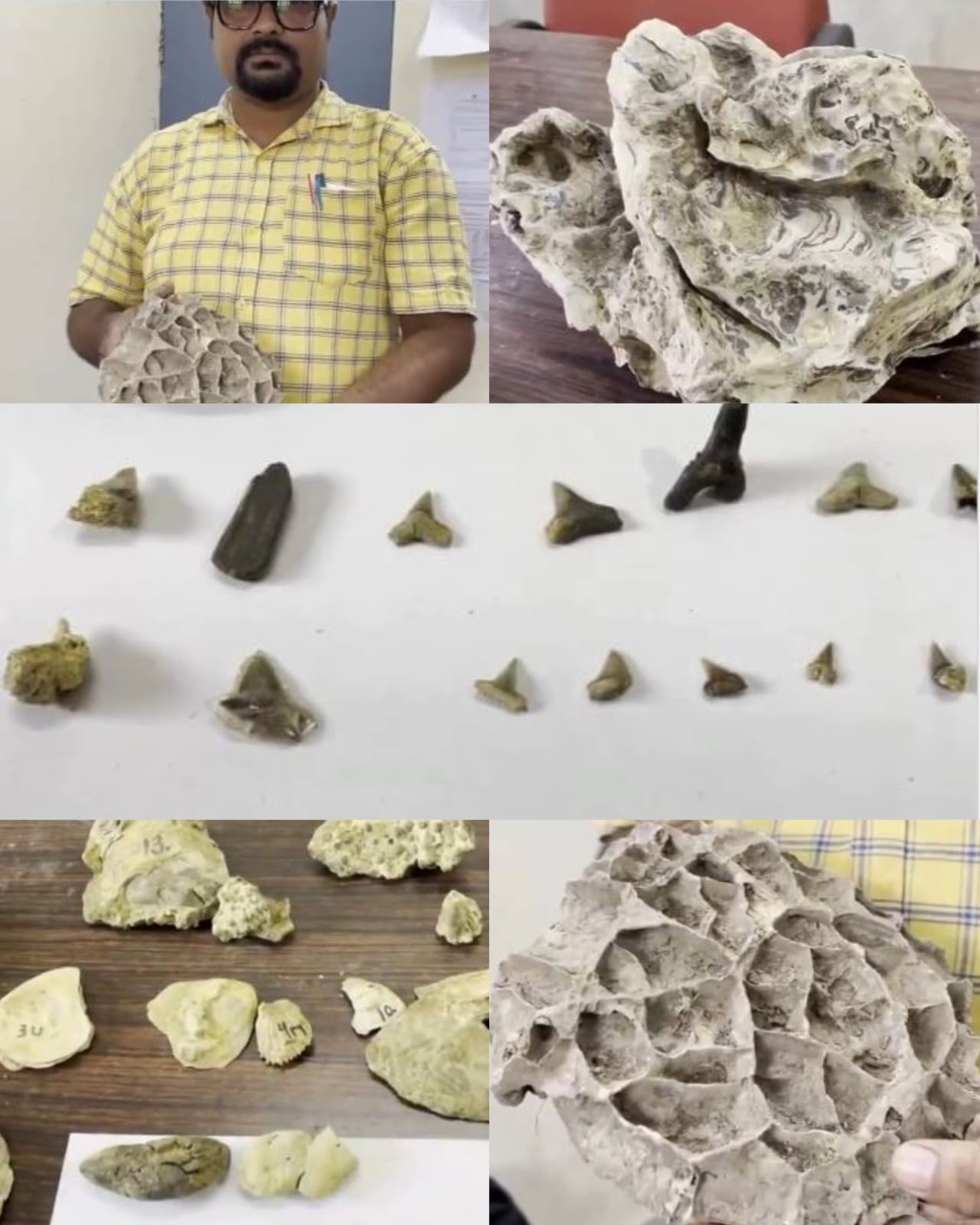
Researchers have identified a rich assemblage of marine fossils at a site locally known as Asurahada, scientifically referred to as the Baripada Fossil Bed, situated in the foothill region near Baripada. The fossils are estimated to be between 12.6 million and 8.3 million years old, dating back to the Miocene epoch.
The findings were documented by Dr Debabrata Nandi, Assistant Professor in the Department of Remote Sensing and GIS at Maharaja Sriram Chandra Bhanja Deo University.
According to Dr Nandi, the fossil-bearing sediments indicate that the region once formed part of a coastal marine basin that supported diverse aquatic life.
“The fossils provide compelling evidence that this area was submerged under a shallow marine environment during the Miocene period, a time marked by major climatic changes, continental shifts and global cooling,” he said.
Among the most significant discoveries are fossilised shark teeth from extinct marine species and a wide variety of well-preserved molluscan shells. Scientists say these remains are helping reconstruct ancient ocean ecosystems and understand long-term changes in climate, sea levels and marine biodiversity.
The discovery has also opened new questions about the geological history of the region, particularly how the coastline gradually retreated to its present position.
“The sea appears to have receded nearly 60 kilometres from present-day Baripada. Understanding whether this happened due to climate change, tectonic activity or other geological processes requires further investigation,” Dr Nandi said.
Researchers believe the Baripada Fossil Bed could become an important geological archive for studying India’s palaeogeographic evolution and evidence of marine transgression in eastern India. The site may also help establish links with similar fossil-bearing formations found elsewhere in the country.
Dr Nandi noted that remote sensing, GIS-based mapping and advanced geospatial analysis played a crucial role in locating and documenting the fossil horizon. By combining field investigations with spatial technology, researchers were able to map fossil distribution and geological features with greater precision.
The discovery has generated significant interest among geologists, palaeontologists and academic institutions, who view it as an important contribution to understanding Odisha’s ancient marine history and the changing geography of eastern India.

