

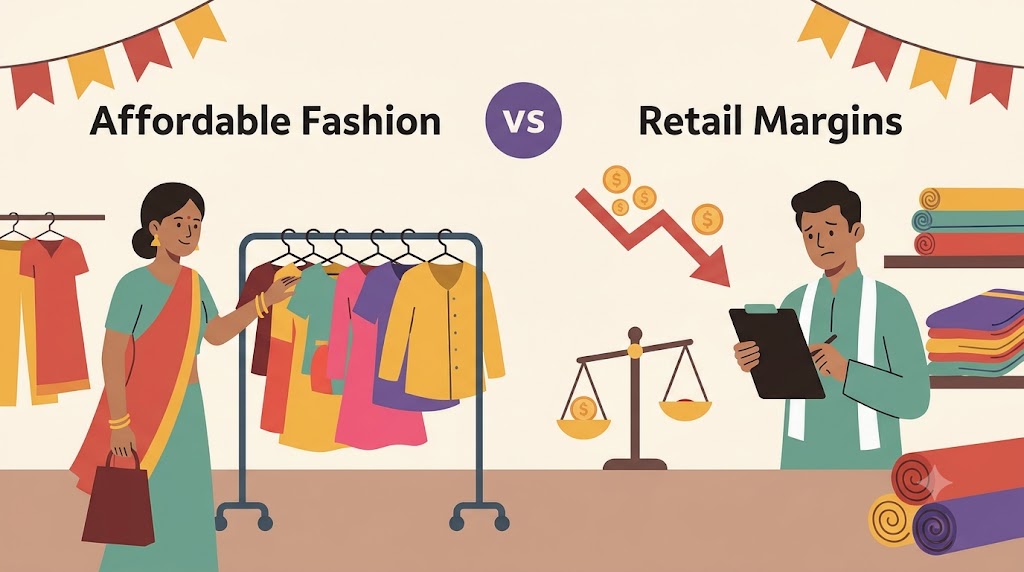
India’s affordable fashion market is reshaping the country’s apparel retail landscape as consumers increasingly seek fashionable clothing that fits their budgets. From everyday essentials and casual wear to workwear and occasion-led collections, value-focused fashion is attracting shoppers who want more choice without paying premium prices. The expansion of organised retail, the growing influence of digital shopping and rising demand in smaller cities are creating fresh opportunities for fashion businesses.
Yet, for retailers, attracting price-conscious shoppers is only half the challenge. The real business test is turning strong consumer demand into sustainable profits without compromising style, quality or affordability. Intense price competition, changing fashion trends, rising operating expenses and unsold inventory are forcing retailers to rethink how they design collections, manage supply chains and price their products.
Affordable Fashion Is Changing India’s Retail Landscape
Value fashion has evolved beyond basic, low-cost clothing. Consumers increasingly expect affordable garments to reflect current trends, offer reasonable quality and provide a convenient shopping experience. This shift has encouraged retailers to combine competitive pricing with organised stores, wider product selections and faster-moving collections.
Demand is also expanding beyond major metropolitan centres. Consumers in Tier-II and Tier-III cities are gaining access to a broader range of organised fashion options, while digital platforms are helping retailers reach shoppers across geographical boundaries.
For fashion businesses, these markets offer opportunities to expand their customer base. However, local purchasing power, seasonal demand and regional preferences vary considerably. Retailers must understand what consumers are willing to pay and which products are most relevant to their markets before committing resources to expansion.
Price Sensitivity Is Squeezing Retail Margins
Affordable fashion retailers operate in a market where even small price differences can influence purchasing decisions. Shoppers frequently compare products across stores and online platforms, making it difficult for businesses to raise prices when production, rent or transportation costs increase.
Discounting can generate footfall and accelerate sales, but excessive promotions reduce the revenue earned from each garment. If retailers rely too heavily on price cuts to compete, higher sales volumes may not translate into stronger profits.
This creates a delicate balance between affordability and commercial viability. Retailers need to understand the full cost of each product, including sourcing, logistics, store operations, applicable taxes and markdowns. Pricing decisions based only on competitors’ offers can leave businesses with insufficient margins to cover their expenses.
The stronger approach is to build value through product relevance, dependable quality and efficient operations rather than competing solely on the lowest price.
Fast-Changing Trends Make Inventory Management Critical
Fashion retail depends on predicting what customers will want before demand becomes obvious. A collection that attracts strong interest initially may lose its appeal within weeks, leaving retailers with stock that must be discounted or carried into another season.
Unsold garments tie up working capital and occupy valuable warehouse and store space. Frequent markdowns can further weaken profitability, particularly when retailers have purchased too much inventory or misjudged demand.
Better forecasting can help businesses reduce these risks. Analysing sales by style, size, colour, location and season allows retailers to identify popular products and adjust future orders accordingly. Smaller initial orders, followed by replenishment when demand is confirmed, can also reduce the risk of overstocking where supply arrangements permit.
In a price-sensitive market, inventory discipline is a major competitive advantage. Selling the right products at the right time can be more valuable than simply increasing the number of styles available.
Sourcing Efficiency Can Protect Fashion Businesses
The economics of affordable fashion begin well before a garment reaches the shop floor. Fabric prices, manufacturing expenses, quality checks, packaging, transportation and warehousing all influence the final cost of a product.
Retailers must manage these expenses without allowing cost reductions to damage quality. Poor fabric performance, inconsistent sizing or weak stitching can increase complaints and returns, ultimately affecting customer loyalty and business reputation.
Closer coordination with suppliers, more accurate production planning and reliable delivery schedules can help reduce waste and improve stock availability. Retailers may also benefit from diversifying sourcing arrangements to manage supply disruptions and avoid excessive dependence on a limited number of suppliers.
The objective is not merely to buy at the lowest price. It is to secure consistent quality at a cost that supports competitive retail pricing and sustainable margins.
Online Fashion Growth Comes With Hidden Costs
Digital commerce gives fashion retailers access to customers beyond their physical store networks. Online platforms also provide valuable information about browsing behaviour, popular designs and customer preferences.
However, online sales involve expenses that can be overlooked when businesses focus only on order volumes. Packaging, delivery, platform charges, marketing expenditure, returns and reverse logistics can significantly reduce the profit earned on a transaction.
Fashion retailers can improve performance by providing accurate product photographs, clear size charts and detailed fabric descriptions. Analysing why customers return products can help businesses address recurring issues related to fit, quality or mismatched expectations.
An integrated online and offline strategy can also improve stock visibility and help retailers make better use of available inventory. The important measure is not simply how many orders a business receives, but how much value those orders contribute after associated costs.
Store Expansion Requires Commercial Discipline
Organised fashion retail offers consumers a more structured shopping experience, but physical expansion comes with substantial financial commitments. Rent, employee salaries, utilities, store maintenance and inventory requirements can weigh on profitability, particularly in locations where sales take time to build.
Before opening new outlets, retailers need to assess local demand, customer spending patterns, competition and expected operating costs. Store performance should be measured against its contribution to the business rather than footfall or revenue alone.
For smaller retailers, a carefully selected location or a compact store format may offer a more manageable route to growth than rapid expansion. Established chains must also ensure that new outlets maintain consistent product availability and operating efficiency.
Expansion creates lasting value only when stores attract customers and generate sufficient returns to justify their costs.
Pricing and GST Compliance Matter
Tax treatment is another consideration in apparel pricing. Under India’s GST framework, apparel can attract different rates depending on the applicable transaction value and classification rules. Retailers must verify the current provisions when setting prices, calculating margins and managing invoices.
For affordable fashion businesses, pricing decisions require particular care because consumers may be reluctant to absorb even modest increases. At the same time, retailers cannot ignore tax obligations or allow rising costs to erode their financial position.
Accurate cost calculations and regular financial reviews can help businesses understand the actual contribution earned from each product category. Clear pricing policies also support better planning across promotions, seasonal sales and new collections.
What Fashion Retailers Need to Prioritise
Sustainable growth in affordable fashion requires a combination of commercial insight and operational efficiency. Retailers can strengthen their business models by focusing on several priorities:
-
Smarter buying: Use sales data and local demand patterns to guide product selection and purchasing volumes.
-
Faster inventory movement: Reduce excess stock and limit the need for deep discounts at the end of a season.
-
Disciplined pricing: Account for sourcing, logistics, applicable taxes and selling costs before launching promotions.
-
Consistent quality: Protect customer trust while controlling production costs.
-
Efficient distribution: Improve supplier coordination and stock allocation across stores and online channels.
-
Profit-focused expansion: Evaluate store-level returns and the true cost of acquiring online customers.
These measures can help retailers identify where margins are being lost and make better-informed decisions as competition intensifies.
The Future of Affordable Fashion in India
India’s affordable fashion market presents a significant opportunity for retailers that understand the changing relationship between price, style and consumer expectations. As organised retail and digital shopping extend their reach, businesses have more ways to attract customers and respond to emerging trends.
But long-term success will depend on more than rapid expansion or aggressive discounting. Retailers must develop collections that meet local demand, maintain reliable supply chains and manage inventory with greater precision.
For fashion businesses, the next phase of growth will be defined by their ability to deliver desirable clothing at accessible prices while preserving profitability. Those that combine consumer understanding with cost discipline and operational efficiency will be better positioned to build customer loyalty and compete in India’s evolving value-fashion market.

