Language: The Core of Identity and Connection

Language is the foundation of identity, the bridge of opportunity, and the heartbeat of human connection — Dr. Birbal Jha

birbal

Patna, Feb 23: On the solemn and globally observed occasion of International Mother Language Day, the auditorium of British Lingua resonated with ideas that transcended grammar and vocabulary. The seminar, titled “Language, Identity, and Opportunity,” evolved into a compelling reflection on how words shape worlds and how language can transform lives.

Delivering the keynote address, noted educationist and social reform advocate Dr. Birbal Jha offered a sweeping vision of multilingual empowerment. His central thesis was both simple and profound:
“Language is not only a medium of communication; it is the foundation of identity, the bridge of opportunity, and the heartbeat of human connection.”

The audience — comprising educators, students, and thought leaders — listened in rapt attention as Dr. Jha unfolded what he described as the three pillars of linguistic strength: mother tongue, Hindi, and English.

The Mother Tongue: Where Identity Takes Root

In a deeply evocative passage, noted author Dr Birbal Jha described the mother tongue as “the first music we hear” — the language of lullabies, affection, and formative dreams. It is here, Dr Jha argued, that identity is first forged and confidence begins to grow.

Dr Jha reminded the gathering that linguistic roots anchor emotional stability and cultural continuity. “Modernity should expand our horizons, not erase our roots,” he observed, urging families and institutions alike to safeguard indigenous languages as repositories of collective memory.

The mother tongue, Dr Jha said, does not merely communicate thought; it nurtures self-respect and strengthens the psychological foundation upon which future aspirations stand.

Hindi: A Bridge Across Diversity

Turning to Hindi, Dr. Jha underscored its role as a vital instrument of social cohesion in India’s vast linguistic landscape. From public discourse to marketplaces, from governance to cinema, Hindi connects diverse communities without demanding uniformity.

“Language is the bridge between diversity and unity,” Dr Jha declared, emphasizing that inclusive communication reduces prejudice and fosters cooperation. In his view, Hindi in India enables participation and strengthens democratic dialogue by amplifying voices from villages, towns, and cities alike.
In a country of many tongues, Dr Jha suggested, a shared language of connection strengthens the social fabric.

English: A Gateway to Global Possibility

If the mother tongue roots identity and Hindi binds society, English, Dr. Jha argued, unlocks the world. In an age defined by globalization, English serves as the language of science, technology, business, and international collaboration.

“English does not define your identity; it multiplies your opportunity,” Dr Birbal Jha asserted, challenging the perception of English as a marker of superiority. Instead, he described it as a pragmatic tool — one that converts talent into visibility and ambition into achievement.

At British Lingua, Dr Jha noted, English education is not about imitation of accents but about articulation, clarity, confidence, and employability. Fluency, he stressed, empowers youth from small towns to compete on global platforms.

Language as Social Justice

Perhaps the most resonant moment of the address came when Dr. Jha framed language education as an instrument of social justice.

“Language education is social justice in action,” Dr Jha proclaimed. When individuals cannot express themselves, he said, their abilities remain hidden. When communication improves, confidence rises — and with confidence comes opportunity.

By equipping young minds with linguistic competence, educational institutions are not merely teaching grammar; they are dismantling barriers and expanding socio-economic mobility.

A Vision for a Multilingual Future

As the seminar drew to a close, Dr. Jha called upon the audience to embrace multilingualism as strength rather than confusion.

“Multilingualism is not confusion; it is competence,” Dr Birbal affirmed.
Dr Jha urged citizens to preserve their mother tongues, strengthen Hindi for national harmony, and master English for global excellence. A nation that values its languages, Dr concluded, secures its intellectual richness and social cohesion.

The applause that followed was not merely for a speech well delivered, but for an idea powerfully conveyed — that language is identity, dignity, and destiny intertwined.
On this International Mother Language Day, the message from British Lingua was clear and compelling:
Language connects hearts, builds society, and shapes careers — and in doing so, it shapes the future.

MIT xPRO Equips Leaders to Move From AI Vision to Measurable Business Value

New Delhi, Feb 20: As artificial intelligence shifts from experimentation to enterprise-wide transformation, organizations are discovering that technology alone does not guarantee results. According to research by PwC, AI-exposed industries have experienced revenue per employee growth three times faster than others (27% vs 9%), while professionals with AI skills command a 56% wage premium. Yet, despite this momentum, 56% of companies report no measurable financial benefit from AI investments to date — highlighting a widening gap between ambition and execution.

Addressing this critical challenge, MIT xPRO’s advanced professional programs are empowering leaders to operationalize AI at scale by integrating strategy, data, and productization into sustainable business impact.

Bridging the Execution Gap

As organizations move beyond pilots and proof-of-concept experiments, the need for strategic alignment, decision-grade analytics, and production-ready AI products has become paramount. MIT xPRO’s portfolio of professional programs is designed to help leaders translate AI investments into enterprise-level value creation.

1. Lead With Strategic Clarity

Advanced Program in Technology Leadership and Innovation (TLIP)

AI initiatives often falter due to fragmented leadership and lack of cohesive strategy. The Advanced Program in Technology Leadership and Innovation equips senior executives to transform emerging technologies into enterprise-wide roadmaps aligned with measurable outcomes.

Participants gain:

  • Executive ownership of AI-driven strategy
  • Systems thinking for cross-functional execution
  • Balanced innovation portfolio design
  • Responsible technology governance frameworks
  • Hands-on experience through immersive simulations and capstone projects

Ideal for: CXOs, VPs, founders, and senior leaders

Duration: 9 months

2. Turn Data Into Decisions

Post Graduate Program in Data Science and AI (DSAI)

In many organizations, analytics efforts remain confined to dashboards and models. The DSAI program focuses on embedding AI into core business decisions — from pricing and risk optimization to operational efficiency and forecasting.

Key outcomes include:

  • Decision-oriented analytics frameworks
  • Mathematical and AI-driven optimization capabilities
  • Explainable and trustworthy AI foundations
  • Hands-on experience with 25+ industry tools and libraries
  • Capstone projects solving real-world business problems

Ideal for: Data professionals, analytics leaders, and tech managers

Duration: 9 months

3. Ship Products, Not Pilots

Building AI Products and Services (AIP)

Moving from concept to production remains one of the biggest hurdles in AI adoption. The AIP program equips teams with structured methodologies to design, validate, and launch AI-driven products that deliver tangible value.

Participants learn to:

  • Apply a structured four-stage AI design framework
  • Develop compelling business cases and risk assessments
  • Select appropriate AI approaches — ML, deep learning, or generative AI — based on strategic fit
  • Integrate human-centric design and adoption principles
  • Explore emerging trends including agentic AI and Retrieval-Augmented Generation (RAG)

Ideal for: Technical product managers, engineers, UX leaders, and founders

Duration: 12 weeks

A Unified Approach to AI Transformation

Operationalizing AI is not solely a technical challenge — it is an organizational transformation imperative. Strategic clarity, data fluency, and product execution must work in tandem to unlock measurable value.

With AI adoption accelerating globally and organizations with deep AI integration seeing disproportionate competitive advantages, MIT xPRO’s complementary programs provide a structured pathway from experimentation to execution.

By combining rigorous academic foundations with applied, real-world learning, MIT xPRO continues to empower leaders to move decisively from AI vision to sustained business value.

UK Education Hub Launched at British Council to Advance India–UK Vision 2035

Kolkata, Feb 20 : Advancing the education objectives of the India–UK Vision 2035, David Lammy, UK Deputy Prime Minister inaugurated the UK Education Hub at the British Council, the UK’s international organisation for educational opportunities and cultural exchange, in the presence of Lindy Cameron OB CBE, British High Commissioner to India, Alison Barrett MBE, Country Director India, British Council, Prof. Eloise Philips, the Academic Provost of the Southampton University Delhi, and dignitaries from India and UK, including Sir Steve Smith, the UK’s Champion for International Education.

The British Council, with over 78 years leading education cooperation between the UK and India, has established the UK Education HUB to help deliver this shared vision – enabling engagement, collaboration, and alignment to India’s National Education Policy and the UK International Education Strategy through a single, structured platform.

UK Deputy Prime Minister David Lammy said:

“To build a better future, we must invest in the next generation who will shape it and expanding access to education will create lasting change.

“By bringing together governments, universities and institutions, the UK Education Hub in New Delhi will forge deeper partnerships with India – sharing expertise, sparking innovation and growing our economies. This demonstrates our shared ambition of turning the UK-India Vision 2035 into a reality.

“Delivering quality education today will change the world of tomorrow – empowering new ranks of entrepreneurs, scientists and leaders who will transform our shared future.”

The Hub will manage the Annual Ministerial India-UK Education Dialogue and support achievement of the education objectives of India-UK Vision 2035. It will act as a platform for structured engagement between UK universities, Indian government ministries, regulators, and sector bodies ensuring smooth two-way transfer of information and a stronger partnership between the education sectors of the two nations.

Looking ahead

The UK Education Hub will:

  • support delivery of the Annual Ministerial India-UK Education Dialogue
  • coordinate requests for information and support for all UK universities seeking to engage in India
  • create and manage the UK Universities in India Members Programme
  • support progress on mutual recognition of qualifications
  • provide continued support for inward and outward education and skills missions between the two countries.

By creating a single, coordinated interface for engagement, the UK Education Hub reinforces India and the UK’s shared ambition to deepen collaboration in education, research, and skills development, strengthening people-to-people ties and supporting inclusive, sustainable growth.

​ULI India launches its Education Portfolio to bridge industry-academia gap in the built environment

Feb 20: The Urban Land Institute India (ULI India), the India chapter of the global non-profit and the oldest, largest network of cross-disciplinary land use experts, has announced the launch of its Education portfolio – strategic initiatives designed to bridge the gap between academia, industry, and the future of urban development. Globally, ULI plays an important role in the education sector: bringing academia and industry together to produce strong graduates who are prepared to meet demands of the industry. For this, ULI has developed education focussed products like the ULI Hines Student Competition, Case Studies, Internships, Mentorship, UrbanPlan and on-demand learning courses on its Knowledge Finder.

As urban centers in India grapple with rapid population growth, environmental concerns, and the pressing need for sustainable infrastructure, ULI India recognizes the critical importance of preparing young leaders to tackle these challenges. In the Indian context, the planned educational initiatives seek to foster collaboration between leading educational institutions, industry professionals, and corporate partners, thereby empowering the next generation of urban leaders – urban planners, architects, designers and entrepreneurs, by equipping them with the knowledge and skills needed to build sustainable, inclusive cities across India and globally.

ULI India’s Education portfolio is spearheaded by Education Co-Chairs, Chhavi Lal, Principal at Perkins Eastman, and Manas Rath, Founder of LEAP Cities and Mumbai Donut CoLAB, and supported by the organisation’s National Executive Committee. Their leadership ensures that ULI India’s educational initiatives are aligned with global best practices and respond to India’s unique urban challenges.

The organisation is already in discussions with leading institutions in key urban centers like Mumbai, Delhi, Bangalore, Pune, Hyderabad, and Chennai. These cities, which represent key hubs for urban growth in India, will serve as focal points for ULI India’s efforts to nurture the next generation of urban professionals.

Speaking on behalf of the ULI India leadership, Education Co-Chair, Manas Rath, said,

“The Education portfolio aims to create a network of professionals capable of addressing India’s urban challenges, from decarbonization and housing attainability to sustainable urban design”, with Chhavi Lal adding, “Through our initiatives, we aim to build capacity at all levels, from students to professionals to government, to strengthen local capability while drawing on global perspectives.”

In the build up to the ULI India Annual Conference 2026 on 26th Feb 2026 in Mumbai, ULI India will host a full-day education program, featuring UrbanPlan and a closed door Education Roundtable on 24th February 2026 with senior representatives from top institutions, including RICS School of Built Environment, Amity University, CEPT University, Sir JJ College of Architecture, NICMAR, and ULI members and practitioners in attendance. The conversation will focus on practical pathways to strengthen industry-academia collaboration, including internships, case-based learning, curriculum relevance, and improving student readiness for professional practice.

Manasvini Hariharan, Executive Director of ULI India, said,

“Education is the mission priority we have chosen to focus on because that is where the capability gap is most visible. India needs stronger platforms for knowledge exchange, practical training, and leadership development to meet the scale and complexity of its urban transition.”

The conference will also present a Projects Showcase featuring 12 transformative urban projects from across the country, with ULI’s Founding Partners and Annual Sponsors leading from the front, demonstrating the best practices in design, sustainability, and urban impact. These projects will serve as a significant resource for students, educators, and professionals, providing real-world insights into the future of India’s cities.

PanIIT Alumni India Felicitates Rajesh Agarwal at Bombay Gymkhana

Mumbai, Feb 19: PanIIT Alumni India organised a distinguished felicitation ceremony at the iconic Bombay Gymkhana, honouring eminent IIT alumni and leaders who have made exceptional contributions in public service, industry, entrepreneurship, and academia.

The highlight of the evening was the felicitation of Rajesh Agarwal, Chief Secretary of Maharashtra and distinguished alumnus of IIT Delhi. PanIIT Alumni India also felicitated Shashi Tripathi, Chairman of the upcoming IIT2026 global conference.

The event witnessed the gracious presence of several prominent IIT alumni and national leaders, including:

          •        Sharad Saraf, Member, Board of Governors – IIT Bombay & IIT Jammu

          •        Ashank Desai

          •        Sudhakar Gande

          •        Raj Nair

Senior leaders from government, industry, startups, and academia across multiple IITs joined the gathering, reflecting the strength and unity of the global IIT alumni network.

Prabhat Kumar, Chairman, PanIIT Alumni India, said

“PanIIT represents the collective strength of over 300,000 IIT alumni across the globe. Today’s felicitation is not just about honouring individuals, but about celebrating leadership that contributes to nation-building and global impact. IITians are playing transformative roles in governance, innovation, entrepreneurship, and global partnerships aligned with the vision of Viksit Bharat 2047.”

He emphasised that PanIIT will continue to act as a bridge between government, industry, academia, and the global alumni ecosystem to accelerate India’s growth story.

Rajesh Agarwal, Chief Secretary, Maharashtra, in his address, welcomed investors, entrepreneurs, and industry leaders to actively engage with Maharashtra’s fast-growing innovation and industrial ecosystem. He highlighted key initiatives of the Maharashtra Government aligned with the Viksit Bharat vision and assured full support to the PanIIT community to invest and collaborate in Maharashtra’s strategic sectors.

Update on IIT2026 – USA (April 22-25, 2026)

Shashi Tripathi shared insights about the IIT2026 Conference, a landmark global summit scheduled from April 22 to 25, 2026, in Long Beach, California, USA. IIT2026 is a three-day conference celebrating 75 years of IIT excellence, bringing together over 2,500 innovators, CEOs, thought leaders, and changemakers from around the world to explore innovation, investment, technology, and global collaboration.  

He invited the entire PanIIT community—especially alumni and professionals in the USA and beyond—to participate in this historic event, engage in transformative dialogues, and build strategic partnerships that will shape the future of innovation worldwide.

The evening concluded with networking and discussions focused on strengthening alumni collaboration, fostering cross-border investments, and positioning the IIT ecosystem as a powerful driver of India’s and global innovation leadership journey.

Ashoka University, École normale supérieure PSL Forge Strategic Academic Partnership

New Delhi, Feb 19 : Ashoka University, India’s leading interdisciplinary research university, today signed a Memorandum of Understanding (MoU) with École normale supérieure PSL Paris, one of France’s most prestigious higher education and research institutions. The announcement was made at the High Level Academic and Scientific Meetings in the presence of French President Emmanuel Macron, marking an important step in strengthening India–France collaboration in higher education, research, and innovation.

The MoU was formally signed by Somak Raychaudhury, Vice-Chancellor, Ashoka University, Delhi-NCR, and Frédéric Worms, Director, ENS-PSL. The partnership reflects a shared commitment to academic excellence, interdisciplinary learning, and global knowledge exchange between two leading institutions known for integrating teaching and research across disciplines.

Ashoka University’s Memorandum of Understanding with École normale supérieure – PSL establishes a deep, long-term partnership spanning joint research, faculty and student exchanges, and collaborative academic programmes in the sciences and humanities. This MoU will create shared research ecosystems, foster co-taught courses and workshops, and open opportunities for Ashoka students and scholars to engage with ENS–PSL’s renowned scientific community in Paris. Together, the two institutions aim to build a vibrant Indo-French intellectual corridor that advances fundamental science, interdisciplinary inquiry, and innovation with global impact.

K VijayRaghavan, Chair, Science Advisory Council, Ashoka University noted,

“France and India are already closely linked in science through bilateral structures such as the Indo-French Centre for Applied Mathematics (IFCAM), DST–India programmes in digital science and technology, and joint initiatives in neuroscience and engineering. Most recently, both countries have expanded this cooperation through new initiatives in AI, health, and digital science, including plans for Indo-French centres for AI in health and digital science and technology under the 2026 Year of Innovation”.

École normale supérieure – PSL is among France’s most prestigious higher education institutions and a globally recognised centre of academic excellence. Founded in 1794, the institution is known for its rigorous research culture and interdisciplinary approach, ENS-PSL has a distinguished legacy of producing leading scholars, scientists, and policymakers, including multiple Nobel laureates and Fields Medal winners.

For Ashoka University students, the partnership will play an important role in shaping research capabilities by providing access to advanced research networks, collaborative projects, and mentorship from internationally renowned scholars. The engagement is expected to strengthen Ashoka University students’ understanding of global techniques and methodologies used in research across multiple domains, thereby equipping them with better skills to carry deep research for better knowledge creation and innovation.

For students and experts of ENS-PSL, this collaboration will offer valuable opportunities to engage with India’s dynamic academic ecosystem, participate in interdisciplinary research initiatives, and gain deeper insights into diverse social, cultural, and scientific contexts of the country.

Both institutions are already connected through the Franco-Indian Campus in Life Sciences for Health, launched in 2022, and the MoU seeks further to deepen academic and research exchanges within this broader framework.

Frédéric Worms, Director, ENS-PSL, said,

This agreement offers a unique opportunity to bring together École normale supérieure – PSL and Ashoka University, two institutions that share a similar academic model and a common commitment to excellence, interdisciplinarity, and the close articulation of teaching and research.”

Somak Raychaudhury, Vice-Chancellor, Ashoka University, said,

“This partnership marks an important step in strengthening global academic collaboration at a time when AI is reshaping industries and societies. Through our engagement with ENS-PSL, we aim to drive high-impact research, foster meaningful academic exchange, and equip our students and faculty with deeper global perspectives.”

MAHE Partners with OpenAI to Integrate Artificial Intelligence Across Teaching, Learning, and Research

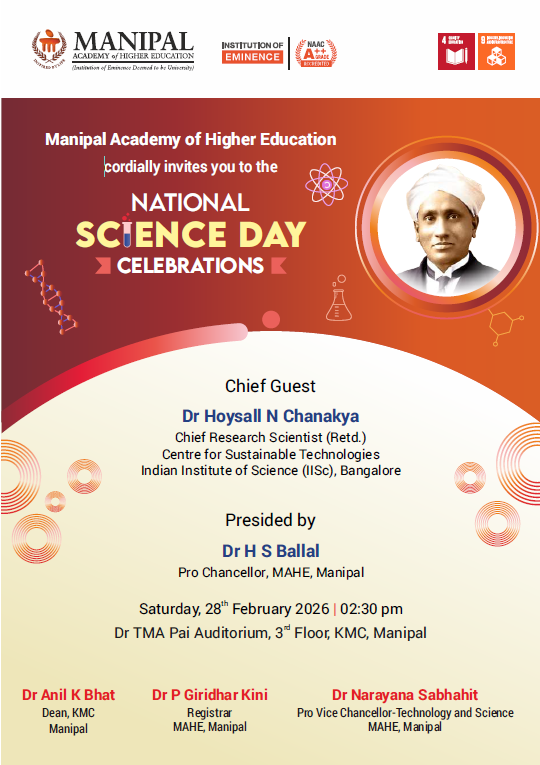
Manipal, Feb 19th: Manipal Academy of Higher Education (MAHE), an Institution of Eminence Deemed to be University, has partnered with OpenAI to integrate advanced artificial intelligence (AI) tools across teaching, research, and academic administration. This collaboration aims to enhance learning outcomes, accelerate research productivity, and equip students and faculty with critical AI skills for a rapidly evolving global workforce. MAHE will implement AI-powered tools and resources across its academic programs to support personalised learning, boost critical thinking, and encourage ethical AI use. Faculty will also gain access to advanced AI tools for curriculum planning, research, and innovation.

Lt. Gen. (Dr.) M D Venkatesh, Vice Chancellor, VSM (Retd.), MAHE, said, “MAHE has always been guided by academic excellence and innovation. Our partnership with OpenAI represents a strategic step toward embedding AI as a transformative enabler across teaching, research, and administration. By integrating advanced AI tools responsibly, we aim to enhance learning outcomes, accelerate research impact, and prepare our students for leadership in an AI-driven world.

The collaboration will focus on building AI literacy across disciplines, ensuring that students from Health Sciences, Technology & Science, Management, Law, Humanities & Social Sciences, and allied fields gain practical exposure to AI applications relevant to their domains. MAHE will also promote interdisciplinary research and innovation using AI to address complex real-world challenges.  MAHE will also establish structured AI governance guidelines to ensure responsible, ethical, and transparent governance use of artificial intelligence across academic functions.

The partnership aligns with MAHE’s long-term digital transformation roadmap and reinforces its commitment to innovation, industry relevance, and societal impact. With this collaboration, MAHE reinforces its vision of becoming a globally benchmarked, AI-enabled university committed to shaping responsible innovation and future-ready leaders.

Over 10,000 Students from 120 plus Schools Upskilled in AI Through ‘Udaan’, a Future Skills Initiative Powered by Sunstone

New Delhi, Feb 18th: Udaan, a large-scale Artificial Intelligence education initiative powered by Sunstone, has equipped over 10,000 students from Classes 11 and 12 with early, practical exposure to AI and emerging technologies. The initiative was conducted across three campuses in North India, bringing school students into real college learning environments and helping them experience how future skills are applied in practice.

The sessions were hosted at HiTech Institute of Engineering & Technology, Ghaziabad; IITM Murthal, Sonipat; and the Institute of Technology & Management (ITM), Dehradun. Students experienced campus life firsthand while gaining exposure to AI tools and real-world applications that are shaping modern careers.

With Artificial Intelligence rapidly transforming how students learn, work, and build careers, Udaan was designed to address a growing gap in early exposure to industry-relevant skills. The initiative reached students across academic streams, school boards including CBSE and State Boards, and both government and private institutions. By introducing AI at the school level, the programme aims to build awareness, confidence, and readiness for a technology-driven future.

Commenting on the initiative, Ankur Jain, Co-Founder and CBO, Sunstone, said, “AI is no longer a future skill. It is a present necessity. Through Udaan, we wanted students from every background to understand how AI can shape their learning journeys and future careers.”

During the programme, students participated in a structured learning experience that included interactive workshops on AI tools, hands-on lab sessions, and short assessments designed to reinforce practical understanding. They also received certificates of participation and gained insight into how AI tools are used by college students to enhance productivity, research, and problem-solving.

The initiative witnessed strong participation across regions. At HiTech Institute of Engineering & Technology, Ghaziabad, 3,200 students from 48 schools across Ghaziabad, Hapur, and nearby areas attended the sessions, with particularly strong engagement during hands-on lab exercises. IITM Murthal, Sonipat hosted 2,500 students from 40 schools, where practical demonstrations helped students understand real-world applications of AI beyond textbooks. At ITM Dehradun, 2,300 students from 37 schools participated, creating awareness around technology-driven learning and AI-enabled problem solving.

As part of Udaan, a Faculty Development Programme on Artificial Intelligence in Education was also conducted to ensure educators remain equipped to guide students in a technology-enabled learning environment. The sessions were led by experienced trainers and industry professionals who shared practical insights on AI tools, classroom integration, and evolving skill requirements in the digital era.

More than 100 school teachers participated in the programme, gaining hands-on exposure to AI-driven teaching approaches and modern learning tools. By strengthening educator capability alongside student learning, Udaan aims to create long-term impact and support the development of a future-ready education ecosystem.

XLRI Jamshedpur Reinvents HR Education with Second-Year Specialisations in its Flagship HRM Programme

Jamshedpur, Feb 18th: XLRI – Xavier School of Management, Jamshedpur, widely regarded as one of the finest institutions for Human Resource Management in the Asia-Pacific region, continues to reaffirm its leadership in HR education through a bold curricular innovation. Building on its rich legacy of producing HR leaders who occupy C-suite roles across national and multinational corporations—and academics who contribute to some of the world’s leading universities—XLRI’s flagship two-year HRM programme has introduced structured second-year specialisations.

Rather than resting on its formidable alumni legacy, XLRI’s HR programme has consistently evolved in response to the changing nature of work, organisations, and society. The newly introduced specialisations enable students to deepen their expertise in chosen domains such as Organisation Development, Compensation, Future of Work, Labour & Social Justice, and Employee Well-being, among others.

The first year of the HRM programme continues to provide a strong general management foundation. Students develop a comprehensive business perspective through rigorous engagement with Marketing, Operations, Finance, Strategy, and Information Systems, alongside core HR courses spanning Performance Management, Talent Acquisition, Learning and Development, and Employee Relations. The second year now offers a deliberate choice: depth through specialisation or breadth through a wide range of electives across HR and allied disciplines such as Strategy, Economics, and Information Systems.

Speaking on the philosophy behind the change, Dr. (Fr.) Sebastian George, SJ, Director, XLRI Jamshedpur, said: “XLRI has always believed that relevance is the true test of academic excellence. The introduction of second-year specialisations reflects our commitment to preparing HR professionals who are not only grounded in strong values and business understanding but also capable of deep expertise in emerging and complex domains of people management.”

Prof. Sanjay Patro, Dean (Academics), XLRI, highlighted the academic intent behind the redesigned structure: “The new specialisation framework gives our students meaningful choice. Some may wish to develop deep functional expertise, while others may prefer a broader, integrative perspective. Our curriculum now enables both pathways, without compromising the rigour and intellectual depth that XLRI is known for.”

Elaborating on the student experience, Prof. R. K. Premarajan, Chairperson – HRM Committee noted: HR roles today demand both strategic clarity and domain depth. By introducing specialisations, we are allowing students to align their learning journeys with their career aspirations—whether in advanced organisation development, rewards strategy, future-of-work challenges or socially responsible HR practice.”

With this initiative, XLRI reinforces its long-standing position as a thought leader in HR education—one that continuously re-imagines curricula to stay ahead of industry realities while remaining anchored in its mission of shaping responsible and impactful leaders. 

ASME Engineering Education Seminar on Drone Technology Highlights Industry-Ready Engineering Skills at REVA University

ASME Engineering Education Seminar on Drone Technology Highlights Industry-Ready Engineering Skills at REVA University
Bengaluru, Feb 17th: The ASME Engineering Education Seminar & Workshop on Drone Technology was held at REVA University as part of the Mechanical Engineering Education Summit (MEEd), focusing on bridging the gap between classroom learning and industry-led drone applications. Hosted in Bengaluru, a growing hub for aerospace, manufacturing, and deep-tech innovation, the seminar examined how engineering education must evolve to align with real-world deployment, regulatory requirements, and business-driven use cases in the drone ecosystem.

Organised by ASME Foundation India, the seminar emphasized  drone technology as an integrated, multidisciplinary system rather than a standalone technical skill. While access to basic drone assembly has become increasingly widespread, the seminar highlighted the growing demand for professionals who can combine mechanical design, electrical systems, digital intelligence, and business understanding to develop scalable, application-ready drone solutions. Through expert interactions and practical sessions, the programme highlighted the need for engineers to develop a broad, hands-on understanding of technology to build careers in drone manufacturing, testing, operations, and field deployment across sectors such as defence, agriculture, logistics, and infrastructure.

Speaking at the seminar, Mr. Madhukar Sharma, president and director of ASME India Private Limited, described the necessity of platforms such as MEEd and IMECE in keeping engineering education up to date with the realities of current engineering practice. “ASME is a not-for-profit, member-driven global engineering society committed to advancing industry-relevant learning and responsible innovation,” Sharma said. “Initiatives such as MEEd and global platforms including IMECE bring together academia, industry, and emerging technologies to shape future-ready engineers. India hosting IMECE outside the U.S. for the first time last year reflects the country’s growing contribution to the global engineering ecosystem. We look forward to the next edition of ASME IMECE India scheduled in Chennai this September.”

Setting the context of the Foundation’s work in relation to the seminar, MsAvni Malhotra, deputy director of  ASME Foundation India, highlighted the importance of application led engineering education. “At the ASME Foundation India, we focus on ensuring that engineering education translates into real-world impact—especially in contexts where access and opportunity are limited,” said Malhotra. “Through initiatives like MEEd, we work to connect students and educators with industry realities, social challenges, and innovation pathways, so that technology is developed not in isolation, but with purpose and relevance.”

Emphasising the role of industry exposure in preparing students for a rapidly changing job market, Dr. KS Narayana Swamy, pro vice chancellor, REVA University, noted that seminars and workshops such as the ASME MEEd programme help students remain relevant amid technological disruption. “Engineering careers today demand far more than academic credentials,” Swamy said. “Students must build problem-solving ability, communication skills, and adaptability, while engaging closely with industry to understand evolving expectations and future career pathways.

The seminar brought together professionals working closely with India’s growing drone and aerospace landscape. Industry leaders such as MrAbhishek Burman, co-founder and CEO, General Aeronautics Pvt Ltd; MrZain Saeed, co-founder and COO, Enord; DrAnanda CM, program director for Civil Aircrafts and head of the Aerospace Electronics Division, NAL; and DrSubrata Nayak, R&D technical lead, ideaForge Technology Inc., shared insights drawn from real industry experience. During the sessions, speakers broke down how drones move from concept to real-world use, covering design decisions, manufacturing processes, certification requirements, deployment challenges, and the regulatory landscape. The discussions also highlighted the blend of technical expertise and cross-functional skills needed to build sustainable careers in UAV-related fields.

Academic insights were shared by DrM. Sivapragasam, professor, M. S. Ramaiah University of Applied Sciences, and DrManjunath S V, associate professor and head of the Department of Aeronautical Engineering at Mangalore Institute of Technology and Engineering. They spoke about the need to better align academic curricula with industry expectations and to strengthen hands-on, experiential learning within engineering programmes.

The seminar also featured a hands-on workshop on Drone Technology in Mechanical Engineering Using ANSYS Simulation, conducted by MrGokul Raj M, technical account manager at Infinipoint Technologies Pvt Ltd, and powered by ANSYS, part of Synopsys. The workshop gave participants a practical look at how simulation tools and AI-enabled UAV workflows are used in real engineering environments, from design validation to testing and operational planning. Two other workshops were also organised: Enabling Next-Generation Autonomous System Workflows: From Design to Deployment by MathWorks, led by Ms. Richa Singh, application engineer, MathWorks; and Physics-Informed Machine Learning for Drones/UAV by ASME Cyber Physical Systems India, conducted by Mr. Anand Nagarajan of Airbus and Mr. Unnat Mankad  of Baker Hughes.

Beyond the technical sessions, the seminar created space for open conversations between faculty members, students, and industry professionals on curriculum relevance, evolving skill expectations, and on-the-ground industry realities. Participants also used the platform to network with practitioners and technology experts, underlining the value of industry-connected learning pathways in drone technology and related engineering fields.

Over the past two years, the MEEd Summits in India have played a key role in bridging the gap between industry and academia, with support from the MEEd India Steering Committee,comprising industry leaders, vice chancellors, and leading researchers. The seminar was supported by technology and industry partners, including ANSYS (part of Synopsys)Infinipoint Technologies, and MathWorks, strengthening the programme’s focus on applied learning, AI driven engineering workflows, and career-oriented skill development.