

India’s energy transition is creating a new investment opportunity as the country prepares for a sharp rise in demand for battery-based electricity storage.
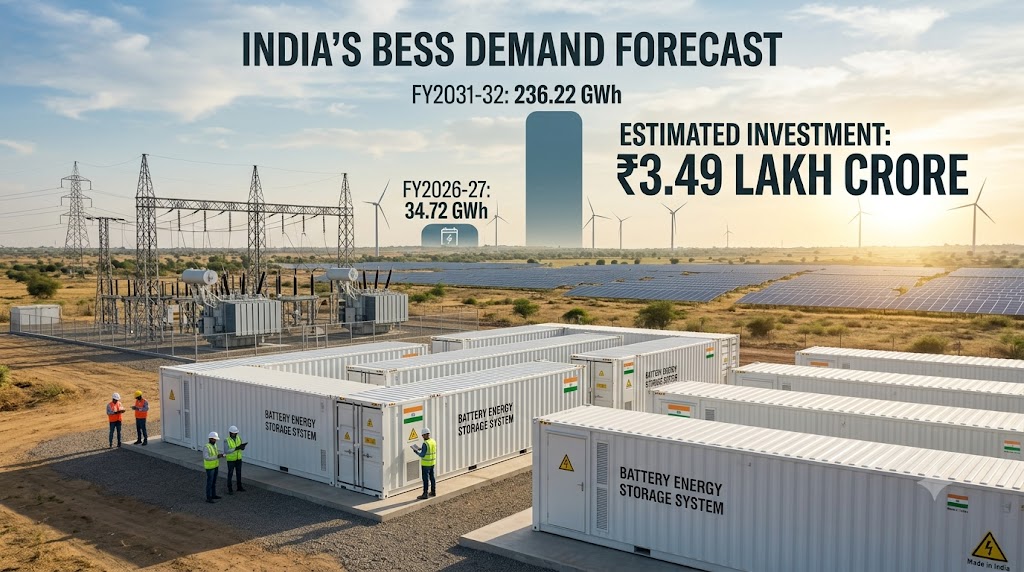
Battery Energy Storage System (BESS) requirements are expected to increase to 236.22 GWh by FY2031-32, compared with about 34.72 GWh in FY2026-27, according to a recent report. Meeting this growing requirement could require investments of around Rs 3.49 lakh crore.
The numbers highlight how energy storage is becoming an important part of India’s power strategy as renewable energy takes a larger role in electricity generation.
Why batteries are becoming essential
India is adding solar and wind power at a rapid pace. However, renewable generation is not available at a constant level throughout the day.
Solar plants generate most of their electricity during daylight hours, while demand can remain high in the evening. Wind generation can also change with weather conditions.
Battery storage can address this mismatch. Electricity generated when supply is high can be stored and released later when the grid needs additional power.
This makes storage increasingly important for maintaining grid stability while allowing India to add more renewable capacity.
A large investment opportunity
The projected investment requirement of Rs 3.49 lakh crore points to a sizeable business opportunity.
The growth will not be limited to battery projects. It is likely to create demand for battery manufacturing, power electronics, software, grid-management systems, engineering services and project financing.
For Indian companies, the sector could therefore become an important part of the broader clean-energy economy.
Renewable-rich states likely to lead
States with substantial solar and wind capacity are expected to remain at the forefront of battery-storage development.
Gujarat and Rajasthan have emerged as important markets for utility-scale storage because of their strong renewable-energy potential. As more renewable projects come online, large-scale storage can help these states manage fluctuations in electricity supply and improve the use of clean power.
Other states are also expected to expand storage capacity as electricity demand rises and grids become more dependent on renewable generation.
Domestic manufacturing remains important
The rapid growth of battery storage also brings attention to India’s dependence on imported battery cells and components.
Building a stronger domestic manufacturing ecosystem could help reduce supply-chain risks and give Indian companies a larger role in the global clean-energy market.
It could also encourage investment in battery technology, recycling, critical-mineral processing and other supporting industries.
Government support can accelerate the market
Policy support will remain critical for the sector. Measures such as viability-gap funding, energy-storage obligations and incentives for renewable integration are helping create a market for large-scale storage.
As the cost of batteries becomes more competitive and project pipelines expand, storage could increasingly become a standard component of large renewable-energy projects rather than an additional technology.
From renewable generation to reliable power
India’s clean-energy story is entering a more mature stage. Building solar and wind capacity is only one part of the transition. The bigger challenge is ensuring that renewable electricity remains available when consumers and businesses need it.
That is where battery storage can make a significant difference.
With demand expected to reach 236.22 GWh by FY32, India’s battery-storage industry is moving towards a major growth phase. The estimated Rs 3.49 lakh crore investment requirement reflects not only the scale of infrastructure needed but also the economic opportunity emerging around the country’s shift towards a more flexible, reliable and cleaner power system.
