

Imagine a world where a disease is recognised before it becomes life-threatening, where a doctor spends less time navigating paperwork and more time understanding a patient, and where quality medical guidance is no longer limited by geographical boundaries. This is not simply a vision of futuristic medicine; it represents the possibilities of a healthcare system reimagined through Artificial Intelligence (AI).
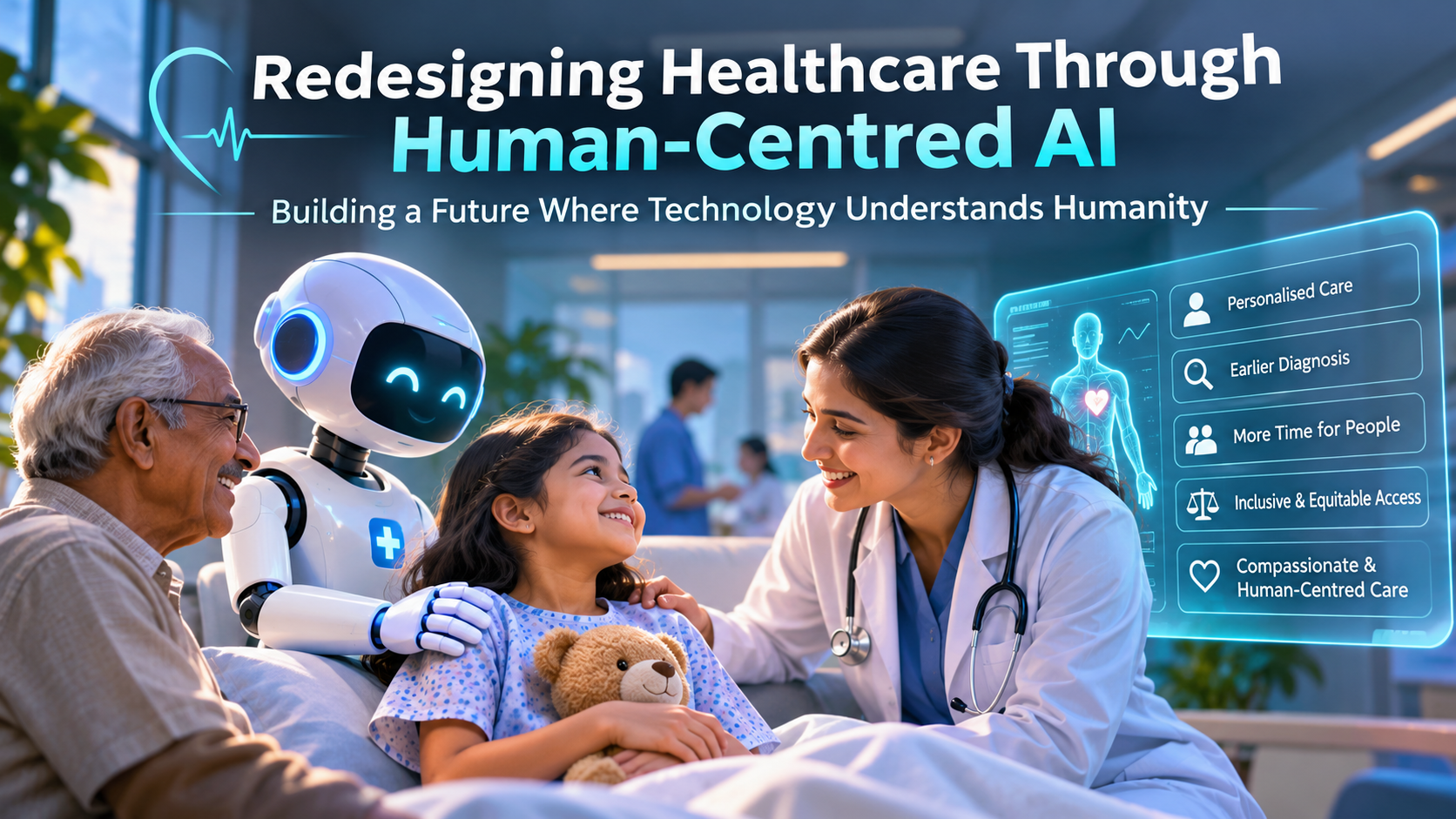
For generations, healthcare has been built around the fundamental relationship between a patient seeking help and a professional providing care. Today, however, this relationship faces growing pressure from increasing disease burdens, limited medical infrastructure, information overload, and unequal access to treatment. Technology has introduced remarkable possibilities, but innovation alone does not guarantee better care. A faster diagnosis means little if a patient feels unheard, and a sophisticated algorithm has limited value if its benefits remain inaccessible to those who need them most.
This is where Human-Centred AI introduces a different way of thinking. Instead of asking how healthcare can accommodate intelligent machines, it asks how intelligent machines can better accommodate human needs. It brings together computational intelligence and human understanding to create healthcare experiences that are more personalised, inclusive, transparent, and compassionate. From recognising patterns hidden within complex medical data to supporting doctors in making informed decisions, AI can become a valuable partner in delivering care that considers not just the disease, but the person experiencing it.
Ultimately, redesigning healthcare through human-centred AI is about redefining progress itself. It is about building a future where technology listens before it recommends, supports before it replaces, and empowers rather than excludes. Because the real intelligence of tomorrow’s healthcare will not lie in machines that can think independently, but in systems that help humanity care more intelligently.
Moving Beyond Traditional Healthcare
Traditional healthcare often follows a reactive approach: patients seek medical attention after symptoms appear, doctors diagnose conditions, and treatment begins. Although this approach has saved countless lives, it sometimes overlooks an essential aspect of health — prevention and individual patient needs.
Human-centred AI introduces a shift from reactive treatment to proactive, personalised, and preventive healthcare.
AI-powered systems can analyse medical histories, lifestyle patterns, diagnostic reports, and health records to identify potential health risks before they become serious. For example, AI can help detect early signs of diabetes, cardiovascular diseases, and certain cancers, allowing healthcare professionals to intervene sooner.
However, the real transformation is not simply the ability to predict diseases. It is the ability to understand each patient’s unique circumstances and support better decisions.
Making Every Patient Feel Seen Through Personalised Care
Every patient is different. Two individuals with the same disease may have different symptoms, medical histories, lifestyles, financial circumstances, and treatment responses.
A one-size-fits-all healthcare system cannot fully address these differences.
Human-centred AI makes personalised medicine more achievable by analysing patient-specific information and helping healthcare professionals develop suitable treatment strategies.
For instance, AI can assist doctors in identifying which treatments may be more effective for a particular patient based on their medical history, genetic information, and clinical characteristics.
Wearable devices and smart health applications can also monitor heart rate, sleep patterns, physical activity, and other health indicators. This enables continuous monitoring beyond hospital walls.
The goal is simple: healthcare should adapt to the patient, rather than forcing every patient to adapt to the healthcare system.
Giving Doctors More Time to Be Human
One of the biggest challenges in modern healthcare is that medical professionals often spend considerable time on paperwork, documentation, scheduling, and administrative responsibilities.
As a result, valuable time that could be spent listening to patients and understanding their concerns is sometimes reduced.
Human-centred AI can help address this problem through intelligent automation.
AI-powered tools can:
-
Organise and summarise electronic health records.
-
Assist with clinical documentation.
-
Support medical image analysis.
-
Identify potential medication interactions.
-
Help prioritise patients who require urgent attention.
-
Provide clinical decision support.
These technologies do not eliminate the need for medical expertise. Instead, they reduce repetitive workloads and allow healthcare professionals to focus on what matters most: clinical judgement, empathy, communication, and patient care.
A successful healthcare AI system should not measure its success only by how many tasks it automates, but also by how much meaningful time it gives back to healthcare professionals.
Breaking Barriers Through Accessible Healthcare
Quality healthcare should not depend on where someone lives, how much money they earn, or how easily they can reach a hospital.
Unfortunately, rural communities and underserved populations often experience shortages of doctors, specialists, diagnostic facilities, and medical infrastructure.
Human-centred AI has the potential to make healthcare more inclusive.
AI-powered telemedicine platforms can connect patients in remote areas with healthcare professionals. Multilingual virtual assistants can help individuals understand basic health information, navigate appointments, and access medical services.
In countries like India, where healthcare access varies significantly between urban and rural communities, AI-enabled healthcare solutions could support wider access to medical guidance and early screening.
However, accessibility requires more than advanced software. Systems must support local languages, affordable devices, low-bandwidth internet connections, and people with limited digital literacy.
Technology becomes meaningful only when the people who need it most can actually use it.
Designing AI With Empathy, Ethics, and Trust
One of the most important challenges in AI-driven healthcare is maintaining patient trust.
Healthcare information is deeply personal. Medical records contain sensitive details about an individual’s physical condition, mental well-being, and medical history. Therefore, AI systems must be designed with strong privacy and security protections.
Another concern is algorithmic bias. If an AI model is trained using incomplete or unrepresentative medical data, it may produce less accurate results for certain populations.
For example, a diagnostic algorithm developed primarily using data from one demographic group may not perform equally well across different ethnicities, age groups, or genders.
To make AI genuinely human-centred, healthcare organisations must prioritise:
-
Transparency: Patients and doctors should understand how AI contributes to medical decisions.
-
Privacy: Personal health information must be protected.
-
Fairness: AI systems should be evaluated across diverse populations.
-
Accountability: Qualified healthcare professionals must remain responsible for clinical decisions.
-
Patient consent: Individuals should understand when and how their data is being used.
AI should support human decision-making, not become an unquestionable authority.
The Future of Healthcare: From Hospitals to Intelligent Health Ecosystems
The next generation of healthcare will extend beyond hospitals and traditional clinics.
Imagine a future where a patient wakes up and receives a personalised health insight from a wearable device. The system notices an unusual health pattern, compares it with previous information, and recommends an appropriate medical consultation.
Before the appointment, an AI assistant prepares a summary of the patient’s health history for the doctor. During the consultation, the doctor uses this information to make an informed decision. After treatment, the patient receives personalised follow-up guidance and reminders.
In this ecosystem, AI connects patients, doctors, laboratories, pharmacies, and healthcare institutions.
But the most important part of this future is not the technology itself. It is the continuous relationship between people and healthcare services.
The hospital of tomorrow should not simply be a place where diseases are treated. It should be part of an intelligent ecosystem that continuously supports healthier lives.
Human-Centred AI in India: An Opportunity for Transformation
India has a unique opportunity to demonstrate how human-centred AI can transform healthcare at scale.
With a large and diverse population, the country faces challenges involving healthcare accessibility, affordability, infrastructure, and the distribution of medical professionals.
AI can contribute to addressing these challenges through:
-
AI-assisted screening for common and serious diseases.
-
Digital health records that improve continuity of care.
-
Telemedicine services for remote communities.
-
Multilingual healthcare information platforms.
-
AI-assisted medical imaging and diagnostics.
-
Predictive systems that help hospitals manage resources.
Initiatives such as the Ayushman Bharat Digital Mission provide an important foundation for strengthening digital healthcare infrastructure.
Nevertheless, innovation must be developed responsibly. Solutions should reflect India’s linguistic, cultural, economic, and geographical diversity rather than assuming that a single technological model will work for everyone.
The real measure of progress will be whether healthcare innovation reaches underserved communities and improves everyday patient experiences.
Reimagining the Relationship Between Humans and Machines
There is a common fear that artificial intelligence will eventually replace healthcare professionals. However, healthcare is not simply a process of identifying diseases and recommending medicines.
It also involves understanding fear, providing emotional reassurance, respecting patient choices, and making difficult decisions.
A machine may analyse thousands of medical images in seconds, but a compassionate doctor understands the anxiety of a patient waiting for a diagnosis.
An AI assistant may provide health recommendations, but a nurse offers reassurance through a conversation, a comforting gesture, and personal attention.
This is why the future of healthcare should be based on human-AI collaboration.
Machines should contribute speed, analytical capability, and consistency. Humans should provide empathy, ethical judgement, creativity, and responsibility.
The strongest healthcare systems will emerge when these capabilities work together.
Conclusion: Technology Should Advance, but Humanity Must Remain at the Centre
Redesigning healthcare through human-centred AI is not merely a technological transformation; it is a transformation in how society understands care.
The purpose of artificial intelligence should not be to create hospitals filled with sophisticated machines or healthcare systems driven entirely by algorithms. Its purpose should be to make healthcare more accessible, affordable, personalised, efficient, and compassionate.
As AI continues to evolve, healthcare organisations must remember that behind every medical report is a person, behind every diagnosis is a story, and behind every treatment decision is a human life.
The future of healthcare will not be defined by how intelligent our machines become, but by how effectively we use that intelligence to improve human lives.
