Archives 2026

Qualcomm-Backed Arduino Teams with Get Set Learn to Boost STEAM Education in India

New Delhi, Feb 26: Get Set Learn, an Arvind Mafatlal Group company focused on future-skills education, today announced a strategic collaboration with Qualcomm Technologies, Inc. and Arduino, provider of a leading open-source electronics platform, to strengthen AI, electronics, and emerging technology education for K–12 learners in India.

As artificial intelligence rapidly evolves beyond the cloud and into real-world physical systems, powering robotics, automation, sensing, and intelligent decision-making, equipping students with the ability to build and apply these technologies has become essential for future workforce readiness and national competitiveness. Through this collaboration, Qualcomm Technologies, Inc., Arduino, and Get Set Learn will bring Physical AI learning and future-ready curriculum into India’s K–12 education ecosystem.

The collaboration aims to make advanced technology more accessible, practical, and buildable in real classrooms. By combining Arduino’s open, developer-trusted hardware and toolchains with Qualcomm Technologies’ energy-efficient on-device and edge AI capabilities, students will gain hands-on experience in designing and building intelligent physical systems that can operate reliably, even in low-connectivity and resource-constrained environments common across India.

Under the collaboration, Get Set Learn, Qualcomm Technologies, Inc. and Arduino intend to:

  • Design and deploy classroom-ready learning pathways that integrate electronics, coding, robotics and artificial intelligence to measurable outcomes from grades K 12.
  • On-device, edge AI experiences where learners design, deploy, and iterate physical systems locally, minimizing cloud dependence while improving responsiveness, privacy, and cost efficiency.
  • Support the transformation of ATL and STEAM labs into structured, certification-led learning spaces aligned with future skills and life skills development
  • Implementation at scale through Get Set Learn’s national school partnerships and content ecosystem, ensuring consistent, classroom level level impact across public and private education systems.

Built for India, Aligned to Global Standards

The initiative embraces open, widely adopted global standards and toolchains so schools can invest with confidence. By focusing on physical computing with on-device AI, programs remain resilient to connectivity variability, reduce recurring costs, and teach the architectural fundamentals engineers use to ship real products- sensing, actuation, control loops, and local inference.

From First Principles to Real-World Impact

Students progress from fundamentals to deployable systems: reading sensors, controlling actuators, implementing feedback and safety, and integrating perception tasks like vision and audio. The result is a portfolio of practical builds and certifications that map to higher education and entry-level industry pathways, building confidence and capability early.

As the implementation partner, Get Set Learn will lead on-ground implementation through its content ecosystem and school partnerships, ensuring that global technology platforms are translated into consistent, classroom-level impact. The initiative aligns with national priorities around digital literacy, innovation and workforce readiness, and reflects Get Set Learn’s focus on delivering future skills at scale.

Savi Soin, Qualcomm Technologies, Inc. Senior Vice President & President, Qualcomm India, commented

India’s AI future will be built on locally deployed, energy-efficient physical intelligence, and that essential journey must begin in our classrooms today. Through our partnership with Get Set Learn, we are placing edge AI directly into students’ hands through accessible, standards-aligned platforms, thereby empowering the next generation of builders to tackle real-world challenges right where the data and people are.”

For India, the question is no longer whether we will participate in the AI era, but whether we will shape it with depth, capability, and responsibility,”

Priyavrata Mafatlal, Vice-Chairman, Arvind Mafatlal Group and Founder of Get Set Learn.

“The partnership creates a practical platform that complements classroom learning by giving students exposure to future skills through building real systems and engaging with real-world problems. If we want a resilient innovation economy, we must start by building confidence and competence in classrooms- early, locally, and at scale.”

“Get Set Learn’s mission is to ensure that future skills are not limited to a few classrooms, but reach learners across geographies and school systems,” said Ameet Zaverii, CEO & Co-founder, Get Set Learn. “By working with Qualcomm Technologies and Arduino, we are bringing together global technology leadership and hands-on learning to create structured, scalable education models that are ready for real classrooms.”

“Arduino has always stood for accessible innovation,” said Fabio Violante, Qualcomm Technologies, Inc. Vice President & General Manager, Arduino, “Together with Qualcomm Technologies and Get Set Learn, we’re scaling Physical AI education so every learner can build, test, and deploy intelligent systems, from first prototypes in school to real solutions in their communities.”

Further details on implementation and scale will be shared at the February 2026 AI Summit, marking the next phase of the collaboration to strengthen AI and future-skills education in India
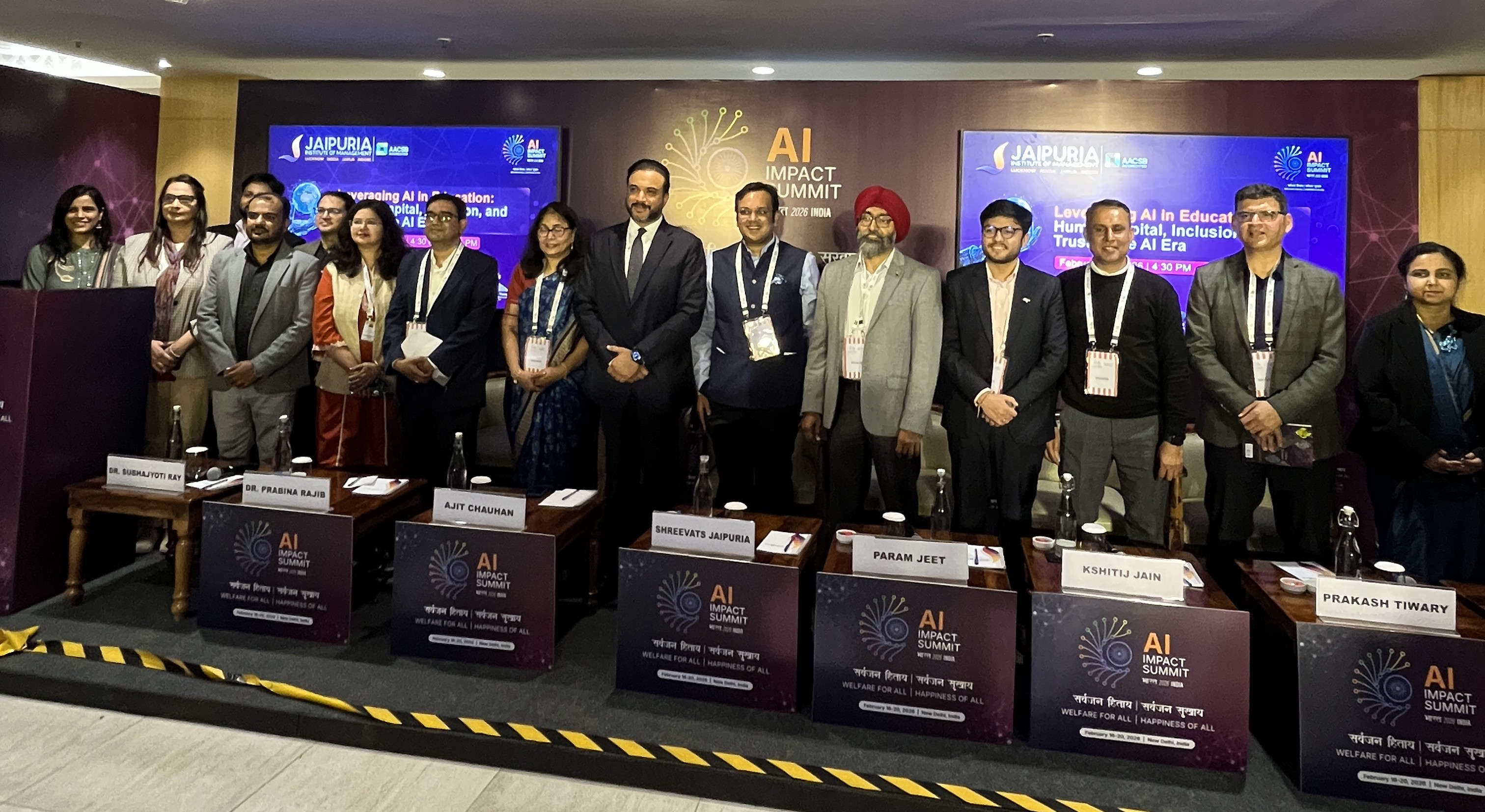
Jaipuria Group Emphasizes Human Accountability in AI Education at India AI Impact Summit 2026

New Delhi, Feb 26: Seth M.R. Jaipuria Group outlined its position on the future of AI in education at the India AI Impact Summit 2026, held in New Delhi, addressing its approach to integrating AI tools within structured academic systems.

The panel discussion, titled Leveraging AI in Education: Human Capital, Inclusion, and Trust in the AI Era,” was held in New Delhi and moderated by Dr. Subhajyoti Ray, Director, Jaipuria Institute of Management, Noida. The session brought together academic leaders and industry representatives to examine how AI is reshaping expectations from students, faculty, and institutions.

The discussion began with an analysis of how AI is changing what is expected of both students and teachers. Panellists discussed the need to differentiate between technical capabilities and human accountability. During the session, Mr. Shreevats Jaipuria, Vice Chairman, Seth M.R. Jaipuria Group, spoke about the importance of building education systems that are AI-native without losing their human core. He said, “While artificial intelligence has expanded access to information and analysis, responsibility for decisions with long-term consequences continues to rest with people.” According to him, institutions must design learning environments where students work with AI regularly from early age as it’s the need, while also developing judgment and accountability on the sidelines.

Expanding on this, Mr. Jaipuria noted that across the Group’s education institutions, tools such as Script/OneCV for résumé optimisation, rehearse for interview simulations, Showrunner for project management, and the AI Space for real-world practice are being integrated into everyday learning. He added that teaching, mentoring, interaction, and reflection through human engagement should be given equal importance.

The discussions concluded with a structured analysis of how schools and higher education institutions are adapting curricula, assessment methods, and skill-development frameworks to align with AI-enabled workplaces.

Toray Develops Bio-Based Polyamide 4 Production Technology for Cosmetics Microparticle Market

Tokyo, Japan, Feb 26 – Toray Industries, Inc., announced that it has developed a proprietary technology to produce bio-based 2-pyrrolidone, a raw material in its polyamide 4, which delivers excellent biodegradability (see note 1) in marine and other environments and helps address microplastic issues. The company will use this technology to verify the scale-up of bio-based polyamide 4, with a view to offering it by the fiscal year ending March 2029, mainly for microparticles in foundation, eyeshadow, and other cosmetics.


In recent years, ocean discharges of microplastics (note 2) from cosmetics and facial cleansers have become a key environmental issue, prompting various countries (note 3) to restrict their use. Toray set about developing and launching polyamide 4 in response to this situation.

The conventional feedstock for 2-pyrrolidone, the raw material in polyamide 4, is petroleum-based. Toray embarked on R&D into synthesis approaches with sugars and other biomass sources, resulting in its bio-based version. The sizes and shapes of polyamide 4 microparticles from polymerizing and processing 2-pyrrolidone with this technique are comparable to those of conventional offerings. This bio-based feedstock conversion does not affect end products.

 It is also worth noting that reactions are milder than those of regular petrochemical processes. Toray’s breakthrough should help lower carbon dioxide emissions across the value chain, from raw materials through polyamide 4 microparticle production.

The applications of 2-pyrrolidone made with Toray’s technology extend well beyond polyamide 4. It is also a feedstock for N-methylpyrrolidone, used extensively in manufacturing semiconductor materials and engineering plastics (note 4), and for N- vinylpyrrolidone (note 6), a monomer for high-performance polymers in pharmaceuticals and other applications. This opens the door to bio-based production across diverse materials supporting next-generation industries.

Toray is pushing ahead with initiatives to transition to a circular economy and conserve natural resources as part of its sustainability efforts. The company will accordingly keep pursuing R&D in keeping with its commitment to delivering new value and contributing to social progress.

 Results from the Ministry of Environment-funded Projects to Promote the Construction of Decarbonized Circular Economy Systems (FY2023 and FY2024) contributed to Toray’s technological breakthrough.

Notes

1.  With biodegradation, bacteria, fungi, and other microorganisms break down organic compounds into simpler inorganic substances, including water and carbon dioxide. Biodegradation is generally slower in the sea, where microorganisms are less abundant than in the soil.

2.  Microplastic particles are smaller than 5 mm. They include primary microplastic microbeads in products like facial cleansers and secondary microplastic fragments from the degradation and fragmentation of items like plastic bottles and shopping bags owing to ultraviolet radiation and waves. There are concerns about the adverse effects of microplastics on ecosystems and human health across the food chain.

3.  Strengthening of Microplastic Regulations Worldwide

Europe amended its Registration, Evaluation, Authorization and Restriction of Chemicals regulation in 2023 to prohibit the use of cosmetics and other products intentionally incorporating microplastics after a transition of six to 12 years. The regulation exempts plastics meeting specific biodegradability test standards. Toray’s polyamide 4 microparticles meet the OECD 301F ready biodegradability standard and are thus not subject to this regulation.

4.  Engineering plastics offer high mechanical strength and heat resistance. Their light weight and high performance make them common substitutes for metals, including in automotive parts.

5.  N-methylpyrrolidone is a liquid compound in which a methyl group replaces the hydrogen on the nitrogen atom of 2-pyrrolidone. It has a high boiling point, excellent chemical stability, and strong solvency for diverse compounds, and is a common cleaning agent, paint stripper, and solvent.

6.  N-vinylpyrrolidone is a liquid compound in which a vinyl group replaces the hydrogen on the nitrogen atom of 2-pyrrolidone. Polymerization from the vinyl group yields polyvinylpyrrolidone. It serves as a thickener in cosmetics, a binder in pharmaceutical tablets, and a clarifying agent in alcoholic beverages.

Himalayan Siddhaa Akshar Highlights How Precise Bhramari Pranayama Transforms Brain and Nervous System

Himalayan Siddhaa Akshar, Author, Columnist, Founder: Akshar Yoga Kendraa, Work: Yoga and spiritual leader

Why Correct Application of Bhramari Pranayama Changes Its Impact on the Brain

Bhramari pranayama is usually related to rest and peace of mind. While this description is accurate, it does not fully explain the profound neurological influence the practice can have when applied correctly. Calmness is not the final result but an apparent consequence of the more profound processes of control that take place in the brain and the nervous system. Its actual difference consists not in the practice, but in its application.

When Bhramari Pranayama is performed with precision–integrating posture, breath rhythm, sound vibration, and hand placement–it influences brain coherence, autonomic balance, and cognitive regulation in measurable and lasting ways. Misuse or incomplete use will reduce the practice to a temporary calming procedure unless proper use will convert it to a way of conscious control of the nervous system.

The Brain as a Rhythmic System.

The human brain works based on the rhythmical electricity. These rhythms–commonly referred to as brain waves–govern perception, emotional response, attention, and decision-making. When neural rhythms become disorganized, the individual experiences anxiety, restlessness, emotional volatility, and mental fatigue. When these rhythms are synchronized and stable, clarity, focus, and emotional steadiness naturally emerge.

The constant rhythmic input is presented by Bhramari Pranayama. The humming sound produced internally is a vibratory signal that is interacting with the existing neural vibrations. As opposed to external sound, which has to be converted, sifted, and translated, internally generated vibration bypasses numerous stages of sensory multifaceted, and has a direct effect on neural timing and coordination.

Internal Sound and Neural Interaction

Vibration of sound created during Bhramari goes through the cranial cavity, sinuses and bones of the face as well as tissues surrounding the head. These vibrations activate auditory processing, interoceptive, and emotional regulation neural pathways. Since the sound is generated inside a body, it is perceived by the brain as an internal stimulus or signal and not as an external stimulus.

This difference is essential. Internal vibration is processed differently by the nervous system. It encourages assimilation and not response. Circuitry that is used in the detection of threats or sensory alertness subside, whereas networks that are used in regulation and coherence get stronger.

The Role of Sensory Withdrawal

Proper use of Bhramari has the position of hands being applied in deliberate manner thus minimizing outside sensory stimulus. Sensory points on the face are stabilized and the ears are closed softly, which means that the brain receives fewer external signals when the ears are closed. This sensory withdrawal allows internal signals–breath rhythm, vibration, and bodily awareness–to take priority.

The neuroscience research on sensory suppression shows that the reduction of the external stimuli maximizes the activity of the brain networks related to self-regulation and introspective awareness. Meanwhile, the background neural noise which is associated with distraction and rumination reduces. This is also done naturally in Bhramari by posture and the position of the hands instead of by means of a concentrated effort.

Breath Rhythm and Autonomic Balance

The major connection between conscious action and autonomic functioning is breath. Bhramari Pranayama involves slow breathing with a long exhalation of humming, which is a decisive factor in the work of the nervous system.

Prolonged exhaled stimulates the vagus nerve which controls the parasympathetic. This transition facilitates a non-dull relaxation. The heart rate variability is enhanced which indicates that the heart and the brain communicate better. Emotional processing centers get more stable and impulsive reactions to stress are decreased.

More to the point, it is not a state of suppression. The nervous system is not being induced to calmness. Rather it is steered towards coherence by rhythmic contribution.

From Relaxation to Calm Alertness.

Calm alertness is one of the greatest results of properly administered Bhramari. This condition contrasts with sedation or mental retardation. The level of awareness is high, with low reactivity. Attention becomes sustained rather than scattered. Emotional responses become measured rather than impulsive.

Cognitive resources are saved in this state. The brain does not spend as much energy in processing inner noise or emotional changes. This allows higher-order functions such as reasoning, creativity, and decision-making to operate more efficiently.

Neural Adaptation Through Consistency.

Nervous system becomes accustomed to repetition. When there is proper and regular practice of Bhramari, the brain will begin to accept the mode of vibratory-breath as a normal existence. Over time, this leads to durable changes in stress response, attention span, and emotional regulation.

The practice adapts the neural behavior of baselines instead of relief, which is short-lived. The reaction to stress is minimized. Healing of emotional disturbance is quicker. Mental clarity becomes easier to access.

Such adaptive process requires regularity and accuracy. Improper or unbalanced practice will result in inconsistent input, which restricts neurological transformation in the long term.

Method Over Effort

Himalayan Siddhaa Akshar stresses that the transformational effects of Bhramari are a result of a method rather than a result of effort. Straining the breath, forcing the sound, or applying excessive pressure disrupts neural harmony. Precision of posture, gentle hand placement, balanced breath, and smooth vibration allow the brain to reorganize itself naturally.

The rationale behind the practice is that it honors the smartness of the nervous system. It is a structured input and the response of biological processes to it is organic.

Relevance in the Modern Cognitive Environment

Modern life is characterized by constant sensory stimulation, information overload, and chronic cognitive demand. Constant internal coherence in the brain is hardly ever experienced. Over time, this leads to fatigue, anxiety, and reduced emotional resilience.

When practiced properly, Bhramari Pranayama provides an effective and scientifically-supported approach to overcome such effects, being non-invasive. It does not involve the use of external resources, medication, or complicated intervention. It relies on breath, sound, and posture to restore neural balance from within.

Conclusion: Precision Determines Outcome

By integrating sound vibration, breath rhythm, sensory withdrawal, and intentional posture, Bhramari reorganizes neural activity toward coherence and stability. In doing so, it offers a pathway to sustained mental clarity, emotional balance, and cognitive resilience in an increasingly overstimulated world.


Kyndryl Launches Cyber Defense Operations Center to Unify Enterprise IT Operations

Business Wire India

Kyndryl, a leading provider of mission-critical enterprise technology services, today launched its first Cyber Defense Operations Center, a next-generation command hub that unifies network operations and security operations into a single, integrated operating model. The new Center is located in Bengaluru, India, providing global customers with deep cybersecurity and network operations expertise to accelerate incident response, resilience, and overall IT performance.


Enterprises are increasingly confronted by rising IT complexity — including AI-driven cyber risks, costly downtime, and growing expectations for continuous service delivery, and they face mounting pressure to deliver always-on, highly secure digital services. According to the 2025 Kyndryl Readiness Report, only 31% of organizations are ready for external business risks, citing technology complexity is cited as a top barrier to scaling AI. This shift is being accelerated by the rise of agentic AI operating autonomously across cloud, data centers, and edge environments, making it untenable for network and security operations to function in isolation.


“As AI adoption surges and hybrid IT environments become more distributed, enterprises face faster, more intelligent cyber risks — and a growing shortage of skilled talent to manage them,” said Paul Savill, Global Cyber Security and Resiliency, Network and Edge Practice Leader, Kyndryl. “Kyndryl’s Cyber Defense Operations Center introduces a unified, agile operating model that combines AI-enabled insights with deep networking and security expertise, helping customers strengthen resilience, accelerate incident response, and increase end-to-end visibility across the IT ecosystem.”


Kyndryl’s Cyber Defense Operations Center breaks down traditional silos to deliver realtime visibility, unified monitoring, and collaborative analysis across the network and security landscape. Featuring endtoend services — spanning advisory, design and implementation, and managed operations — the Center helps enterprises modernize and operate their IT environments with greater security, efficiency, and uptime.


Kyndryl’s offers a unique combination of capabilities, supported by the Company’s global network of security and network specialists trained to operate complex, mission-critical environments at scale, including:

  • AI-enabled assessment services – The Kyndryl Agentic AI Framework is embedded into the network security assessment services to evaluate customer environments, identify operational and security gaps, and prioritize remediation — creating a datadriven roadmap for modernization and managed operations.
  • Role-based operational dashboards and collaboration – Personadriven dashboards provide tailored, realtime insights for executives, security and network teams, incident commanders, and DevSecOps leaders — improving visibility and collaboration across roles.
  • Automated end-to-end operations at scale – Integrated runbooks, security telemetry, playbooks, and rationalized toolsets reduce manual handoffs, and alert fatigue to accelerate detection and response while providing Zero Trust support.


Kyndryl’s Cyber Defense Operations Center builds upon the company’s established global footprint of security operations centers and network operations centers located across North America, Europe, AsiaPacific, and Latin America. The Center will be integrated into Kyndryl Bridge, the company’s AIpowered openintegration platform, to provide a single operational view of network and security telemetry. Together, these centers provide 24×7 monitoring, threat detection, incident response, and network performance management for customers worldwide. Kyndryl plans to expand the Center beyond the India location to support growing global demand and accelerate adoption of Kyndryl’s integrated operating model.


The new Center is the latest addition to Kyndryl’s robust portfolio of network and security services designed for the AI era — including advanced data center networking, secure access service edge (SASE), and quantum-safe networking services.


Learn more about Kyndryl’s security and resiliency services and network and edge services.

Sun Neo | Kushagre Dua on Handling Comparisons and Passion in Prathaon Ki Odhe Chunri: Beendani: I believe that when you take pressure you lose…

Starting something new, especially after a big change, often brings expectations and comparisons along with it. Recently, Prathaon Ki Odhe Chunri: Beendani underwent a major transformation with its generation leap, introducing new faces and a fresh direction to the story. After this change, Kushagre Dua, who is playing the lead role of Garv in the show, shared his thoughts on pressure and comparison. Kushagre opens up about how he looks at this new phase and what it means to him as an actor.

Sharing his thoughts on handling pressure, Kushagre said, “I don’t feel any pressure at all. I believe that when you take pressure, you lose your creativity. I stay focused on my character and my acting. I try to understand the character deeply, and once I do that, ideas automatically come to my mind. I just follow those ideas and give my hundred percent to every scene. I am someone who believes in going with the flow and trusting the process.”

Further talking about the comparisons, he added, “If we talk about comparing the old characters with the new ones, that is natural in the beginning because a lot has changed in the show. But the best thing we can do is give our best and stay honest to our work. The real happiness will be when people stop comparing and start remembering us because of our character. That will be a big win for us as actors.”

Watch Prathaon Ki Odhe Chunri: Beendani Everyday at 09:00 PM only on Sun Neo

Youthbeat Secures “Myntra Style Squad” Campaign to Strengthen Creator-led Fashion Influence

New Delhi, Feb 26th: Youthbeat, the youth and creator-focused division of SW Network, a leading integrated advertising agency, has won the Myntra Style Squad campaign. As part of the engagement, Youthbeat will curate a squad of influencers to deliver fashion-forward content for Myntra.

Under this mandate, the team will build and manage a dedicated group of creators across fashion, lifestyle, and youth culture. The focus is on authentic, creator-led storytelling that feels relatable, current, and aligned with how young audiences engage with fashion today.

Expressing excitement about the collaboration, Raghav Bagai, Co-Founder, Youthbeat, said, “We are thrilled to partner with Myntra once again and support their mission of strengthening digital fashion culture. With a powerful line-up of talented creators and a long-term, structured content journey, we aim to craft engaging and trend-forward narratives that resonate with Myntra’s audience. Our focus is on delivering consistent impact while driving measurable value.”

Shubham Chawla, Business Head – Creator & Influencer Vertical, Youthbeat, said, “Creators today play a powerful role in shaping fashion discovery and purchase decisions among young consumers. With the Myntra Style Squad, our goal is to build a high-impact creator ecosystem that blends cultural relevance, trend awareness, and authentic storytelling. By combining Myntra’s strong fashion authority with our creator-first approach, we aim to deliver content that not only inspires but also drives meaningful engagement and long-term brand affinity.”

Commenting on the collaboration, Monalisa Panda, Head of Social, Myntra, said, “Creator-led storytelling continues to be a key growth driver for the fashion category. Partnering with agencies that deeply understand consumer behaviour and prioritise authenticity in content is crucial. Youthbeat’s proven track record and strong creator network make them an ideal partner for the Myntra Style Squad initiative. We look forward to amplifying our brand voice and unlocking new possibilities together.”

With a strong track record of large-scale influencer campaigns, Youthbeat continues to be a trusted partner for brands leading with content and community. The Myntra Style Squad reflects a shared vision to create fresh, inspiring, youth-led fashion content across India.

Africa, Venezuela Advance Practical Trade and Investment Cooperation

Venezuela Advance Practical Trade and Investment CooperationThe African Energy Chamber’s delegation to Caracas advanced cooperation with Venezuelan authorities on expanding trade beyond energy, addressing regulatory bottlenecks and promoting reciprocal investment across the Global South

CARACAS, Venezuela, Feb 26:A high-level working visit to Caracas by the African Energy Chamber (AEC) (https://EnergyChamber.org) this February marked a significant step in strengthening Africa–Venezuela cooperation, moving engagement beyond hydrocarbons toward broader South–South trade and investment opportunities. The discussions focused on removing longstanding transactional bottlenecks and boosting bilateral trade in goods, services and industrial collaboration.

Leading discussions with Coromoto Godoy Calderón, Minister of Foreign Trade of the Bolivarian Republic of Venezuela, the AEC delegation explored strategies to expand African markets for Venezuelan goods while facilitating reciprocal African investment in Venezuela. The visit emphasized creating a comprehensive framework for trade that extends beyond oil and gas, promoting manufactured goods, services and skills exchange.

“Together with the Minister, we discussed opening up African markets on a Global South–South strategy,” said NJ Ayuk, Executive Chairman of the AEC. “A priority is working on Venezuelan goods in Africa – not just energy. We are committed to removing bottlenecks, improving regulations and building a framework that accelerates trade and development between our regions.”

The visit also addressed potential alignment with the African Continental Free Trade Area, signaling new pathways for Venezuelan products to access African markets under continental trade frameworks. This reflects a growing interest in integrated commercial engagement that leverages shared resources and strengthens economic ties between African nations and Venezuela.

Institutional cooperation was another key focus. The AEC and Venezuelan authorities agreed on the importance of sharing best practices to position Venezuela as an attractive partner for African investors. Programs are being developed to promote Venezuelan products in African markets while encouraging investment in Venezuela’s broader non-oil economy.

Financial collaboration is central to this strategy. The delegation met with the Venezuelan Export–Import Bank to explore partnerships with African regional development banks and export finance institutions. These initiatives aim to facilitate trade finance, streamline payments and reduce transaction risks, providing a clearer, bankable framework for industrial and commercial projects.

Both sides pledged to showcase Venezuela in key African trade platforms, including the Intra-African Trade Fair organized by Afreximbank, and African Energy Week 2026, where Venezuelan products and expertise can be highlighted. Capacity-building workshops are planned to strengthen skills and technical exchange, reinforcing long-term trade and industrial collaboration.

The working visit marks a shift from energy-centered engagement to a broader, market-oriented partnership. By addressing regulatory challenges, expanding institutional cooperation and promoting trade-enabling frameworks, Africa and Venezuela are laying the foundations for reciprocal investment, industrial growth and deeper integration across the Global South.

“Our focus is on enabling trade that drives development. By working together to break down bottlenecks and expand commercial exchange, we are helping to shape a future in which African and Venezuelan economies grow stronger through partnership – not just in energy, but across the full spectrum of goods, services and investment,” Ayuk added.

Neilsoft Q3 – F.Y. 2025-26 Shows Good Recovery After Slower Growth in H1 F.Y. 2025-26

Business Wire India

Neilsoft Limited, a technology-driven, pure-play engineering services and solutions company operating in the ER&D industry catering to the Architecture, Engineering and Construction (AEC), Manufacturing and Industrial Plant segments globally, today released its Q3, F.Y. 2025-26 results following the Board approval in its meeting held on February 20, 2026.  

Mr. Nilesh Malpani, CFO, commenting on the results, said, “Our Q3 Revenues stood at Rs. 1,259.95 Mn. reflecting YoY growth of 18.1% (in Rs. terms) and QoQ Revenue growth of 25.9%.  In US $ terms, Q3 FY 2025-26 revenue grew 16.2% YoY.  We estimate Q4 Revenue to come in at a similar level as Q3 and are pleased to see a good acceleration in our YoY Revenue growth in H2 F.Y. 2025-26.”

Mrs. Rupa Shah, Whole-time Director of Neilsoft, further commented – “The acceleration in our Revenue is due to the boom in Data Centers, Battery Energy Storage Systems and Semiconductor projects worldwide. We expect continued contribution from these segments in F.Y. 2026-27.”

Neilsoft Q3, F.Y. 2025-26 Consolidated Results are as follows:


             In Rs. Mn.

Particulars

Q3

FY 25-26

Q3

 FY 24-25

Growth %

YOY

Q2

FY 25-26

Revenue from Operations

1,259.95

1,067.15

18.1%

1,000.41

Other Income

19.29

11.67

65.3%

30.52

Total Income

1,279.24

1,078.82

18.6%

1,030.93


Total Expenses

1,086.24

919.30

18.2%

886.22


Net Profit before exceptional items & tax

193.00

159.52

21.0%

144.71


Exceptional item (New labour wage code)

86.15


Net Profit before tax and after exceptional item

106.85

159.52


144.71

Net Profit after tax and after exceptional item

86.79

130.41


110.79

Total Comprehensive Income for the period

104.84

128.41


143.12

Mobileum Enables GSMA Industry Services’ Launch of VOLTIS 5G Extension, Streamlining Global 5G Roaming Verification

Business Wire India

Mobileum Inc. (“Mobileum”), a leading global provider of analytics and network solutions, today announced its expanded role in enabling GSMA Industry Services’ launch of the VOLTIS (Voice over LTE Interoperability & Testing Service) 5G Extension Verification Program. The new extended program goes beyond the existing VoLTE/IMS verification framework to include 5G readiness verification, providing operators with a standardized path to validate next-generation roaming and interoperability.


As an appointed verification partner, Mobileum manages the end-to-end validation process, from test planning and resource validation through test execution, troubleshooting, and final reporting, delivering a streamlined, globally recognized verification experience for operators worldwide.


As 5G roaming scales globally, operators face increased complexity in validating VoLTE and 5G interoperability across international partners. The VOLTIS 5G Extension offers a standardized verification path that helps operators reduce reliance on bilateral testing, strengthen service reliability, and gain formal industry recognition. Operators can more quickly form roaming partnerships and launch services with greater confidence.


GSMA Industry Services, part of the wider global mobile industry association, provides device, network and verification services to over 2,200 customers, including mobile operators and device manufacturers.


“As operators transition to 5G, roaming interoperability becomes significantly more complex and business-critical,” stated Miguel Carames, Chief Product Officer at Mobileum. “We are excited to continue partnering with GSMA Industry Services to extend the VOLTIS program to include 5G. We believe it is critical for the industry to provide a standardized global verification path that removes friction from bilateral testing and enables operators to validate and deploy 5G roaming faster to enable transformational roaming experiences at a global scale.”


“The expansion of the VOLTIS Testing Program to include 5G readiness marks a significant step forward in strengthening end‑to‑end interoperability across the global mobile ecosystem,” stated Tyler Smith, Head of Industry Services at GSMA. “By providing a consistent and trusted framework under the GSMA Interoperability services umbrella, we are helping operators, vendors, and device manufacturers reduce testing friction, enhance service reliability, and accelerate the rollout of dependable next‑generation capabilities across all markets.”


According to GSMA Intelligence, 5G connections are forecast to reach 5.6 billion by 2030 (5G in Context, Q3 2025, Nov,2025), with 65% operating on standalone networks. At the same time, Kaleido Intelligence projects that combined wholesale and retail roaming revenues will exceed $50 billion in 2027, driven by rapid growth in 5G roaming and IoT connectivity.


As roaming traffic increases and operators sunset legacy networks, ensuring voice continuity and seamless cross-border performance becomes essential. Without proper testing and verification, operators risk roaming failures, degraded user experience, interoperability issues, customer churn, and delays in launching international partnerships.


Mobileum brings decades of experience supporting global roaming, interoperability testing, and network validation across voice, messaging, and data services. Through its roaming analytics, active testing, and signaling intelligence solutions, Mobileum helps operators assure service performance, protect roaming revenues, and accelerate the launch of new international partnerships.


The VOLTIS Verification Program and its 5G Extension are available globally to support operators across all regions.


For more details on GSMA Interoperability testing, please visit this link.


About Mobileum Inc.


Mobileum is a leading provider of Telecom analytics solutions for roaming, core network, security, risk management, domestic and international connectivity testing, and customer intelligence. More than 1,000 customers rely on its Active Intelligence platform, which provides advanced analytics solutions, allowing customers to connect deep network and operational intelligence with real-time actions that increase revenue, improve customer experience, and reduce costs. Headquartered in Silicon Valley, Mobileum has global offices in Australia, Germany, Greece, India, Japan, Portugal, Singapore, UK, and United Arab Emirates. Learn more at www.mobileum.com


About GSMA


The GSMA is a global organisation unifying the mobile ecosystem to discover, develop and deliver innovation foundational to positive business environments and societal change. Our vision is to unlock the full power of connectivity so that people, industry, and society thrive. Representing mobile operators and organisations across the mobile ecosystem and adjacent industries, the GSMA delivers for its members across three broad pillars: Connectivity for Good, Industry Services and Solutions, and Outreach. This activity includes advancing policy, tackling today’s biggest societal challenges, underpinning the technology and interoperability that make mobile work, and providing the world’s largest platform to convene the mobile ecosystem at the MWC and M360 series of events.


Find out more at www.gsma.com.