Archives 2026

IndusInd Bank Goes Live with Next-Gen UPI Processing Platform

Chandigarh, Feb 26:  IndusInd Bank, today, announced that its digital banking channels are now live on the Next-gen UPI processing platform, marking a transformative leap in India’s real-time payments ecosystem. This new platform sets a fresh benchmark in digital banking by combining advanced speed, scalability, and reliability to deliver uninterrupted, high-performance payment experiences for millions of customers of the Bank as well as merchants across the country. 

Christened UPI 6.0, the platform is a 6th generation upgrade built by Mindgate Solutions, on a hyper-scalable, cloud-ready and resilient architecture which offers a state-of-the-art real-time payments stack. 

IndusInd Bank is the first private bank to go live on this next-gen processing platform, for both Issuer and Acquirer services on the cloud. This upgrade delivers 30% faster recovery time (RTO) and provides up to 75% higher scalability headroom with the current infrastructure. 

“At IndusInd Bank, our digital-first approach is driven by the foremost goal of enhancing customer experience,” said Ravi Pangal, Chief Information Officer, IndusInd Bank. “The next-generation UPI processing platform is another step forward in our commitment to deliver speed, resilience, and trust in every transaction. This milestone aligns seamlessly with our Digital strategy to create future-ready, intelligent banking ecosystems that serve individuals, merchants, and enterprises in real time.” 

The next-gen UPI processing platform is designed to deliver sub-second response times, near-zero technical declines, and seamless disaster recovery within minutes. Together, these capabilities ensure superior transaction reliability and operational continuity, even during peak volumes. 

IndusInd Bank’s Digital 2.0 strategy focuses on creating a seamless, secure, and intuitive banking ecosystem. The launch of its next-generation UPI processing platform reinforces this vision, delivering faster, resilient, and real-time payment experiences for customers.

Abar Proloy Returns With A Bang – A Giant Poster Of Season 2 Unveiled By Bangla ZEE5

Feb 26: Bangla ZEE5, unveiled the giant poster of the much-anticipated second season of Abar Proloy at Jatra Shuru Sangha Ground, Garia, igniting excitement among fans and audiences alike. Building on the momentum of the grand poster reveal, the official trailer of Season 2 was unveiled the following evening, offering audiences a gripping first glimpse into the high-octane drama that awaits. The highly anticipated new season is set to premiere on 27th February, exclusively on Bangla ZEE5.

Directed by Raj C, the cultural phenomenon that redefined Bengali crime thrillers is all set to return, bigger, bolder and more explosive than ever. The grand poster unveiling marked the beginning of the celebrations, with the much-awaited trailer being launched the following evening, further amplifying anticipation among fans. The unveiling was marked by the presence of the cast including Saswata Chatterjee, Sauraseni Maitra, Rohan Bhattacharya, Debasish Mondal and Raj C, Director, who shared their enthusiasm for the upcoming season.

Rusa Banerjee, Business Head, Bangla ZEE5 stated, “The love and response that Abar Proloy Season 1 received was truly phenomenal. It grew beyond a series to become a cultural conversation, with audiences embracing its characters and storytelling wholeheartedly. The grand poster unveiling of Season 2 reflects the scale and ambition with which we are approaching this new chapter. This season is bigger in ambition, grander in scale and truly gigantic in every sense,”

At the core of the narrative stands Animesh Dutta, the resolute and sharp-witted cop whose unwavering moral compass and commanding presence once again place him at the forefront of a brewing storm. The newly revealed poster hints at heightened stakes, sharper tension and an even more intense chapter ahead. The storm is building once again and Bengal is ready.

Abar Proloy Season 2 premieres on 27th February 2026, exclusively on Bangla ZEE5 – the storm returns, and this time, it is unstoppable.

IR Power launches derisked solution for factory energy loss and smart opex savings

LONDON, UK – Feb 26: IR Power, a Scottish energy tech firm owned by MWNW Group, introduces its cutting-edge solution to the vast industrial energy waste experienced when factory machines slow down – helping manufacturers to achieve extensive energy savings using a rental model where manufacturers pay nothing upfront and only pay from proven savings.

In modern factories, many large machines constantly speed up and slow down as part of normal operation; automotive presses lifting and lowering, conveyor systems starting and stopping, industrial mixers ramping up and down. Every time these machines decelerate, they generate electricity that’s currently wasted.

IR Power’s plug-and-play systems work like regenerative braking in electric cars, but for industrial equipment. They capture this energy (that would otherwise be burned off as heat) and feed it back into factory power grids for immediate reuse. On large automotive press lines typically consisting of machine clusters cycling every six seconds, this recaptures 10-20% of total electricity consumption – representing up to £50,000-100,000 in annual savings per machine cluster at current UK energy prices.

The problem: Proven technology, broken business model

While energy recovery technology has existed for years, previous solutions required expensive custom engineering that typically demanded weeks or months of install and interrupted operations, high upfront costs, and longer integration cycles – particularly where drive systems had to be modified or replaced. At historical electricity prices of £50/MWh, the complexity wasn’t justified. At today’s prices of £100-150/MWh – combined with binding net-zero commitments – the economics have fundamentally changed.

The solution: Redesigned technology and commercial model

IR Power has eliminated the adoption barriers that prevented previous solutions from scaling:

Standardised sizing – Three standard product sizes work across different applications, replacing expensive custom engineering that previously cost £30-40k or more.

Plug-and-play installation – Systems connect to existing equipment in hours. No modifications to machines, no changes to operations, and no production downtime.

Rental model – Customers pay nothing upfront. Monthly fees are based only on measured energy savings. If the system doesn’t save energy, customers don’t pay.

Equipment agnostic – Unlike solutions locked to one manufacturer’s drives or motors, IR Power’s systems integrate with any supplier. Factories can connect multiple machines into a single energy recovery network, optimising across the entire site.

Fail-safe design – When braking energy exceeds system capacity, excess safely routes to existing waste resistors while the system continues operating. Competitor systems often shut down completely when overloaded, requiring manual restarts.

Why now: Energy prices and net-zero create perfect storm

With industrial electricity prices doubling and manufacturers facing binding net-zero commitments, energy efficiency has shifted from ‘nice-to-have’ to business-critical. IR Power’s technology addresses both imperatives simultaneously: cutting costs and carbon.

Industrial machines have 20–30-year lifespans and even upgrading drive systems can cost £1m or more, making retrofit the viable route for capturing immediate savings. The rental model, typically approved as operating expense rather than capital, removes approval barriers and aligns incentives perfectly – IR Power only succeeds when customers save money.

Richard Bradshaw, Founder and Managing Director of IR Power, said:

“For years, energy recovery systems existed but didn’t deploy at scale because they cost too much and put all the risk on customers. We’ve inverted that model completely. Our customers pay zero upfront – no capital expenditure, just operating expense. Installation takes hours with no production downtime. And here’s the key: if our system doesn’t save them money, we don’t get paid; we take all the performance risk. The equipment lasts 15-20 years, so customers get over a decade of pure savings. The technology works – it always has. Our job was removing every barrier that prevented adoption: the cost, the complexity, the risk, and the disruption.”

Commercial deployment

IR Power is beginning commercial deployments in 2026, prioritising press applications including tier-one automotive and construction materials manufacturing. The company deliberately chose diverse sectors to prove the technology across different operating conditions before accelerating deployment.

The addressable market includes thousands of suitable machines across automotive, construction materials, food processing, and other sectors in the UK alone, with global expansion planned once the model is proven. Target applications include motor-driven machinery with frequent start/stop or speed-change cycles where braking energy is highest and most consistent.

Prospective customers can currently request a complimentary, no-obligation site assessment by contacting the IR Power team at info@i-r-power.com.

India’s streaming industry to crown its best through ITSA 2026

Mumbai, 26 Feb: A decade ago, Indian television meant the living room, the cable box and a primetime soap opera. Today it means a smartphone, a connected TV or a computer, a password and a catalogue of original content spanning a dozen languages, fifty genres and several hundred million viewers. The transformation has been staggering in speed and scale – and it has produced, as all industries eventually do, its own awards night.

The fourth edition of indiantelevision.com’s Indian Telly Streaming Awards (ITSA 2026) takes place on 27 February in Mumbai, and it arrives at a moment when India’s OTT industry is no longer merely promising. It has delivered. The country now ranks among the world’s most hotly contested streaming markets, with global giants and scrappy domestic upstarts alike competing for the attention – and the subscription fees – of one of the planet’s most voracious audiences.

The ceremony, hosted by actors Nakuul Mehta and Mukti Mohan, will draw together the people who built that story and the platforms that bankrolled it. The confirmed guest list reads like a directory of India’s streaming establishment. Manoj Bajpayee, who has spent the better part of a decade reminding audiences what serious acting looks like, is expected. So are Huma Qureshi, Ali Fazal, Rasika Dugal, Ishaan Khatter, Abhishek Banerjee, Vineet Kumar Singh, Boman Irani, Soha Ali Khan, among others. Cultural phenomenon Munawar Faruqui, screenwriter Kanika Dhillon and a clutch of directors, producers and platform executives round out an attendance list that reflects just how wide India’s streaming tent has become.

Crucially, the senior leadership of Netflix, Amazon Prime Video, SonyLIV, JioHotstar and ZEE5 are expected to be in the room. In an industry still sorting out the economics of original content – where subscriber acquisition costs are high, churn is stubborn and profitability remains elusive for many – the presence of platform chiefs at an awards night is not merely ceremonial. It is a statement about where the industry believes it is going.

The awards span a comprehensive range of categories, and the breadth is deliberate. Performance honours cover Best Actor in OTT Original Films and Series. Programming categories recognise Best Director and Best Writer. Business and marketing excellence gets its own moment. Fan Favourite and Editorial Choice awards acknowledge the gap between critical consensus and popular appetite – a gap that, in streaming, is often considerable.

Then there are the regional categories, and these may matter most of all. Dedicated honours for storytelling in Tamil, Telugu, Malayalam, Bengali, Marathi, Odia and Gujarati languages serve as a pointed reminder that India’s content revolution is not a Hindi-language affair conducted out of Mumbai. It is a genuinely multilingual explosion, one in which a Malayalam thriller or a Bengali crime drama can outperform a big-budget Hindi original on any given weekend. The platforms have learned this lesson, sometimes painfully. ITSA is codifying it.

The event draws support from a formidable roster of production houses and platforms. Abundantia Entertainment, Applause Entertainment, Balaji Telefilms, Hoichoi, Pocket Aces, Pritish Nandy Communications, Shemaroo Entertainment and Z5 are among the names associated with ITSA 2026 – a coalition that spans legacy Hindi cinema production, digital-native studios and regional content specialists. The diversity of that list is itself a measure of how the industry has evolved.

Waman Hari Pethe Jewellers comes aboard as Presenting Partner, lending the evening a touch of old Mumbai grandeur. DS Spice joins as Spice Partner. Neither association is incidental; awards nights in India have always been as much about the business relationships they cement as the trophies they distribute.

Behind ITSA sits the Indiantelevision.com Group, and behind the group sits a family that has spent the better part of four decades chronicling and shaping India’s television, content, cable TV, advertising and media and more recently the streaming industries.

Anil Wanvari, Founder and CEO, is a veteran who understood early that Indian television would need to find its place in a global conversation. He served as India’s representative at MIPCOM and MIPJunior in Cannes – the largest content markets where international content deals are made – and played an active role with the International Academy of Television Arts and Sciences. He has hosted International Emmy semi-final judging rounds in India, helping place Indian talent on the world stage long before that became fashionable.

His daughter Prerna Wanvari, Executive Director of the group, brings an unusual dual perspective to the organisation. A working actor known for roles in 24 Season 2, Bandini, Parichay and Hum Rahe Na Rahe Hum, she represented India as a presenter at the 40th International Emmy Awards in New York in 2012. Today she co-leads the ITV Group, steering it through a period of profound transition while preserving the institutional credibility it has spent decades accumulating.

His Son Mishaal Wanvari is building out the group’s newer frontiers. As co-founder of Anime India, he is cultivating a fast-growing platform dedicated to India’s anime and AVGC – Animation, Visual Effects, Gaming and Comics – ecosystem. As Treasurer of MIDCCA, the Maharashtra Immersive and Digital Content Creators Association, he is working to position Maharashtra as a serious global player in AVGC-XR innovation, a sector that the Indian government has identified as a strategic priority.

India’s streaming wars are far from settled. The battle for subscribers is intensifying, the cost of premium content continues to climb, and the question of which platforms will still be standing – in their current form – five years hence remains genuinely open. Against that backdrop, an awards night might seem like a luxury.

It is not. In a market defined by noise, fragmentation and relentless competition, shared moments of recognition matter. They establish standards, celebrate craft and remind an industry that can sometimes seem obsessed with metrics and monetisation that the thing it is actually selling is stories. Good ones, told well, in the languages that people dream in.

ITSA 2026, on 27th February 2026, intends to honour exactly that.

Vivekanand Education Society’s College of Pharmacy Signs MoU with Saint Louis University, USA to Strengthen Global Academic Collaboration

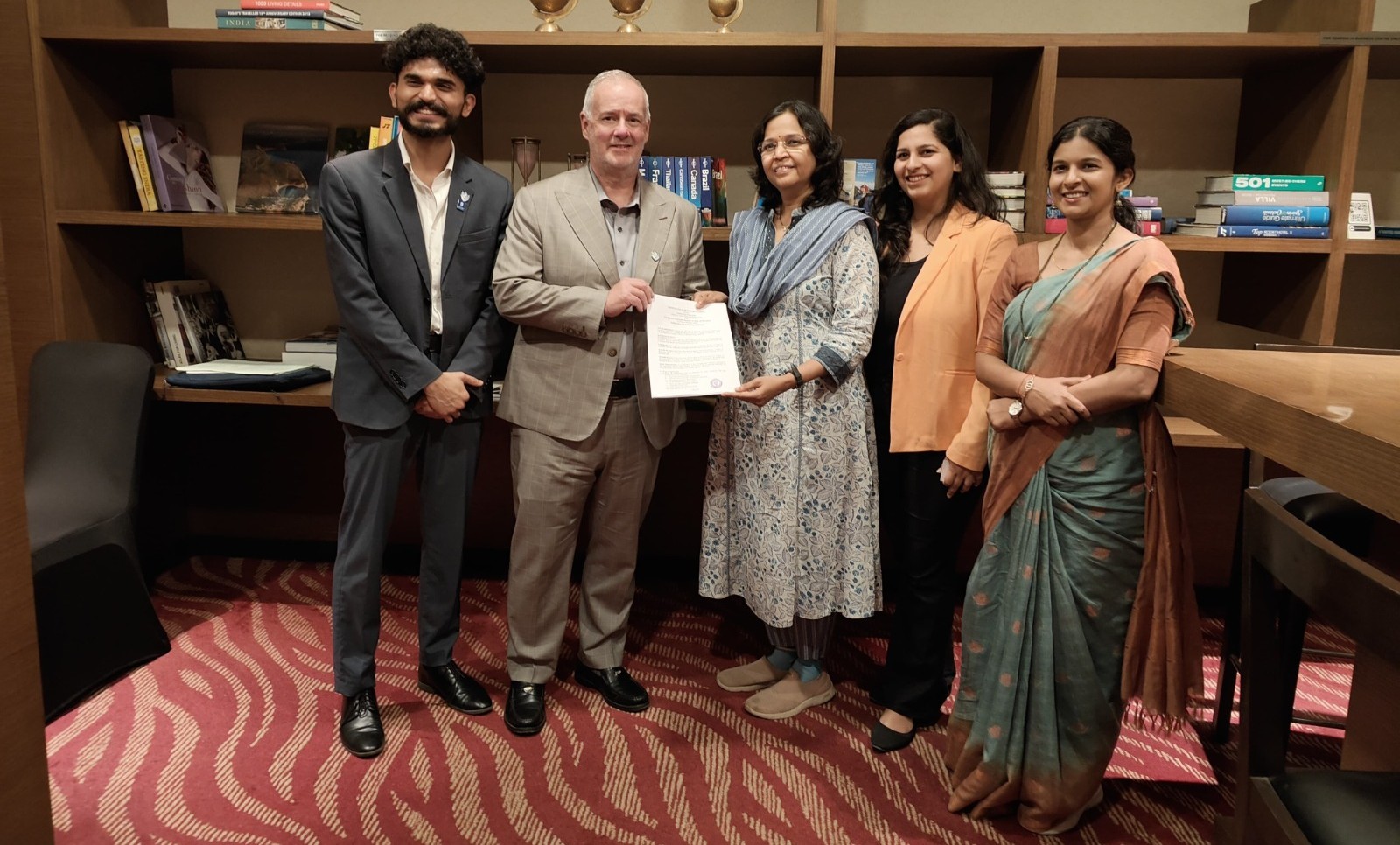
Mumbai India, Feb 26: Vivekanand Education Society’s College of Pharmacy (Autonomous), Mumbai has signed a five-year Memorandum of Understanding (MoU) with Saint Louis University (USA), marking a significant step towards expanding its international academic and research collaborations. 

The strategic partnership aims to foster structured cooperation in joint research initiatives, academic exchange programs, faculty and student mobility, collaborative publications, and knowledge-sharing platforms. The agreement reflects a shared commitment by both institutions to promote excellence in pharmaceutical education and advance impactful research outcomes. The MoU was formalized under the leadership of Dr. Supriya Shidhaye, Principal, VESCOP, along with the leadership team of Saint Louis University. The Department of Students Development, University of Mumbai, played a key facilitating role in establishing and strengthening this collaboration between the two institutions. The execution and coordination of the agreement was supported by Dr. Pradnya Shinde Korlekar, Assistant Professor, VESCOP. The two institutions initiated discussions in May 2025 to advance this collaboration, culminating in the formalization of the MoU in February 2026. 

Speaking on the occasion, Dr. Supriya Shidhaye, Principal, VESCOP, said, “This collaboration with Saint Louis University represents a meaningful step in strengthening our global academic engagement. It will create valuable opportunities for our students and faculty through collaborative research, academic exchange, and shared learning experiences. At VESCOP, we remain committed to building sustainable international partnerships that enhance research capabilities and broaden global exposure for our academic community.”

 The partnership reinforces VESCOP’s ongoing efforts to expand its global footprint and position itself as a forward-looking institution focused on innovation, research excellence, and international academic integration.

About Saint Louis University

Saint Louis University is located in St. Louis, Missouri, with an additional campus in Madrid, Spain. Founded in 1818, it is one of the nation’s oldest and most prestigious Catholic universities. The University is recognized for world-class academics, life-changing research, compassionate health care, and a strong commitment to faith and service.

 Guided by its enduring Jesuit mission, the University provides more than 13,300 students with a highly rigorous and deeply transformative education designed to develop bold, confident leaders. Academically, ethics, spirituality, and compassion are central to the student experience.

 Saint Louis University has earned the prestigious “R1” designation from the Carnegie Foundation for the Advancement of Teaching — the highest classification awarded to universities for research activity — placing it among an elite group of research institutions in the United States.

SIAM Ignites Shared Value Revolution at 7th CSR Conclave, Forging Powerful Partnerships for Nation-Building

Mumbai, Feb 26: In a resounding call to elevate Corporate Social Responsibility (CSR), the Society of Indian Automobile Manufacturers (SIAM) organised the 7th SIAM CSR Conclave under the theme “CSR Partnerships – From Shared Vision to Shared Value.” This Conclave united industry titans, CSR practitioners, policymakers, NGOs, and development experts to reimagine collaborative partnership models that drive inclusive growth, community empowerment, and self-reliant national development.

The Opening Session on “CSR as National Development Catalyst – Building the Nation, Responsibly” set a powerful tone for discussions on the automobile industry’s commitment to a sustainable future and responsible nation-building.

Welcoming the dignitaries, Mr. Prashant K. Banerjee, Executive Director, SIAM, underlined the role of industry-led CSR initiatives in improving lives across communities. He said, “The whole idea of SIAM’s focus on CSR comes from the fact that we believe in building the nation responsibly. Our founders always believed that the industry must contribute to society in the best possible capacity. The Viksit Bharat 2047 vision can only be realised through an ecosystem where businesses look beyond sectoral growth and include civil society, health, sanitation, and social development in every part of the country. As a diversified and deeply integrated industry with a presence across the country, we have meaningful touchpoints with communities. Reaching them in a sustainable and socially responsible manner is our collective contribution.”

Later in the session, a screening of SIAM CSR Initiatives followed in the presence of the dignitaries. The occasion also marked the release of SIAM’s CSR Compendium, showcasing key CSR initiatives undertaken by SIAM member companies. 

Guest of Honour Dr. Bhaskar Chatterjee, IAS (Retd.), Director General & CEO of Indian Institute of Corporate Affairs, who engaged in an insightful dialogue, discussed about, “Corporates must remain relevant to both the planet and the people around them. In India, CSR began as charity at home, with public sector enterprises taking nearly a four-year lead over the private sector, and was long seen as the government’s responsibility before evolving into a powerful opportunity. The next phase of CSR 2.0 calls for fresh thinking and stronger impact, enabled by technology such as AI for on-ground, verifiable data, along with third-party evaluation and greater professionalisation of the field. Sectors like automobiles must also address priorities such as waste management, process re-engineering, and carbon capture. CSR must move from the backroom to the boardroom, driven by robust governance and a long-term commitment to social change.” 

Mr. Puneet Anand, Chairman, SIAM CSR & Community Services Group and Associate Vice President & Vertical Head, Hyundai Motor India Ltd., highlighted the importance of partnerships in creating long-term social value. He stated, “India is the first country to mandate CSR through legislation, with nearly 800 organisations participating and about ₹2.2 lakh crore invested so far. Over time, CSR has matured into a structured pillar of corporate governance, guided by alignment, accountability, and impact. The sector must now move beyond the statutory 2% threshold to deliver measurable outcomes, strengthen skill development and employability, build community resilience, and create replicable district-level models through collaborations that enable lasting national transformation.” 

Mr. Prabhakant Jain, CSR Head, D S GroupMr. Yashpal Sachar, Vice President (Corporate Affairs), Ashok Leyland Ltd.; Mr. Tarun Agarwal, Sr. Vice President & Head-CSR, Maruti Suzuki India Ltd., and Ms. Sulekha KaulPartner, Vaish & Associates Advocates, also shared their insights on impactful CSR models as a catalyst to drive sustainable change. 

The session concluded with closing remarks by Mr. Rajeev Taneja, Co-Chair SIAM CSR & Community Services Group and Vertical Head – CSR Operation, Honda Motorcycle & Scooter India Ltd. He added, “CSR is central to India’s automobile sector’s journey toward inclusive growth. In the next phase, we must rapidly evolve from compliance to conviction. It must now be pursued intentionally and measurably through collaboration for real impact. Behind every CSR program lies a human story, and at its core, CSR is about empathy, dignity, and tangible change that improves lives. While the statutory framework has provided structure, the industry must now focus on outcomes through stronger transparency, alignment with national priorities, and cross-industry collaboration, especially in priority geographies.”

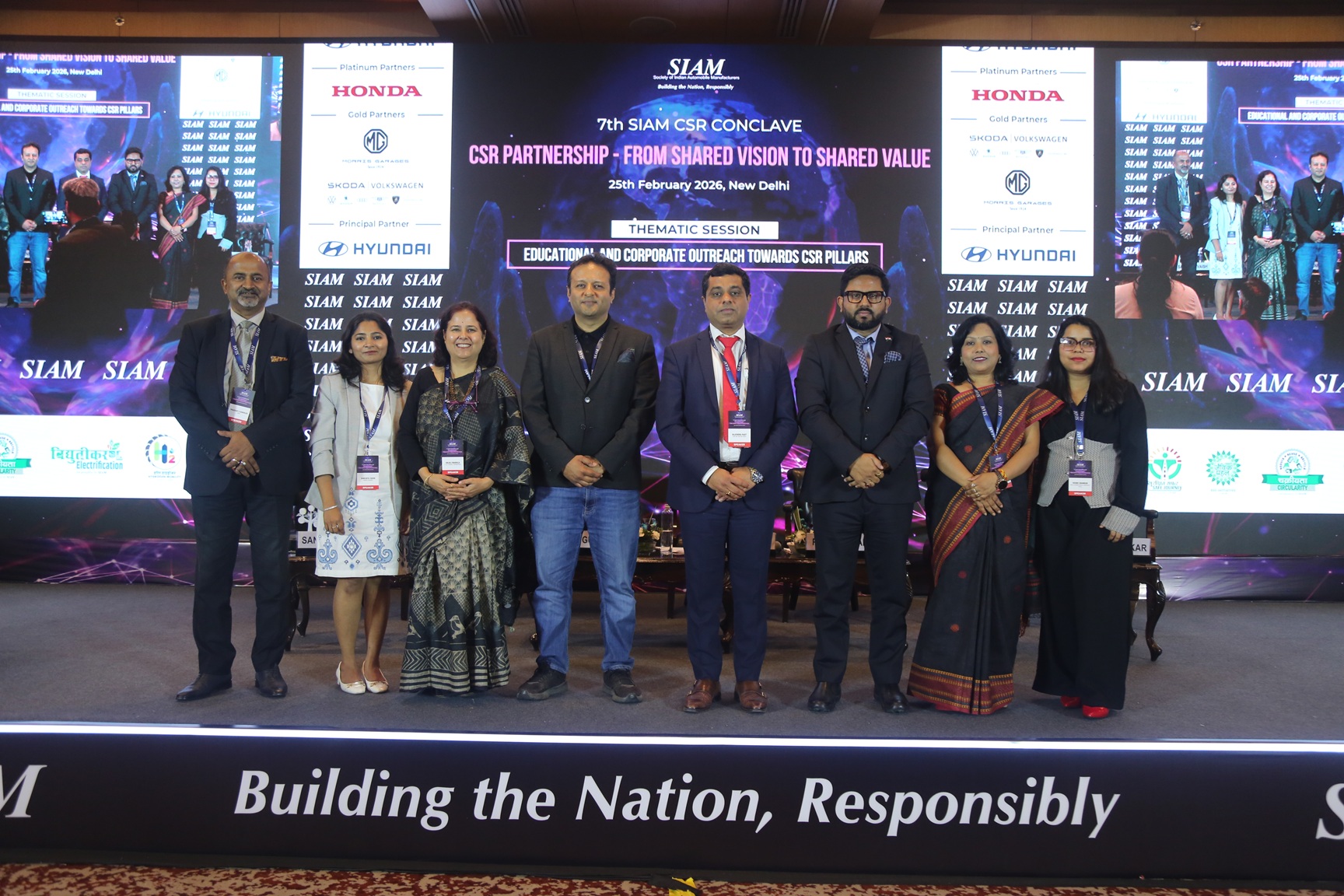
The Thematic Session on “Educational and Corporate Outreach towards CSR Pillars” was moderated by Mr. Anuj Guglani, Founder & CEO, WAF Group, where he discussed about the four pillars of CSR including Environmental Rejuvenation & Circular Economy, Road Safety & Education, Health Sanitation & Well-being, and Skills Development & Employability. 

The session was chaired by Mr. Rajendra Raut, Co-Chair, SIAM CSR & Community Services Group and Director (Corporate & Govt. Affairs), JSW MG Motor India, who stated, “Education is the enabling force in CSR which strengthens other pillars. Our CSR outreach must shift from donor-recipient approach to partnership and co-creation. It is evident that education and corporate engagement are foundational enablers. Without informed community and empowered youth, the most well-designed CSR programs will struggle achieving scale. Corporate outreach is evolving and it is no longer limited to philanthropy.” 

The session included important presentations by Ms. Sanchita Vaish, Lead Specialist-Global Entity Governance & CSR Lead (India), Baker Hughes; Mr. Praveen Karn, Group Head Sustainability & CSR, Minda Group; Dr. (Ms.) Veenu Shankar, Assistant Professor, Delhi School of Management (DSM), Delhi Technological University (DTU); Ms. Anjali Makhija, CEO, S. M. Sehgal Foundation; and Dr. Chitra, CEO, Indian Head Injury Foundation (IHIF). This was followed by a panel discussion moderated by the session moderator, with closing remarks by the session chairman. 

The Panel Discussion on “NGO & Corporate Perspective on Successful Collaboration Models towards CSR Execution” was moderated by Ms. Mugdha Mishra, Editor, Auto Media Strategy, Autocar India

Esteemed panellists included Mr. Arindam Lahiri, CEO, ASDC; Mr. Rahul Bansal, Head of Private & Public Sector Partnerships, UNICEF; Mr. Shailendra Singh, Director, Dhartie Warriors Foundation; Ms. Pritika Chand, Corporate Head, Jindal Stainless; Mr. Prabhu Nagaraj, Head – Corporate Affairs, Honda Motorcycle & Scooter India Pvt. Ltd. & Co-Chairman, SIAM Skilling Group; Mr. Ajay Bhatt, Head-Comm., Ex. Affairs, Sustainability & CSR, Škoda Auto Volkswagen India Pvt. Ltd.; Mr. Saurabh Sharma, Head CSR & ESG, Hyundai Motor India Ltd.; and Ms. Runa Ahlawat, General Manager, JSW MG Motor India, who emphasised the importance of collaboration towards CSR execution.

 The highlight of the day was the Fireside Chat on the theme “CSR Partnerships — From Shared Vision to Shared Value”, moderated by Ms. Mugdha Mishra, Editor, Auto Media Strategy, Autocar India, where Guest of Honour Dr. Bhaskar Chatterjee, IAS (Retd.), Director General & CEO of Indian Institute of Corporate Affairs, emphasised that sustainability practices such as waste management, process re-engineering, and carbon capture are critical priorities for the automobile industry. 

This was followed by an Award Ceremony, which recognised outstanding CSR contributions. Mr. Puneet Anand, Chairman, SIAM CSR & Community Services Group, delivered the opening remarks. The prestigious SIAM CSR awards were distributed by dignitaries, including Dr. Bhaskar Chatterjee, IAS (Retd.), Director General & CEO of Indian Institute of Corporate AffairsMr. Alok Jaitley, President – SAFE & EVP, Maruti Suzuki India LtdMr. Puneet AnandChairman, SIAM CSR & Community Services Group; Mr. Rajeev Taneja, Co-Chair, SIAM CSR & Community Services GroupMr Rajendra Raut, Co-Chair, SIAM CSR & Community Services GroupMr. Rajesh Menon, Director General, SIAM; and Mr. Prashant K Banerjee, Executive Director, SIAM

The SIAM CSR awards presented under Category – Skill Enhancement and Education to Kedman Skilled India Foundation (Honda Motorcycle and Scooter India Pvt. Ltd.) and Centum Foundation (Mahindra and Mahindra Ltd.); under Category – Healthcare & Sanitation to Karma Healthcare Trust (Hyundai Motor India Ltd.) and Sparsha Trust (Toyota); under Category – Road Safety to Learning Links Foundation (Ashok Leyland Ltd.) and The TSL Foundation (Mahindra and Mahindra Ltd.); and under Category – Environmental Rejuvenation to Mahabodhi International Meditation Centre (Škoda Auto Volkswagen India Pvt. Ltd.) and NAAM Foundation (TATA Motors). 

Over the years, SIAM has consistently collaborated with governments, industry leaders, corporations, and key stakeholders to champion the transition to cleaner fuels and cutting-edge technologies. These purposeful engagements reflect SIAM’s core mission of ‘Building the Nation, Responsibly’ while advancing sustainable mobility and contributing meaningfully to India’s Sustainable Development Goals by 2030.

Liquid Intelligent Technologies Announces Debt Repayment and Agrees New Credit Facilities

LONDON, United Kingdom, Feb 26 — Liquid Intelligent Technologies, a business of Cassava Technologies (www.CassavaTechnologies.com), has confirmed the full repayment of its ZAR term loan and USD revolving credit facility.

In tandem with this repayment, Liquid has agreed $410 million in new ZAR and USD credit facilities from a syndicate of commercial and development finance lenders. Cassava Technologies is further reinforcing Liquid’s financial position by injecting $195 million in fresh capital into the business.

Commenting on these developments, Hardy Pemhiwa, President and Group CEO stated: “These transactions, alongside the recent sale of a minority stake in a data centre subsidiary in South Africa, are part of a significant strengthening of our capital structure as we position the Group for accelerated growth. Through our One Cassava ecosystem, we are delivering innovative AI, cloud, data centre, payments, and low latency broadband connectivity solutions to enterprise customers across Africa.”

Africa Data Centre Holdings (“ADCH”) remains a wholly owned subsidiary of Cassava Technologies as the minority stake sale was in the ADCH South Africa business.

Looking ahead, Liquid intends to issue a new $300 million bond to replace its existing $620 million bond in advance of its maturity in September 2026. This move will reduce Liquid’s overall leverage and further strengthen the company’s balance sheet.

Wordly Introduces Mobile-First Enhancements to Translation App, Expanding Onsite and Hybrid Event Accessibility

Los Altos, CA, Feb 26: As events become more global and multilingual, organizers are under increasing pressure to deliver seamless, inclusive experiences without adding operational complexity. Wordly, the pioneer and leader in live AI translation and captioning, on February 25 announced new mobile-first enhancements to the Wordly Translation App designed specifically for conference, tradeshow, and events.

The latest updates include background audio and screen-lock functionality, allowing attendees to listen to live translations while multitasking and conserving battery life, along with instant language search for faster onboarding. Speakers also benefit from push-to-talk and automatic language detection, enabling seamless, two-way multilingual communication in dynamic sessions, all at no additional cost to existing customers.

“Event professionals are rethinking accessibility as a core part of the attendee experience,” said Lakshman Rathnam, Founder and CEO of Wordly. “These mobile enhancements give organizers a scalable way to provide inclusive, multilingual access without additional hardware, staffing, or logistical burden.”

Designed for the Realities of Live Events

The updated Wordly Translation App introduces several features tailored to how attendees and speakers engage during events, including:

  •  Background Audio for Multitasking: Attendees can now continue listening to translated audio while switching between apps on their mobile device. Whether checking the event app, reviewing presentation materials, or responding to messages, participants remain connected to the session without interruption.
  •  Screen-Lock Battery Optimization: With extended conference days in mind, the app now allows translated audio to continue playing while a device screen is locked. This feature helps conserve battery life, critical for multi-session agendas and large-scale conventions.
  •  Instant Language Search: A newly added search function enables users to quickly locate their preferred language from dozens of options, reducing onboarding friction and minimizing the need for onsite support.

New Capabilities for Speakers and Session Leaders

In addition to enhancing the attendee experience, Wordly has expanded functionality for presenters and facilitators, including:

  •  Push-to-Talk Functionality: Speakers can now use push-to-talk directly within the app, allowing for two-way communication in multilingual settings. The feature is particularly well-suited for breakout discussions, workshops, hosted buyer meetings, and small-group sessions, where interactive dialogue is essential.
  •  Automatic Language Detection and Switching: For sessions where presenters shift between languages, the app automatically recognizes language changes and adjusts translations accordingly to ensure a smooth experience for diverse audiences without manual resets.

Scalable Language Access Without Headsets or Booths

Unlike traditional interpretation models that require physical equipment, interpreters onsite, or dedicated booths, the Wordly mobile app operates on attendees’ own iOS or Android devices. Participants simply enter a Session ID provided by the organizer and select their language, no account creation is required. For speakers, access to advanced features such as push-to-talk is granted through a secure passcode.

Meeting Industry Demand for Inclusive Design

With international attendance rebounding and hybrid formats remaining standard, language accessibility has become a strategic priority for event organizers, associations, and corporate planners. Wordly’s mobile enhancements support:

  •  Global events and tradeshows seeking to broaden international participation
  •  Corporate events connecting distributed teams
  •  Association meetings aiming to increase member engagement
  • Education and campus events serving multilingual communities
  • Government and civic gatherings prioritizing public access

By eliminating hardware requirements and simplifying user onboarding, the updated Wordly Translation App enables planners to scale multilingual access across general sessions, breakouts, and ancillary meetings with minimal operational lift.

Analyzing Financial Performance in Corporate Organizations: Strategies and Insights

Financial performance analysis is the systematic assessment of an organization’s financial health, profitability, and operational efficiency. It evaluates how effectively a company manages resources, controls costs, and maintains long-term stability. For corporate organizations, it supports strategic decision-making by helping executives improve planning, enabling investors and creditors to assess risk and returns, and ensuring regulatory compliance through transparent reporting.

Core Financial Metrics

Evaluating financial performance requires the use of measurable indicators that reflect various aspects of business health.

Revenue Growth

Revenue growth measures the increase in sales over a specific period. Consistent growth often signals strong market demand and competitive positioning.

Profit Margins

Profitability is commonly assessed through gross, operating, and net profit margins. These ratios show how efficiently a company converts revenue into profit at different operational levels. Higher margins generally reflect effective cost management and pricing strategies.

Return on Equity (ROE)

ROE indicates how effectively a company generates profits from shareholders’ investments. It is calculated by dividing net income by shareholder equity. A strong ROE suggests efficient capital utilization.

Earnings Per Share (EPS)

EPS measures profitability on a per-share basis and plays a significant role in influencing investor confidence and stock valuation.

Together, these metrics provide a comprehensive understanding of corporate financial strength.

Understanding Financial Statements

Financial statements are the primary sources of data for performance analysis. The three key statements include:

Income Statement

This statement reports revenues, expenses, and profits over a defined period. It helps stakeholders evaluate operational efficiency and overall profitability.

Balance Sheet

The balance sheet presents assets, liabilities, and shareholders’ equity at a specific point in time. It reveals financial structure, liquidity, and long-term stability.

Cash Flow Statement

This statement tracks cash inflows and outflows from operating, investing, and financing activities. It highlights the organization’s ability to maintain liquidity and fund future growth.Collectively, these documents provide a complete financial overview and support accurate performance evaluation.

Analytical Tools and Techniques

Organizations apply various analytical methods to interpret financial data effectively.

Ratio Analysis

Financial ratios assess relationships between statement items to evaluate liquidity, profitability, leverage, and efficiency.

Trend Analysis

Trend analysis examines financial data across multiple periods to identify patterns and predict future performance.

Common-Size Statements

By expressing financial statement items as percentages of a base figure, common-size analysis simplifies comparisons across time periods or industry benchmarks.

These techniques enhance decision-making by translating raw financial data into meaningful insights.

Comparative and Benchmark Analysis

Comparative analysis enables organizations to evaluate their financial performance against competitors and industry standards. By benchmarking key metrics such as profit margins, ROE, and debt ratios, companies can identify performance gaps and improvement opportunities.

This approach not only reveals relative strengths and weaknesses but also encourages the adoption of best practices, strengthening competitive positioning in the marketplace.

Challenges in Financial Performance Analysis

Despite its importance, financial analysis presents several challenges:

  • Data inconsistency: Variations in reporting systems can lead to inaccuracies.

  • Non-recurring items: One-time gains or losses may distort financial results.

  • Accounting standard differences: Variations across regions complicate comparisons, especially for multinational corporations.

To overcome these challenges, organizations should standardize reporting practices, adjust for unusual items, and ensure alignment with recognized accounting frameworks.

Practical Applications in Corporate Settings

Financial performance analysis directly influences corporate strategy and operational improvement. Companies use it to:

  • Identify cost inefficiencies

  • Evaluate investment opportunities

  • Optimize capital allocation

  • Support expansion and diversification decisions

Organizations that consistently apply structured financial analysis are better positioned to enhance profitability, manage risk, and sustain long-term growth.

Emerging Trends in Financial Performance Analysis

Technological innovation is reshaping financial evaluation methods.

Advanced Analytics Software

Modern platforms enable real-time tracking and faster data processing, improving accuracy and responsiveness.

Artificial Intelligence and Machine Learning

AI-driven tools enhance predictive analysis, automate routine financial tasks, and improve forecasting capabilities.

Data Visualization Tools

Interactive dashboards and graphical reports make complex financial information easier to interpret, supporting quicker and more informed decisions.

As these technologies evolve, they will continue to strengthen the precision and strategic value of financial analysis.

Conclusion

Financial performance analysis is essential to corporate success, helping organizations assess profitability, manage risk, and align financial strategies with long-term goals. By consistently monitoring key metrics, applying diverse analytical methods, adapting to changing market conditions, and fostering cross-functional collaboration, companies can strengthen financial resilience, remain competitive, and support sustainable growth in a complex business environment.

Buying Decorative Lighting Online: What Homeowners Should Actually Look For?

Jaipur : Buying decorative lighting online has become easier than ever. With access to global styles, finishes, and formats at the click of a button, homeowners are no longer limited to local showrooms. Yet with this convenience comes confusion. Too often, lighting is chosen based on appearance alone, leading to fixtures that feel oversized, underwhelming, or impractical once installed.

As Indian homeowners become more design aware, the process of buying lighting online is also becoming more deliberate. Understanding what to look for beyond aesthetics is key to making choices that last.

Start with Scale, Not Style

One of the most common mistakes homeowners make when buying decorative lighting online is ignoring scale. A chandelier that looks balanced on screen can easily overwhelm a room or disappear into it if proportions are misjudged.

Before selecting a fixture, it is essential to consider ceiling height, room dimensions, and furniture placement. Dining tables, coffee tables, and beds often act as natural reference points. Lighting should feel connected to these elements rather than floating arbitrarily above them.

“Scale is the foundation of good lighting,” says Naman Jain, Founder of Lumeil.
“Online platforms give you access to beautiful designs, but homeowners need clarity on proportions. When the scale is right, even a simple light feels elevated.”

This is why detailed product dimensions and clear application guidance matter as much as design.

Understand the Purpose of the Space

Every room in a home demands a different lighting approach. A living room needs a balance of presence and flexibility. A bedroom calls for softer, more controlled light. Entryways benefit from visual impact, while dining spaces require focus and warmth.

When buying online, homeowners should ask one simple question. What role will this light play. Is it meant to anchor the room, support daily activity, or add atmosphere.

Lumeil’s curated collections are structured around this understanding. Instead of overwhelming buyers with endless variations, the platform focuses on helping homeowners identify fixtures that suit specific spaces and functions.

Look Beyond Brightness

Brightness alone does not determine comfort. Colour temperature plays an equally important role. Warm light creates a sense of ease and intimacy, while cooler light can feel sharp and impersonal in residential settings.

Decorative lighting should enhance mood rather than dominate it. Warm and neutral tones are generally better suited for living areas and bedrooms, while controlled brightness works well in dining and social spaces.

“Good lighting should feel natural,” Jain explains.
“It should complement how people live, not interrupt it. That is why understanding warmth and output is just as important as choosing the design.”

Online buyers should always check specifications related to light tone, wattage compatibility, and diffuser materials.

Material and Finish Matter More Online

When shopping in person, finishes can be examined closely. Online, this requires trust. Material quality and finish consistency directly affect how a light ages over time.

Polished metals, brushed finishes, glass thickness, and craftsmanship details all influence durability and visual appeal. Choosing a platform that prioritises quality curation helps reduce uncertainty.

Lumeil’s approach centres on premium materials and finishes that translate well from screen to space. This focus has made it a preferred choice for homeowners looking to invest in decorative lighting without compromise.

Installation Clarity Is Not Optional

A common oversight in online lighting purchases is installation complexity. Fixtures that look effortless in images may require specific ceiling support, wiring preparation, or professional assistance.

Clear installation guidance, mounting details, and support information should always be reviewed before purchasing. This ensures that the lighting experience remains seamless from delivery to installation.

“Buying lighting online should not feel intimidating,” says Jain.
“When the right information is available upfront, homeowners feel confident making decisions.”

Why Buying from a Curated Platform Matters

With countless options available online, curation has become a form of trust. Platforms that filter products through design relevance, quality benchmarks, and functional clarity help homeowners make better choices faster.

Lumeil positions itself not just as an online lighting store, but as a design-led destination. Its collections are built to simplify decision making, offering pieces that are visually strong, technically sound, and appropriate for contemporary Indian homes.

For homeowners navigating online lighting purchases, this balance of inspiration and information makes all the difference.

A Smarter Way to Buy Lighting Online

Decorative lighting is no longer an impulse buy. It is a design decision that shapes how a home looks and feels every day. Buying it online requires attention to scale, purpose, warmth, material, and installation clarity.

When these factors are considered carefully, online platforms open up new possibilities for thoughtful, lasting interiors.

As Indian homes continue to evolve, homeowners are learning that the best lighting choices are not the loudest or the trendiest. They are the ones made with understanding and intention. And increasingly, they are being made online, with trusted brands like Lumeil guiding the way.