

New Delhi, Oct 24: India is poised to unlock an estimated $220 billion in clean energy investment opportunities between FY2027 and FY2030, as the country accelerates its transition towards renewable power and advances its ambitious target of 500 GW of non-fossil fuel capacity.
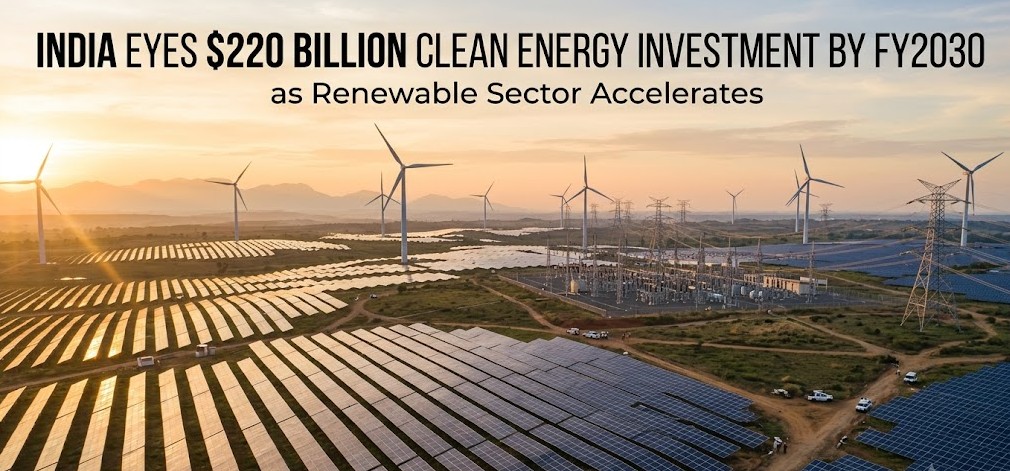
Representational Image
According to the Ministry of New and Renewable Energy (MNRE), the investment opportunity spans the entire clean energy value chain, including solar and wind power, energy storage, domestic manufacturing, electricity transmission, green hydrogen and hydropower. The scale of the opportunity is expected to create significant avenues for private investment, technological innovation and industrial growth.
Private Sector to Drive Clean Energy Expansion
The private sector is emerging as a key driver of India’s energy transition, accounting for nearly 74 per cent of the country’s renewable energy capacity, according to the ministry.
J.V.N. Subramanyam, Joint Secretary at MNRE, emphasised that private investment would remain central to achieving India’s clean energy ambitions, with the government focusing on providing a stable policy framework and an investor-friendly environment.
He described the projected $220 billion opportunity not as a financial constraint but as an indication of the enormous potential for growth across India’s clean energy industry.
The government believes that sustained private capital, supported by predictable policies and reliable project revenues, will be essential to expand renewable energy infrastructure at the required pace.
Policy Support to Strengthen Investor Confidence
Several policy measures are intended to improve the attractiveness of India’s renewable energy sector for domestic and international investors.
These include allowing 100 per cent foreign direct investment (FDI) under the automatic route, introducing payment security mechanisms and maintaining policy support for clean energy development.
The reduction in Goods and Services Tax (GST) on renewable energy equipment from 12 per cent to 5 per cent is also expected to help lower project costs.
In addition, a 500 MW Contract for Difference pilot implemented through the Solar Energy Corporation of India (SECI) aims to strengthen project bankability and provide greater revenue certainty.
Such measures are particularly important for capital-intensive projects that require substantial upfront investment and long-term financial commitments.
Investment Opportunities Across the Energy Value Chain
The projected investment is expected to extend beyond the installation of solar panels and wind turbines. Energy storage, transmission infrastructure and domestic equipment manufacturing will also play critical roles in supporting the expansion of renewable electricity.
Green hydrogen and hydropower are additional areas expected to contribute to India’s broader clean energy strategy.
Expanding transmission networks and storage capacity will be particularly important to integrate variable renewable power into the electricity grid while maintaining reliability as demand grows.
The investment opportunity could also support domestic manufacturing, create new business partnerships and strengthen India’s position in emerging clean energy technologies.
Bharat Renewable Energy Summit to Attract Global Stakeholders
India will host the Bharat Renewable Energy (BRE) Summit and Expo 2026 from November 2 to 5 at Bharat Mandapam in New Delhi.
The event is expected to bring together more than 400 exhibitors and delegates from over 75 countries. It will also incorporate the ninth session of the International Solar Alliance Assembly and the fourth International Conference on Green Hydrogen.
The summit aims to facilitate investment commitments, showcase state-level renewable energy project pipelines, encourage business-to-business partnerships and promote international technology collaboration.
It is expected to provide a platform for policymakers, investors, manufacturers and energy companies to explore opportunities arising from India’s expanding clean energy market.
From 500 GW to Net Zero by 2070
India’s target of achieving 500 GW of non-fossil fuel capacity represents a major milestone in its long-term energy transition. The country has already crossed the halfway mark in terms of the share of non-fossil sources in its total installed power capacity, which now exceeds 54 per cent, according to MNRE.
Looking further ahead, the government has outlined an ambition to reach 1,800 GW of non-fossil fuel capacity by 2047, aligning with its broader vision of Viksit Bharat, or a developed India.
The country has also committed to achieving net-zero emissions by 2070.
However, meeting these goals will require substantial financial resources, faster infrastructure development, technological advancement and stronger coordination between government agencies and private industry.
Subramanyam stressed that public funding alone would not be sufficient to finance the 500 GW target. Creating a commercially viable investment environment that attracts private capital at scale will therefore remain a central priority.
A Defining Opportunity for India’s Green Economy
The estimated $220 billion investment pipeline highlights the growing economic significance of India’s clean energy transition. Beyond expanding renewable electricity generation, the opportunity could strengthen domestic manufacturing, encourage innovation, attract foreign investment and generate employment across multiple sectors.
The challenge will be to convert the projected investment potential into financially viable projects, reliable infrastructure and measurable progress towards decarbonisation.

