Archives January 2026

Instagram Empowers Creators to Go Global with Local Voice Translations and Indian Fonts

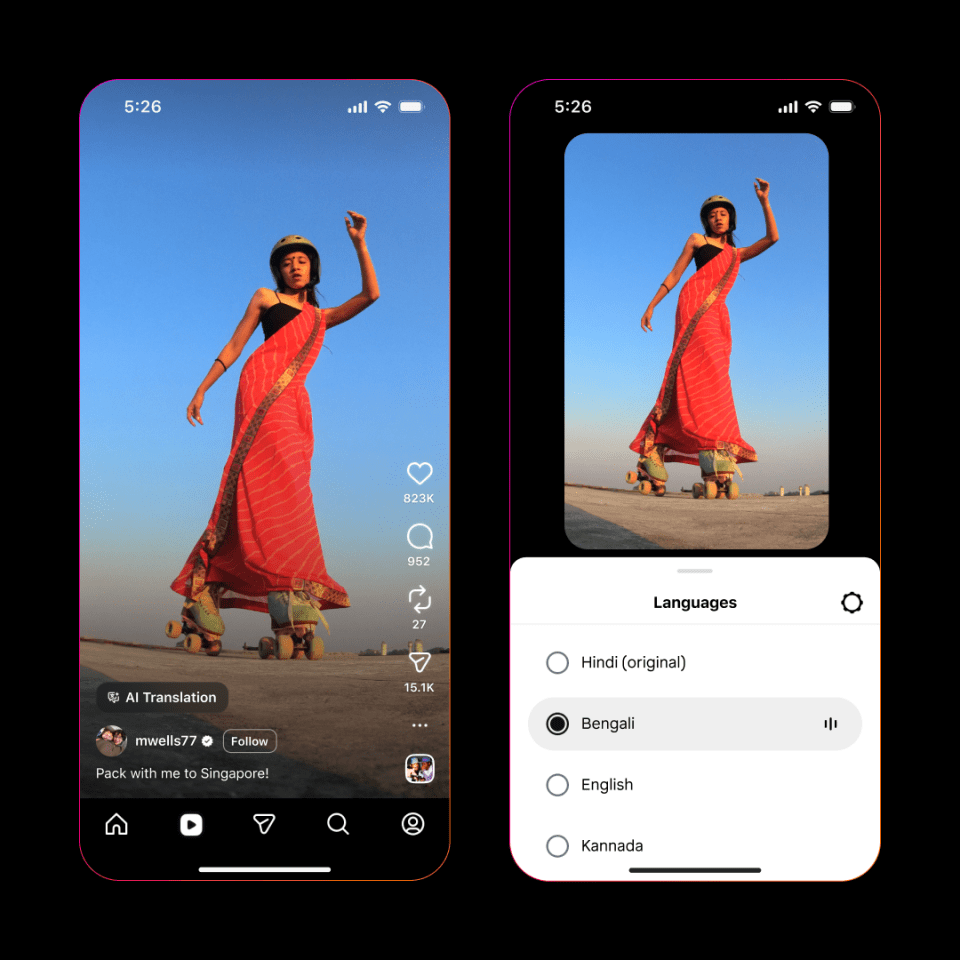
Mumbai, Jan 16: Instagram today announced expanded capabilities for creators to reach audiences worldwide with more authentic, localised content. Meta AI now allows creators to translate, dub, and lip-sync reels into five additional Indian languages—Bengali, Tamil, Telugu, Kannada, and Marathi—alongside existing support for Hindi, English, Spanish, and Portuguese. While this feature was first introduced in November 2025, it is now rolling out to all users across India.

image001

The announcement was made at the exclusive ‘House of Instagram’ event in Mumbai, highlighting India’s growing significance for Meta and underscoring Instagram’s commitment to empowering creators to connect with wider audiences.

Meta AI Translations Expand to Five New Indian Languages

Creators can now leverage Meta AI to transform their reels so they sound and look fluent in some of the world’s most spoken languages, preserving the tone and authenticity of the original content. Lip-sync functionality ensures that translated audio matches mouth movements, making it appear as though the creator is speaking the translated language natively.

This capability allows creators to reach more people across India and globally, unlocking the potential for international growth while retaining their unique voice and style.

New Indian Fonts Available in Edits

Creators also gain access to new Indian fonts for their text and captions, including Devanagari and Bengali-Assamese scripts, supporting languages such as Hindi, Marathi, Bengali, and Assamese.

How it works:

  • In your editing timeline, select “Text” from the bottom tools tray.

  • Tap the “Aa” icon to view available fonts.

  • Devices set to Devanagari or Bengali-Assamese scripts will default to these fonts; others can filter fonts by language in the “all fonts” tab.

This update, rolling out soon on Android, allows creators to stylise content with culturally relevant scripts, enhancing accessibility and engagement.

Additional Creator Features

These updates follow a series of recent enhancements designed to boost creator productivity and creativity, including:

  • Restyling photos and videos in Instagram Stories using Meta AI.

  • Bulk editing captions and reversing videos.

  • Lip-syncing for photos and videos to bring content to life.

  • Access to 400 new sound effects for richer audio experiences.

With these tools, Instagram continues to provide creators with innovative ways to grow their audience, tell authentic stories, and engage communities across India and beyond.

Celebrating P. L. Deshpande: Two Iconic Productions Return by Popular Demand at the NCPA

Mumbai, Jan 16:  The National Centre for the Performing Arts (NCPA) brings back two celebrated theatrical works by the legendary P. L. Deshpande in a special double bill, following their acclaimed run in November 2025. Returning by popular demand, the productions pay tribute to Deshpande’s sharp wit, fearless artistic voice, and enduring contribution to Marathi literature and theatre.

Mad Sakharam - NCPA Mumbai

The evening features Mad Sakharam and Marathi Vangmayacha Ghaliv Itihas, offering audiences a rare opportunity to experience Deshpande’s satire and literary brilliance on stage in one compelling programme.

 Mad Sakharam

Godrej Dance Theatre,  January 18, 2026, 5:00 pm
An NCPA Collaboration

Mad Sakharam revisits a pivotal moment in Marathi theatre history, when P. L. Deshpande used satire to defend artistic freedom. Written as a response to the censorship controversy surrounding Vijay Tendulkar’s Sakharam Binder in the 1970s, the play—originally titled Bhagwan Sri Sakharam Binder employs humour to expose the absurdity of moral policing while standing firmly in support of free expression.

Directed by Mangesh Satpute, the production features performances by Sunil Jadhav, Vishal More, Shreyas Vaidya, Alka Parab, Kiran Rajput, and Prajakta Pawar. With music by Mandar Kamlapurkar, set design by Sandesh Bendre, and lighting by Amogh Phadake, the play underscores how satire remains a powerful medium to question hypocrisy and societal gatekeeping—making it as relevant today as ever.

Age Recommendation: 6+, Duration: 60 minutes, Late entry not permitted

 Marathi Vangmayacha Ghaliv Itihas

Godrej Dance Theatre, January 18, 2026, 7:15 pm
An NCPA Presentation

Marathi Vangmayacha Ghaliv Itihas is a theatrical adaptation of P. L. Deshpande’s much-loved literary work, originally published in Mauj magazine. Known for its scholarly yet playful humour, the piece offers a satirical exploration of the overlooked and unconventional history of Marathi literature. Though Deshpande could not expand the work further due to health reasons, this singular creation stands as a testament to his intellectual depth and comic genius.

Presented on the occasion of his birth anniversary, the adaptation by Mukesh Machkar and direction by Mangesh Satpute introduces younger audiences to Deshpande’s distinctive brand of “serious humour.” The performance blends the essence of the original text with familiar Deshpande characters, drawing connections between literary history and contemporary life. The cast includes Sanjay Gosavi, Mayuresh Khole, Dhanashri Lele, Mehul Bharti, Dhanashri Patil, and Shreyas Vaidya, and is presented by Sonali Kulkarni.

GPS-Like Neuro-Navigation Technology Redefining Brain tumor Surgery with Greater Precision and Accuracy

Guwahati, Jan 16: When we think of brain surgery, many people imagine a highly risky procedure where the chances of damaging healthy brain tissue are high. While surgery for brain tumors remains one of the most delicate operations in medicine, advances in technology are making it far safer and more precise. One such breakthrough is neuro-navigation, often compared to a GPS for the brain.

Dr. Hrishikesh Chakrabartty

Neuro-navigation is a computer-assisted technology that allows surgeons to map and guide their way through the brain during surgery. Much like the GPS in a car helps drivers follow the safest and shortest route, neuro-navigation helps neurosurgeons plan the most accurate path to reach a brain tumor.

Dr. Hrishikesh Chakrabartty, Associate Director Neurosurgery, Max Super Specialty Hospital, Vaishali said

“Using MRI or CT imaging, neuro-navigation creates a detailed three-dimensional map of the patient’s brain, which is used to guide the surgeon in real time during surgery. This technology helps accurately identify the exact location of the tumor before any incision is made, enables selection of the safest surgical pathway with minimal disturbance to healthy brain tissue, and allows continuous tracking of surgical instruments to maintain precision throughout the procedure.”

By acting as a guide, neuro-navigation minimises guesswork. The surgeon can see where the tumor begins and ends, as well as nearby blood vessels and sensitive brain areas. This reduces the risk of complications such as speech difficulties, weakness, or vision loss after surgery. It also increases the chances of removing the tumor completely, which is crucial in preventing recurrence and improving long-term survival.

Dr. Hrishikesh further added

Neuro-navigation greatly reduces the risk of injury to healthy brain tissue, making brain tumor surgery safer and more controlled. By enhancing surgical precision, it leads to shorter operation times, reduced blood loss, quicker recovery, and better preservation of neurological function, resulting in improved overall outcomes for patients. Neuro-navigation is most useful for patients with tumors located deep within the brain or close to areas that control important functions. Not all cases require it, but for many patients, it provides a safer option and greater confidence in treatment.”

Neuro-navigation is transforming neurosurgery by acting like a GPS for the brain. It allows surgeons to plan their route, avoid critical structures, and reach the tumor with remarkable accuracy. For patients, this translates into safer surgeries and a better chance of recovery without loss of vital brain function.

Federal Bank Posts Record Q3 FY26 Performance as Margins Improve and Asset Quality Strengthens

Federal Bank Delivers Record Q3 FY26 Performance with All-Time High NII, Operating Profit and Fee Income; Margins Expand and Asset Quality Strengthens Further

Federal Bank reported a strong and well-rounded performance for the quarter ended December 31, 2025 (Q3 FY26), marked by sustained margin expansion, improving profitability, disciplined cost management, and a further strengthening of asset quality. The results underscore the Bank’s continued focus on building a stable, margin-led, and resilient franchise.

Key Financial Highlights Q3 FY26

  • Net profit recorded healthy sequential and year-on-year growth, supported by stronger core income and operating leverage.

  • Net Interest Income reached an all-time high, reflecting steady balance-sheet expansion and improved yield dynamics.

  • Net Interest Margin expanded quarter-on-quarter, driven by an improved liability mix and timely asset repricing.

  • Operating profit posted solid growth on both a quarterly and annual basis, supported by disciplined cost management.

  • Fee income achieved a record level, registering strong year-on-year growth and enhancing the quality and diversification of earnings.

  • Total business continued its upward trajectory, delivering steady growth across both advances and deposits.

  • Advances growth was led by Commercial Banking and Corporate & Institutional Banking segments.

  • Deposits grew consistently, supported by a strengthening liability franchise.

  • CASA ratio improved meaningfully on both a quarterly and annual basis, with strong growth in CASA balances.

  • Cost-to-income ratio improved further, reflecting operating leverage and efficiency gains.

  • Asset quality strengthened to decadal lows, with continued reduction in both gross and net NPAs.

  • Provision coverage improved, reinforcing balance-sheet resilience.

  • Return on Assets and Return on Equity showed sequential improvement, reflecting enhanced profitability.

  • Earnings per share recorded healthy quarter-on-quarter growth.

Management Commentary

Commenting on the performance, Mr. KVS Manian, Managing Director & CEO, Federal Bank, said:

“Our Q3 performance reflects the continued strengthening of the Bank’s underlying fundamentals. Improvements in margins, declining funding costs, and sustained stability in asset quality are the direct outcome of the balance-sheet discipline and execution focus we have maintained over the past few quarters.

We are seeing increasing benefits from a stronger liability franchise and a calibrated shift in our asset mix toward segments that deliver superior risk-adjusted returns. While competitive intensity remains high, our emphasis remains on consistency and quality of earnings rather than headline growth. This approach positions the Bank well to deliver sustainable performance across market cycles.”

Strategic and Business Updates

Branch Expansion:
During the quarter, the Bank added six branches, aligned with its calibrated and market-focused expansion strategy.

Stake Increase in Ageas Federal Life Insurance:
Federal Bank increased its stake in Ageas Federal Life Insurance Company, strengthening its strategic partnership in the life insurance business. The transaction was completed during the quarter after receiving all requisite regulatory approvals.

Brand Refresh – The Fortuna Wave:
The Bank unveiled The Fortuna Wave, a refreshed brand identity reflecting its evolution into a contemporary and future-ready institution. Rooted in authenticity, prosperity, and togetherness, the new identity sharpens Federal Bank’s connection with a digitally driven customer base.

Strategic Investment by Blackstone:
Federal Bank welcomed a strategic minority investment from Blackstone, marking a significant milestone in its growth journey. The investment, which received approvals from the Board of Directors, shareholders, and regulatory authorities, underscores strong confidence in the Bank’s strategy, governance, and long-term growth potential.

With strong core earnings momentum, improving asset quality, and a strengthened balance sheet, Federal Bank remains well positioned to deliver consistent and sustainable performance in the coming quarters.

Sachin Tendulkar’s Ten x You makes e-commerce debut on Myntra

Bengaluru, Jan 16: Myntra, one of India’s leading fashion, beauty and lifestyle destinations, today announced the e-commerce launch of Ten X You, the sports and athleisure brand co-created by cricket legend Sachin Tendulkar. Marking its marketplace debut, Ten X You has a distinct proposition as a play-first sportswear brand, designed to make sport more inviting, enjoyable and accessible for everyday Indians.

IMG_6260

Built on a powerful belief “to help shift India from being a sports-loving nation to a sports-playing one”Ten X You is designed for recreational, aspiring and fit-curious consumers who want to move more often, stay active and reconnect with sport in a way that feels natural. The brand also has a range of professional batsmen cricket shoes and plans to expand the portfolio of technically sound products across sports. The brand focuses on a far larger base of everyday players, putting comfort and community at the centre of its philosophy.

The Ten X You launch on Myntra spans an expansive range across footwear and apparel, built around comfort-led performance and everyday versatility. The footwear portfolio includes cricket shoes, multi-sport shoes for all turfs and courts, recovery shoes for running and walking and casual footwear. Sachin Tendulkar’s 25 years of insights as a cricketer and keen observer of other sports has shaped the design of Ten x You’s products. We combine the years of his technical experience to develop unique solutions to some of the problems which consumers face. The shoes are also designed especially for Indian feet which is slightly wider than the global average making it very stable and comfortable.  The apparel range comprises over 60 styles, including performance t-shirts, tanks and running shorts, crafted using premium nylon fabrics and functional silhouettes to ensure sweat wicking, temperature regulation,  breathability, ease of movement and seamless transition from play to everyday wear.

Commenting on the launch, Karthik Gurumurthy, Co-Founder and CEO, Ten x You, said,

“Ten X You is built to create comfortable, versatile sportswear that fits easily into everyday active lifestyles. The brand is designed for both professional and casual play, training and daily movement. The launch of our collection on Myntra, a platform that truly understands the pulse of India’s fashion, helps our fans hit their own style centuries every single day. Its long-standing role in enabling active, healthy lifestyles makes it the ideal partner to take this idea of joyful play to millions.”

Speaking on the association, Sachin Takkar, Vice President – Category Management, Myntra said,

 “Sportswear today goes far beyond the field; it has become a key part of everyday dressing. With sustained momentum and repeat engagement across our sports categories, Ten X You is a timely and compelling addition to Myntra’s sports portfolio. The brand’s focus on comfort, inclusivity and community-led play resonates strongly with evolving consumer preferences.”

Myntra has seen steady growth across its sports footwear and sports apparel categories, with core essentials such as sports shoes, t-shirts, track pants and jackets continuing to witness consistent demand. In the last six months, more than 60% of customers have made a repeat purchase within the category, highlighting the increasing demand. According to industry reports, India’s activewear and athleisure segment is among the fastest-growing lifestyle categories, driven by rising fitness awareness, casualisation of dress codes and demand for comfort-led clothing.

Ten X You is a step in bringing Sachin Tendulkar’s vision to encouraging the country to adopt a fitter lifestyle. He plays an active role in shaping the brand’s product philosophy, bringing decades of experience across grassroots, recreational and professional sport to ensure every product delivers on comfort, confidence and durability, without losing its everyday appeal.

Equirus sole advisor to Kalpataru Projects on Vindhyachal Expressway sale to Actis

Mumbai, Jan 16: Mid-market specialist investment banking firm Equirus Capital today announced the successful completion of the 100% stake sale of Vindhyachal Expressway, an 89-km, four-lane operational highway asset of Kalpataru Projects International Limited (KPIL), to leading global private equity investor Actis. Equirus acted as the sole financial advisor to Kalpataru Projects on the transaction.

The divestment marks the 11th successful road M&A transaction advised by Equirus, further reinforcing its leadership in infrastructure monetisation and capital recycling mandates, particularly for mid-market companies. The transaction highlights Equirus’ deep expertise in yield-oriented infrastructure assets, with a strong track record in road sector advisory.

“This transaction underscores our differentiated capabilities in yield-oriented infrastructure assets and road M&A, where value creation is driven by cash-flow durability, risk allocation, and long-term return optimisation. Leveraging deep sector expertise and rigorous process management, we led the transaction end-to-end — from structuring and asset positioning to negotiations and closure,” said Vijay Agrawal, Managing Director and Sector Lead – Infrastructure and Real Estate, Equirus Capital.

As per Kalpataru Projects’ disclosure to stock exchanges, the transaction values the Vindhyachal Expressway asset at an estimated enterprise value of approximately ₹775 crore, subject to closing adjustments. The company also confirmed that “All necessary approvals and conditions precedent for the transaction have been successfully completed,” with the sale expected to be finalised before the long stop date of January 31, 2026.

Brokerages tracking Kalpataru Projects have viewed the transaction positively, noting,

“The divestment is financially positive for KPIL, as the asset contributes just ~0.43% of FY24 consolidated revenue while unlocking meaningful capital. The proceeds can strengthen the balance sheet and support redeployment into core EPC segments and growth opportunities, improving capital efficiency without impacting operating scale.”

“This is another example of a win-win deal that we have been able to seal providing Kalpataru Power with strategic capital recycling while giving Actis ownership of a high-quality, stable-yield road asset aligned with its long-term investment strategy,” Mr. Agrawal added.

Vindhyachal Expressway operates under a build-operate-transfer (BOT) concession with a residual concession period of over 20 years. As of March 31, 2024, the asset reported revenue of ₹85.07 crore and a net worth of ₹144.55 crore. The project stretch is located on NH-7 from Rewa to the Madhya Pradesh–Uttar Pradesh border, with traffic largely driven by inter-state commercial vehicle movement.

According to credit rating agency Crisil that rates VEPL Rs 284 crore of bank loans, “Commercial vehicles form a sizeable portion of traffic on the project stretch,” adding that the concession agreement allows for extension of the concession period by up to 20% in case of traffic shortfall, subject to approvals. Crisil further noted that traffic grew at a 6% CAGR between FY2018 and FY2024, while toll collections increased 12.7% year-on-year to ₹70.6 crore in the first nine months of FY2025, supported by inflation-linked toll hikes. The asset is also undergoing major maintenance, with ₹109 crore planned over FY2025–FY2026.

Fintech Must Be Treated as Core Financial Infrastructure in Budget 2026

Finance and Fintech sector 

By:  S. Anand, Founder & CEO of PaySprint, a fintech venture

“As India approaches Union Budget 2026, fintech must now be recognised as core financial infrastructure rather than a peripheral startup category. Digital rails such as payments, verification, and API-led banking today power MSMEs, merchants, and financial inclusion at population scale. The next phase of growth will depend on how strongly the budget prioritises resilience, security, and interoperability across this infrastructure.

A key expectation from Budget 2026 is policy and investment support for AI-led compliance, verification, and fraud prevention. As transaction volumes continue to rise, fintech infrastructure providers play a critical role in enabling secure onboarding, real-time risk assessment, and regulatory adherence. Encouraging India-first, explainable AI for regulated use cases will strengthen trust and scalability across the ecosystem.

Equally important is regulatory clarity and harmonisation. Fintechs operating across banking, payments, and verification need predictable compliance pathways and coordinated guidance from regulators. Simplifying compliance for startups while maintaining strong governance will help innovation and accountability grow together.

Finally, Budget 2026 should continue backing fintech models that expand financial access for MSMEs and underserved regions through low-friction digital onboarding and automation. With the right focus on infrastructure, compliance, and inclusion, India can consolidate its position as a global leader in fintech and regulatory technology”

Infrastructure & Commercial Design & Build 

By: Sammeer Pakvasa, Managing Director & CEO, Eleganz Interiors Limited.

“As we approach the Union Budget 2026–27, the focus for industries connected to India’s built environment must shift decisively from intent to execution. Over the past few years, strong momentum in commercial real estate, infrastructure, and workplace development has been driven by urbanisation, private sector investment, and government-led capital expenditure. The upcoming Budget presents an opportunity to consolidate this momentum through greater policy predictability, operational efficiency, and long-term capacity building.

For project-driven sectors such as interiors and general contracting, the most impactful outcomes are those that reduce execution-level friction. Faster approvals, clearer compliance frameworks, and deeper digitisation across regulatory processes can significantly improve delivery timelines and cost certainty, while strengthening ease of doing business. Continuity in infrastructure and urban development spending remains critical, particularly across commercial districts and transit-oriented development, given its strong multiplier effect across the value chain. Workforce development also deserves sharper focus, with industry-linked skilling, safety, and certification frameworks playing a key role in improving productivity and quality.

Sustainability and technology adoption must continue moving from intent to implementation. Incentives for green materials, lifecycle-based procurement, BIM, and advanced project management tools will accelerate responsible, efficient execution. For working-capital-intensive businesses, stability through clear tax structures and reduced compliance complexity remains essential. At Eleganz Interiors, our execution experience reinforces how policy clarity, skilled manpower, and disciplined systems translate into resilient, future-ready commercial environments aligned with India’s growth priorities.”

Hospitality, Travel & Tourism,  Homestays & Alternative Accommodation 

By: Husain Khatumdi, Managing Director & Co-Founder, EkoStay, a homestay venture

“With travel preferences in India undergoing a clear shift, the lead up to Union Budget 2026 27 places renewed attention on the hospitality sector, especially homestays and alternative accommodation. As travellers increasingly seek private, experience driven stays, this segment has emerged as a significant contributor to tourism growth, local employment, and the strengthening of regional economies. A key expectation from this Budget is formal recognition and standardisation of the homestay and vacation rental ecosystem. Clear classification, uniform guidelines across states, and simplified licensing would reduce operational ambiguity and support organised growth.

Tax rationalisation is another priority. Hospitality operates on thin margins while managing high fixed costs. A more balanced GST structure and smoother input credit mechanisms would allow operators to reinvest in quality, safety, and service consistency. Continued investment in tourism infrastructure, regional connectivity, and destination promotion is equally critical, especially for unlocking Tier II and Tier III markets.

At EkoStay, we believe Budget 2026 can strengthen this ecosystem by enabling sustainable expansion, formalisation, and long-term policy stability for experience-driven travel in India.”

Healthcare sector

By- Nivedita Basu, Founder & Chief Vision Officer, Global Cancer Care 

“As the Union Budget 2026–27 approaches, India’s healthcare system finds itself at a defining moment where growing intent must be matched with sustained, people-centric action. Public health spending has steadily increased and is estimated at around 1.9 per cent of GDP, yet it continues to fall short of the National Health Policy target of 2.5 per cent. This shortfall is critical in a system where out-of-pocket expenditure remains high and illness can still push families into financial distress.

The Union Budget 2025–26 took a positive step with a near 10 percent increase in health allocations, but rising disease burden and demographic shifts call for sharper focus on prevention and early intervention. From a cancer care perspective, late detection remains one of India’s most expensive healthcare failures. India records over 1.4 million new cancer cases annually, with a large proportion detected at advanced stages. Global evidence consistently shows that early detection significantly improves survival outcomes while reducing long-term treatment costs.

Budget 2026 should therefore prioritise preventive screening programmes, subsidised diagnostics, and patient navigation systems that enable timely action. Expanding access beyond Tier I cities through diagnostics, oncology services, tele-health, and workforce development is equally important. Rationalising tax and regulatory structures for diagnostics and medical devices would further improve affordability and innovation.

Healthcare must be treated as foundational to productivity, dignity, and economic resilience. Sustained investment in prevention, early detection, and accessible care will save lives while reducing the invisible economic burden on Indian families.”

HealthTech & Health sector

By: Apurv Modi, Managing Director & Co-Founder, Abhay Group

“Union Budget 2026 27 arrives at a defining moment for India’s healthcare journey when technology is no longer a support function but a system level enabler of access quality and efficiency. HealthTech today sits at the intersection of public health economic growth and digital governance. The upcoming budget has the opportunity to move the sector from momentum to maturity.

India has seen widespread adoption of teleconsultations e pharmacies home diagnostics and digital health records. However much of this progress remains fragmented. Budget 2026 27 should prioritise the shift from standalone pilots to interoperable platforms that work seamlessly across states providers and populations. Focused investment in digital infrastructure for Tier 2 Tier 3 and rural India including connectivity cloud capacity and last mile delivery will ensure technology translates into outcomes.

MSMEs form the backbone of HealthTech innovation yet face regulatory complexity, capital constraints and delayed approvals. Simplified compliance, faster validation pathways, affordable working capital and clear GST treatment for digital health solutions can significantly accelerate innovation without demanding subsidies.

India is now ready for the next phase of digital public health. Interoperable health data standards secure exchanges incentives for identified research data and stronger cybersecurity will enable early detection, smarter policy and preventive care. With the right policy push HealthTech can evolve from convenience to national capability and position India as a global innovation hub for the decade ahead.”

Advertising & Marketing , Creative Services, Services Economy 

By- Siddharth Jalan, Founder, SquidJC, a boutique marketing lab

“India’s services economy is entering a phase where growth alone is no longer the differentiator. As Union Budget 2026–27 approaches, the focus is shifting toward how much long term value the sector can create and retain. Across advertising and marketing, Indian firms today operate at the centre of business thinking. In fashion, consumer goods, BFSI, and education, agencies have moved from execution to shaping how brands are understood, trusted, and remembered. This shift matters because brands increasingly decide who competes globally and who falls behind.

In fashion and consumer businesses, brand strength drives pricing power and export readiness. In BFSI, communication builds confidence at scale as products become more digital. In education, credibility influences partnerships, mobility, and long term value. Creative services quietly shape outcomes though policy rarely reflects this. The budget must offer clarity through predictable taxation, simpler compliance, and smoother cross border operations. Agencies are talent and IP led firms where friction slows growth. IP creation is rising as brands invest in platforms, data, and AI tools. Clear IP rules would drive investment. Talent remains central. Applied skilling and AI education would strengthen the pipeline. Tax rationalisation would free capital for reinvestment. Budget support here matters. At SquidJC, we work with brands across fashion, consumer goods, BFSI, and education that are building for long-term relevance, both in India and globally. Union Budget 2026–27 has the opportunity to support this shift by backing clarity, capability, and ownership. A budget that understands the role of brands, IP, and creative services strengthens India’s position as a serious, value-led exporter of services.”

IoT & Power 

By:  Building India’s Next-Generation Digital Energy Infrastructure by Teppo Hemiä, Founder & CEO, Wirepas

“As India enters the next phase of its energy transition, Union Budget 2026–27 has an opportunity to strengthen how the country builds and operates its digital power infrastructure. While electrification and renewable integration have made strong progress, the focus must now shift to intelligence, resilience, and operational efficiency across the grid.

One of the most critical areas is power distribution, where the rapid rollout of smart meters, rooftop solar, electric vehicles, and distributed energy resources is increasing grid complexity. Budget support that accelerates Advanced Metering Infrastructure beyond billing use cases, toward grid operations, power quality monitoring, and demand-side flexibility, will unlock far greater value from existing investments.

Equally important is grid-edge intelligence enabled by interoperable, standards-based IoT connectivity. Supporting scalable, cost-efficient connectivity options and long-term lifecycle-efficient infrastructure will help utilities adapt to evolving requirements without repeated asset replacement. A forward-looking Budget can ensure India’s energy infrastructure is not only large-scale, but future-ready and resilient.”

Jewellery Sector

By- Anand Lukhi, Founder & CEO, Lukson, on budget expectations.

India’s gems and jewellery industry is entering a new phase of transformation, shaped by shifting consumer values, sustainability priorities, and technological advancement. As Union Budget 2026–27 approaches, the sector finds itself at a pivotal moment, particularly with the growing adoption of lab grown diamonds. 

Budget 2026–27 should recognise lab-grown diamonds as a strategic sunrise segment, with continued rationalisation of duties on raw materials and equipment, and targeted incentives for advanced manufacturing. Such measures can lower entry barriers for MSMEs and accelerate ethical, future-ready diamond production.

Given the sector’s strong MSME backbone, simplified GST compliance, faster refunds for export units, and improved access to affordable credit would meaningfully strengthen cash flows and scalability. Equally important is investment in design-led skilling and technology adoption, ensuring India moves up the value chain from volume-driven exports to high-value branded jewellery. A balanced policy focus on manufacturing, sustainability, exports, and consumer trust can position India as a global leader in next-generation jewellery innovation.”

Scaling with Integrity: Lessons from Building a Food Startup One Meal at a Time

National Startup Day 2026

susmita

By – Susmita Chakravarty, Founder & Director, Eastern Staple

Starting a business in India comes with very real, day-to-day challenges, managing teams, sourcing reliably, and ensuring quality while scaling operations. Initiatives like Startup India provide support and visibility, but the real lessons come from working on the ground, solving problems as they arise.

This is how Eastern Staple began. During the pandemic, my home kitchen became a way to serve families and communities, and what started small grew into a structured B2B operation catering corporates, hostels, industrial plants, and large events. Scaling meant building systems, training teams, and maintaining the warmth and integrity of home-style food every day.

Today, we serve thousands of meals daily with a team of over 50 people. National Startup Day is a reminder that meaningful growth comes from consistent effort, resilience, and practical problem-solving.

NIVEA Makes Its Lollapalooza India Debut With “Baddie But Softie” Campaign

Mumbai, Jan 16: NIVEA, one of India’s most trusted skincare brands*, is redefining how it connects with younger audiences by stepping into the world of music and live cultural experiences. With Gen Z seeing music as a powerful form of identity and self-expression, the brand is making its presence felt at Lollapalooza India 2026 – a cultural extravaganza, to build deeper, more relevant connections with the youth in an authentic, meaningful way.

Since the objective is to engage with the younger generation where they are present, music festivals rank right at the top- making Lollapalooza India the ideal platform to connect with the audience. NIVEA’s presence this year goes beyond mere visibility; it is rooted in meaningful engagement and cultural relevance.

The brand has introduced a personalised anthem, “Baddie But Softie,” designed to decode one’s music festival personality and turn it into a custom track. By answering a few simple questions about their festival vibe, users are identified as either a Softie or a Baddie. Based on their persona, users receive a song that reflects their unique festival identity. The idea celebrates the freedom to move between a softer, easy-going side and a bolder, more confident energy, with music and self-expression as the connecting thread.

Beyond the anthem, NIVEA has curated a range of engaging on-ground experiences- from dedicated booth and picture-worthy moments to a relaxation zone and immersive product interactions. The hero product on-ground will be NIVEA Soft UV, a moisturiser that offers both hydration and SPF protection, making it an ideal companion for outdoor music festival settings, alongside a host of other brand offerings. This year at Lollapalooza India, NIVEA offers something for every music lover, culture enthusiast, and NIVEA loyalist.

Geetika Mehta, Managing Director, NIVEA India, said,

 “Music is the moment in India right now, and young people are driving it. They express themselves through music, discover culture through it, and spend their time where the music is. NIVEA wants to meet them there. While our legacy of trust remains strong, staying relevant to young India is key. With NIVEA Soft UV, we’re showing up in a way that feels fresh and culturally in sync. Our presence at Lollapalooza India reflects this. We want young consumers to choose NIVEA not only for its legacy, but because it fits their world today. At the festival, they’ll experience hyper personalisation, AI led interactions and standout photo moments designed for this music powered generation.”

Samradha Tibrewala, Head – Partnerships and Revenue, BookMyShow, said,

What resonates with younger audiences today is not brand messaging, but brand intent. When a leading brand like NIVEA chooses to step into a space like Lollapalooza India, it signals an understanding that culture is no longer something to observe from the sidelines – it’s something to participate in. Music festivals have become modern town squares for Gen Z, where identity, creativity and community converge. Collaborations like these underscore how live experiences are increasingly where brands earn relevance, not through visibility alone, but through presence that feels natural to the world audiences inhabit today.”

Set to take place on 24–25 January at Mahalaxmi Race Course, Mumbai, Lollapalooza India 2026 promises an immersive cultural experience with NIVEA seamlessly woven into the festival experience.

In a shift from AI hype to AI realism, organizations are increasing their AI investments with a focus on long-term value

Mumbai, Jan 16: New research shows that after an era of ‘AI hype’,  business leaders are now increasingly realistic and pragmatic about their AI strategies, and have started using it in their decision-making. The Capgemini Research Institute publishes today a report on AI perspectives, The multi-year AI advantage: Building the enterprise of tomorrow, along with a spotlight report on AI and decision-making, How AI is quietly reshaping executive decisions. As organizations enter 2026, the research suggests that organizations and their leaders will need to be more deliberate about governance, skills, accountability and human-AI chemistry to realize the full transformative value of AI.

As AI adoption is growing, businesses are accelerating AI investments for competitiveness and long-term value creation

According to  The multi-year AI advantage: Building the enterprise of tomorrow, which surveyed 1,505 executives at large organizations globally, 38% of organizations already operationalize generative AI use cases, while six in ten organizations are now exploring agentic AI applications. Nearly half of Chinese organizations are piloting or deploying agentic AI, ahead of US and European ones. Two thirds of business leaders believe that if they fail to scale AI as rapidly as their competitors, they risk missing strategic opportunities and losing their competitive edge.

Meanwhile, the way organizations measure AI success is evolving. Operational efficency and cost reduction are no longer the sole benchmarks: new measures of ROI include revenue growth, risk management and compliance, knowledge management and customer experience and personalization. Business leaders globally are more mindful than ever of the need to maintain control over their critical assets. More than half of organizations now prioritize data sovereignty, ensuring that sensitive or regulated data remains under their control.

Looking ahead, organizations are planning to accelerate AI investments, prioritizing functions with well-defined processes and measurable outcomes, and signaling a shift from experimentation towards long-term value creation. Nearly two thirds say they have started pausing lower-value AI projects to redirect their efforts toward high-impact areas. On average, they expect to allocate 5% of their annual business budget[1] to AI initiatives in 2026, up from 3% in 2025, and aim to focus on infrastructure, data, governance, and workforce upskilling, laying a strong foundation for AI adoption and impact.

“We have now entered a new, more pragmatic and realistic era of AI-driven transformation, focused on longer-term, enterprise-wide implementations, to improve not just productivity , but revenue, customer experience, risk management, innovation, or decision-making,” says Pascal Brier, Chief Innovation Officer at Capgemini and Member of the Group Executive Committee. “AI has now crossed a critical threshold: the question is no longer whether to pursue AI, but how to embed it into the fabric of the enterprise. As we enter 2026, many organizations are rightly prioritizing strong AI foundations – data, governance, and human-AI chemistry – but one other area stands out as a critical factor in successful AI deployments – leadership readiness. AI use is also now informing strategic decision-making. How leaders set a clear vision for its use across the enterprise and take responsibility for it will be key to effectively harness its transformative power.”

AI is reshaping decision-making

In addition, a spotlight report on decision-making, How AI is quietly reshaping executive decisions, surveyed 500 CXOs including 100 CEOs. It finds that more than half of CXOs are using AI to support or inform their strategic decision-making today, either “actively” – a trend expected to more than double within the next three years – or “selectively”, with close to another third currently “experimenting” with it. If these CXOs are currently mostly using AI to help with emails, meeting notes and documents, and research and analysis, in 3 years they expect to use it primarily to augment and challenge strategic thinking.

Early adoption is already delivering value. More than half of CXOs report reduced time and cost to make decisions, and improvements in creativity and foresight through the use of AI. At the same time, leaders are clear that AI remains an input rather than a replacement for human judgment. Just 1% of CXOs believe AI could autonomously make certain strategic decisions in the next one to three years.

CEOs, CFOs and COOs are also mindful of the ramifications of AI-driven decision making. Just 41% of them report an above-average level of trust in AI for executive decision-making, with the main concerns for all CXOs being legal and security risks as well as difficulty to explain AI-influenced decisions. In addition, many senior leaders remain reluctant to discuss their own use of AI publicly. Only 11% of CXOs say they currently highlight or plan to highlight the use of AI in business decisions. Those who prefer not to disclose AI use cite concerns about reputational risk if AI-influenced decisions go wrong and uncertainty around how clients, partners and the public perceive AI use.

Methodology of the reports

For The multi-year AI advantage: Building the enterprise of tomorrow report, 1,505 executives at organizations with more than $1 billion in annual revenue across 15 industries in North America, Europe, APAC, and Latin America were surveyed. All these organizations have already deployed AI at limited or full scale and executives surveyed were director-level and above. The survey was conducted in November 2025.

For the How AI is quietly reshaping executive decisions report, the Capgemini Research Institute conducted a quantitative survey of 500 C-suite executives, including 100 CEOs. Executives surveyed were employed at organizations with annual revenue exceeding $10 billion, spanning 16 countries and 13 industries. The survey was conducted in August and September 2025. The survey findings were complemented with insights from in-depth interviews with 6 C-level executives.